Meta Title: Pickleball Paddle Manufacturers in China: OEM Guide
Meta Description: Compare pickleball paddle manufacturers in China, materials, manufacturing processes, quality control, customization, and supplier selection for private-label brands.
How to Choose Pickleball Paddle Manufacturers in China: Materials, Processes, and OEM Sourcing
Compare pickleball paddle manufacturers in China, materials, manufacturing processes, quality control, customization, and supplier selection for private-label brands.
Key Takeaways
- Evaluate complete paddle construction, not only carbon-fiber weave labels.
- Use written tolerances for weight, thickness, dimensions, printing, and packaging.
- Approve physical samples and a golden sample before mass production.
- Match junior, beginner, recreational, and premium paddles to different specifications.
Introduction
The pickleball market is becoming more segmented, and buyers are no longer looking for one generic paddle that fits every player. Retailers, sports brands, promotional-product distributors, clubs, and e-commerce sellers increasingly need paddles designed for specific audiences: junior players, beginners, recreational users, tournament competitors, and premium power players. This shift makes supplier selection more important than simply comparing a unit price.
For importers and private-label brands, working with experienced pickleball paddle manufacturers in China can provide access to flexible materials, multiple core thicknesses, custom graphics, branded packaging, and scalable production. The best sourcing result, however, comes from understanding how a paddle is engineered, how factories control quality, and which specifications genuinely match the target customer.
This guide explains the pickleball paddle manufacturing process, compares carbon-fiber options such as 3K, 12K, and 18K surfaces, discusses 14 mm thin-core construction, and provides a practical framework for evaluating top pickleball paddle manufacturers for OEM and wholesale projects.
Why China Remains a Major OEM Source for Pickleball Paddles
China has a mature sporting-goods supply chain that combines composite-material processing, honeycomb-core cutting, handle assembly, printing, edge-guard molding, packaging, and export logistics. A capable factory can coordinate these processes under one production plan, reducing the number of separate vendors a buyer must manage.
The main advantage is not simply low cost. Reliable pickleball paddle manufacturers in China can offer a broad range of constructions, from entry-level fiberglass paddles to thermoformed carbon-fiber models. Buyers can often customize surface texture, shape, thickness, grip length, grip circumference, weight range, logo placement, color artwork, retail cartons, paddle covers, and complete sets.
Production flexibility is especially useful for brands testing a new market. A buyer may begin with a moderate order for one design, collect customer feedback, and then expand into a family of paddles for children, beginners, intermediate players, and competitive athletes. This staged product-development model is usually more sustainable than launching too many unrelated specifications at once.
Understanding the Pickleball Paddle Manufacturing Process
A professional pickleball paddle manufacturing process begins with a product specification sheet. This document should define the face material, core material, core thickness, paddle shape, finished dimensions, target weight, balance point, grip length, grip circumference, edge-guard design, surface finish, artwork method, packaging, labeling, and testing requirements.
The core is commonly made from polypropylene honeycomb. Sheets are cut to the required paddle profile, and the density and cell structure must remain consistent. The face material—such as fiberglass, graphite, or woven carbon fiber—is prepared and bonded to the core using controlled adhesive, pressure, temperature, and curing time. Poor bonding can cause bubbles, soft spots, delamination, or inconsistent sound.
After lamination, the paddle is trimmed to its final shape. The handle structure is assembled and reinforced, grip materials are wrapped, and an edge guard may be installed. For thermoformed models, heat and pressure are used to create a more unified perimeter structure. Artwork is applied by UV printing, heat transfer, screen printing, decal, or another approved method, depending on the material and visual effect.
Final production should include weight sorting, dimensional inspection, surface checks, handle-strength testing, adhesion checks, packaging verification, and random performance sampling. A transparent factory should be able to explain each control point rather than only showing finished-product photos.
3K Carbon Fiber for Beginner and Recreational Paddles
3K carbon fiber refers to a woven fabric in which each tow contains approximately 3,000 filaments. It is widely recognized for its classic carbon-weave appearance and balanced feel. In pickleball paddles, the playing characteristics depend not only on the weave but also on resin content, surface treatment, core thickness, shape, and overall construction.
A 3K carbon fiber pickleball paddle manufacture program can work well for brands that want a carbon-fiber story without moving immediately into the highest-cost premium tier. The surface can provide a clean technical appearance, good durability, and a controlled response when paired with a suitable polypropylene core.
When evaluating 3K pickleball paddle for beginner manufacturers, buyers should prioritize forgiveness, a generous sweet spot, manageable weight, comfortable grip dimensions, and predictable rebound. Beginners benefit more from consistency and comfort than from an aggressively stiff face or highly head-heavy balance.
Some 3K sport leisure pickleball paddle manufacturers focus on clubs, schools, family recreation, corporate gifts, and general sporting-goods retail. For these channels, the best specification often combines a durable 3K-style face, medium weight, broad body shape, easy-to-hold grip, protective edge guard, and attractive packaging. The product should feel noticeably better than a basic wooden or low-grade fiberglass paddle while remaining accessible to new players.
18K Power Pro Paddle Construction
18K carbon-fiber surfaces are associated with a bold, tightly packed visual pattern and are frequently used in premium power-oriented designs. The term “Power Pro” is often used by brands to describe an elongated, thermoformed, or performance-focused paddle, but it is not a universal engineering standard. The buyer must define the exact construction behind the marketing name.
When comparing 18K power pro pickleball paddle manufacturers, ask whether the model uses cold pressing or thermoforming, whether the perimeter is foam-injected, how the handle is reinforced, what core thickness is used, and how the target swing weight is controlled. These details have a greater impact on power and stability than the 18K label alone.
A premium 18K paddle should also receive stricter cosmetic inspection. Larger, highly visible woven patterns can reveal misalignment, resin marks, print-registration problems, and surface blemishes. Approved limit samples are useful for defining what is acceptable in mass production.
14 mm Thin-Core Pickleball Paddles
A 14 mm core sits between very thin speed-oriented constructions and thicker control-oriented models. It can offer a lively response, fast handling, and a direct feel while still providing more stability than an extremely thin paddle. This makes 14 mm a versatile specification for intermediate players and performance-minded recreational users.
A buyer searching for 14 mm thin core pickleball paddle manufacturers should confirm the actual finished thickness rather than relying only on the nominal core sheet. Face layers, adhesive, finishing, and edge construction can change the final measurement. The specification sheet should state both the nominal core and acceptable finished-paddle tolerance.
For a 14 mm thin core pickleball paddle manufacture project, weight distribution is especially important. A thin paddle can feel quick in hand, but an overly heavy head may reduce maneuverability at the kitchen line. Sample evaluation should include static weight, balance point, swing feel, vibration, handle comfort, and rebound consistency.
A strong OEM partner can build multiple 14 mm versions using 3K, 12K, or 18K carbon-fiber faces. This allows a brand to create good-better-best tiers while keeping the same basic silhouette and grip platform.
Pickleball Paddles for Kids
Children need more than a smaller graphic. Pickleball paddle for kids manufacturers should consider total weight, grip circumference, grip length, balance, paddle dimensions, edge protection, and material safety. A paddle that is too heavy or has an adult-size grip can make learning uncomfortable and may encourage poor technique.
A junior paddle typically benefits from a lighter target weight, compact grip, rounded edges, forgiving sweet spot, and durable surface. Bright colors and age-appropriate graphics can improve appeal, but functional ergonomics should come first. The packaging should clearly identify the recommended age range and explain that adult supervision and proper court safety are still required.
For schools, camps, and family sets, durability and replacement consistency matter. Buyers should ask whether the factory can maintain the same grip size and weight range over repeat orders. A low first-order price has little value if later batches feel significantly different.
How to Identify Top Pickleball Paddle Manufacturers
The phrase top pickleball paddle manufacturers should not be interpreted as a simple online ranking. The best manufacturer for one buyer may be unsuitable for another. A premium paddle brand needs different capabilities from a promotional-products distributor or a school-equipment wholesaler.
Start by reviewing whether the supplier has direct experience with the exact construction you need. Request factory photos or video of lamination, trimming, handle assembly, printing, inspection, and packaging. Ask for a documented production flow, quality-control checklist, material specifications, and examples of completed OEM projects.
Next, evaluate communication quality. A capable supplier should identify missing specifications, explain trade-offs, and provide realistic tolerances. Vague promises such as “any weight is possible” or “all paddles are professional” are less useful than a clear engineering discussion.
Finally, assess sample-to-production consistency. Approve a signed or sealed golden sample, artwork proof, packaging proof, color standard, and inspection checklist. For larger orders, consider a pre-shipment inspection that verifies quantity, workmanship, labeling, packaging, weight range, dimensions, and agreed functional checks.
OEM Customization Options for Private-Label Brands
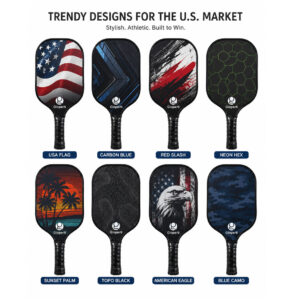
A complete OEM program can include custom paddle shape, face material, core thickness, surface texture, color artwork, logos on both sides, grip color, grip band, butt-cap logo, edge-guard color, paddle cover, set packaging, barcode labels, instruction cards, and shipping marks.
UV printing is a common choice for vivid full-color graphics and relatively flexible artwork. However, the printer profile and coating system should be tested on the selected face material. Fine gradients, metallic effects, very small text, and exact brand colors may require additional proofing.
For buyers developing a product family, it is efficient to standardize hidden components where possible. The same handle platform, edge guard, packaging dimensions, and accessory set may be used across several face materials. Standardization can reduce tooling, simplify spare parts, and improve repeat-order consistency.
At Xiamen ShiPinTengYue Sports Co., Ltd., custom programs can be developed around carbon-fiber or fiberglass faces, 10 mm, 13 mm, 14 mm, and 16 mm core options, custom two-sided UV artwork, private labels, and retail packaging. Project feasibility depends on the final specification, quantity, testing requirements, and artwork complexity.
Questions to Ask Before Placing an Order
Before confirming an order, ask for the material specification, sample lead time, production lead time, minimum order quantity, mold or setup fees, artwork requirements, packaging options, weight tolerance, dimensional tolerance, inspection standard, defect allowance, payment terms, export carton details, and replacement policy for verified manufacturing defects.
Also clarify whether the quoted price includes paddle covers, retail boxes, logo printing, barcode labels, instruction sheets, and freight to the chosen port or destination. Many sourcing misunderstandings come from comparing quotations with different inclusions.
For performance claims, request evidence and use precise wording. Do not assume that a paddle is tournament approved, certified, or compliant merely because a similar-looking model has been tested. Approval normally applies to a specific submitted construction and branding configuration. Buyers should verify current requirements with the relevant governing organization before marketing the product.
Common Sourcing Mistakes
One common mistake is selecting a paddle based only on surface material. A 12K or 18K face does not compensate for poor bonding, weak handle construction, inconsistent core density, or uncontrolled weight. The entire paddle system must be evaluated.
Another mistake is approving only a digital rendering. Artwork can look different after printing on woven carbon fiber, and edge trimming may reduce the visible safe area. Physical pre-production samples and printed color proofs are far more reliable.
Buyers also underestimate packaging tests. A premium paddle can arrive damaged if the retail box, paddle cover, inner protection, and export carton are not designed for parcel delivery. Drop resistance, abrasion protection, moisture protection, and carton strength should match the sales channel.
Finally, avoid changing multiple specifications after sample approval without repeating validation. A different grip, edge guard, surface coating, adhesive, or core source may alter weight, feel, or durability. Changes should be documented and re-approved.
Conclusion
Choosing among pickleball paddle manufacturers in China requires a balance of product knowledge, supplier verification, sample testing, and written quality standards. Buyers should look beyond material labels and understand how the face, core, handle, edge construction, printing, and packaging work together.
3K carbon fiber can support beginner and sport-leisure products, 12K can create a premium control-oriented appearance, and 18K can suit high-end power-focused concepts when the full construction is properly engineered. A 14 mm thin-core platform offers a useful middle ground for fast, responsive paddles, while junior models require genuinely child-friendly dimensions and weight.
The strongest OEM projects begin with a clear target customer and a measurable specification. With a qualified manufacturing partner, careful sample approval, and consistent inspection, private-label brands can build a paddle range that is commercially attractive, repeatable, and suited to its intended players.
Frequently Asked Questions
What should I look for in pickleball paddle manufacturers in China?
Look for relevant construction experience, clear material specifications, documented quality control, consistent samples, realistic tolerances, responsive communication, and transparent packaging and export terms.
Is 18K carbon fiber always better than 12K or 3K?
No. The K number describes the filament bundle used in the weave, but performance also depends on fabric weight, resin, layup, core, thickness, surface treatment, shape, and overall construction.
What is the advantage of a 14 mm thin-core pickleball paddle?
A 14 mm paddle can provide quick handling, a direct response, and more stability than extremely thin models. Its final performance depends on face material, weight distribution, shape, and manufacturing quality.
Are 3K carbon-fiber paddles suitable for beginners?
Yes. A well-designed 3K paddle can suit beginners when it has a forgiving shape, manageable weight, comfortable grip, consistent rebound, and a balanced core construction.
How are custom graphics applied to pickleball paddles?
Common methods include UV printing, heat transfer, screen printing, decals, and surface coatings. The right method depends on the face material, artwork, quantity, durability target, and desired finish.
Can a factory make lighter paddles for children?
Yes. Junior paddles can be designed with lower weight, smaller grips, shorter handles, compact dimensions, rounded edges, and durable graphics. Buyers should approve the exact weight and grip tolerances.
What files are needed for custom paddle artwork?
Factories usually prefer vector artwork in AI, EPS, or editable PDF format, with outlined fonts, color references, bleed, and a defined safe area. High-resolution raster files may also be accepted for some designs.
Should I request a pre-shipment inspection?
A pre-shipment inspection is recommended for larger or first-time orders. It can verify quantity, workmanship, weight, dimensions, packaging, labels, and agreed functional checks before the shipment leaves the factory.
Develop Your Custom Pickleball Paddle Line
Need an OEM paddle for juniors, beginners, sport-leisure retail, or premium carbon-fiber players? Prepare your target material, thickness, weight, quantity, artwork, and packaging requirements, then request a structured quotation and sample plan.
Ready to Source the Right Paddle?
Whether you need OEM/ODM manufacturing, wholesale pricing, or a custom branded paddle – we’re here to help. Get a free quote within 24 hours.