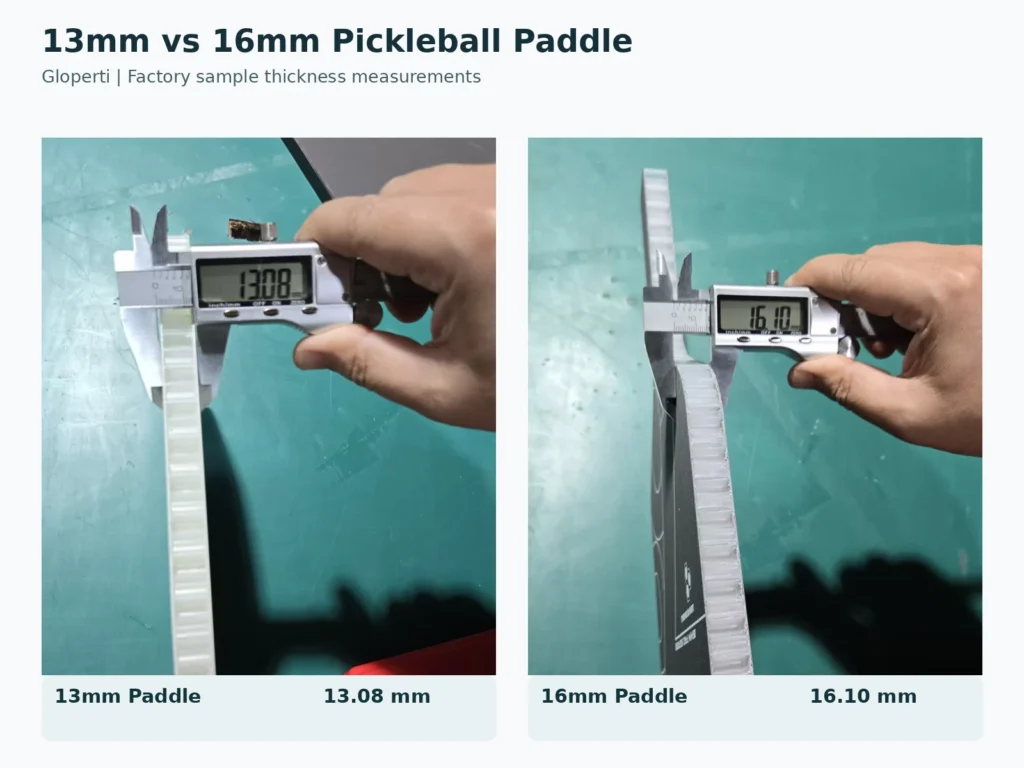
Labeled factory measurement photos of 13mm and 16mm pickleball paddle samples showing digital caliper readings of 13.08 mm and 16.10 mm

13mm vs 16mm Pickleball Paddle: A Manufacturer’s Guide to Core Thickness

When developing a private-label pickleball paddle, choosing between nominal 13mm and 16mm paddle designs is more than a specification decision. Thickness can influence the way a paddle feels, how its construction is engineered, and where the finished model fits in a product range. But thickness alone does not determine power, control, durability, or quality. Quick […]

13mm vs 16mm Pickleball Paddle: A Manufacturer’s Guide to Core Thickness Read More »
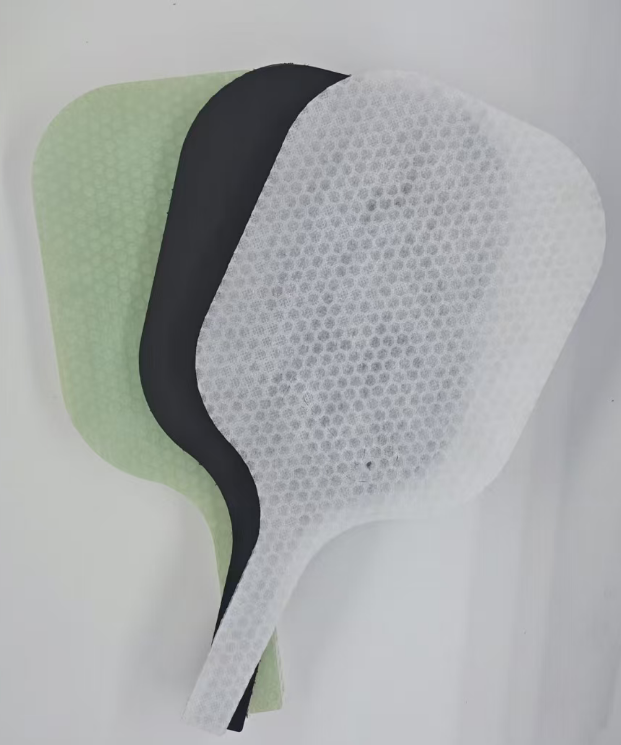
Gloperti honeycomb-core paddle sample showing the cellular core and separated adjacent layers

Foam Core vs Honeycomb Core Pickleball Paddles: A Buyer’s Guide

Two paddle quotations can specify the same carbon face and 16 mm thickness while describing very different interiors. When comparing a foam core vs honeycomb core pickleball paddle, the first purchasing decision is to establish what each supplier is actually offering. Quick answer: A full foam core uses engineered foam in the main core area,

Foam Core vs Honeycomb Core Pickleball Paddles: A Buyer’s Guide Read More »

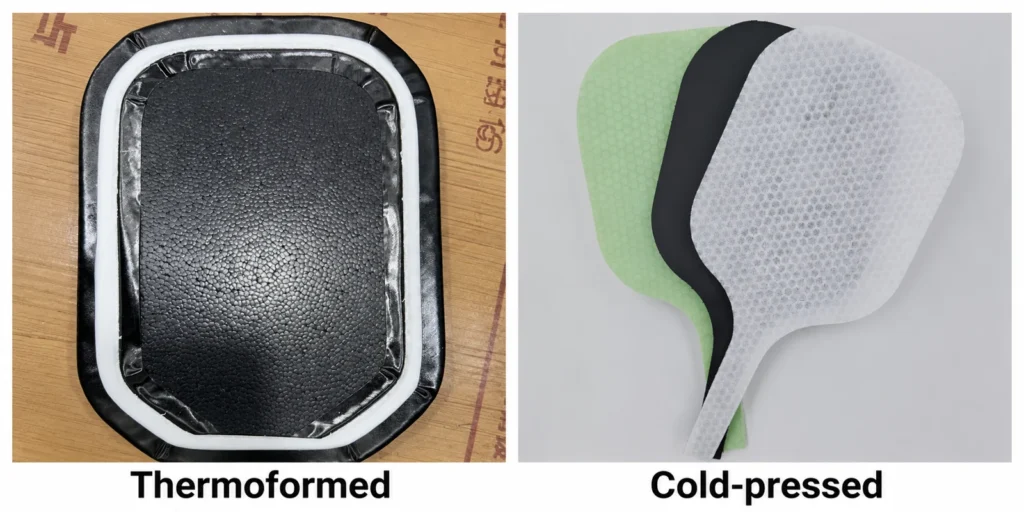
Labeled side-by-side comparison of a thermoformed pickleball paddle with a wrapped edge and foam perimeter next to layered cold-pressed paddle face and core sheets

Thermoformed vs. Cold-Pressed Pickleball Paddles: An OEM Buyer’s Guide

Choosing between thermoformed and cold-pressed pickleball paddles affects more than the description on your product listing. For brands, importers, and wholesale buyers, the decision influences the construction you approve, the tooling you need, the quotation you compare, and the checks used to accept production. Quick answer. Cold-pressed pickleball paddles commonly bond face sheets to a

Thermoformed vs. Cold-Pressed Pickleball Paddles: An OEM Buyer’s Guide Read More »

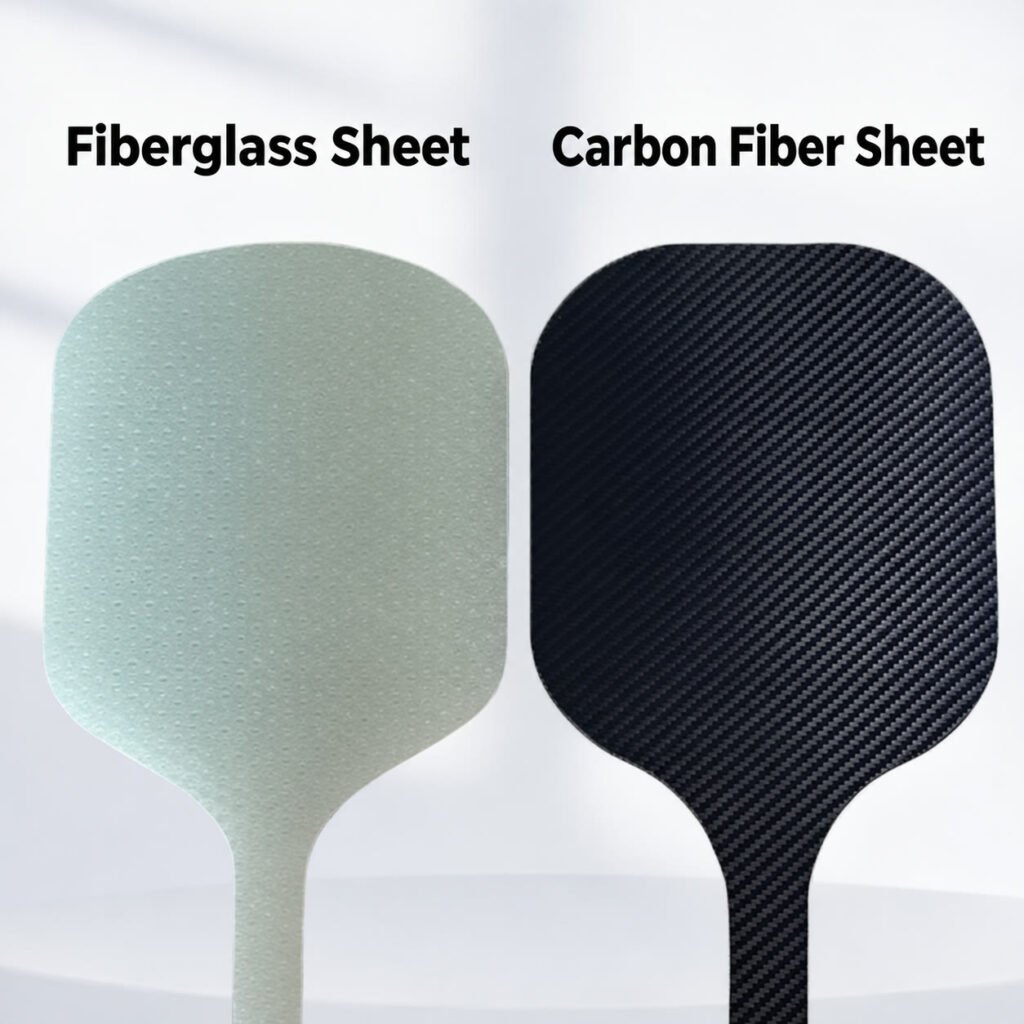
Fiberglass sheet sample and carbon fiber sheet sample shown as paddle-shaped face panels side by side

Fiberglass vs Carbon Fiber Pickleball Paddles: A Buyer’s Guide

Choosing between fiberglass and carbon fiber paddle faces is one of the first decisions brand owners and importers make when developing a new pickleball paddle line. This guide compares fiberglass vs carbon fiber pickleball paddles across playing feel, sample evaluation, cost, and product positioning. For OEM buyers, fiberglass is a practical starting point for value-priced

Fiberglass vs Carbon Fiber Pickleball Paddles: A Buyer’s Guide Read More »

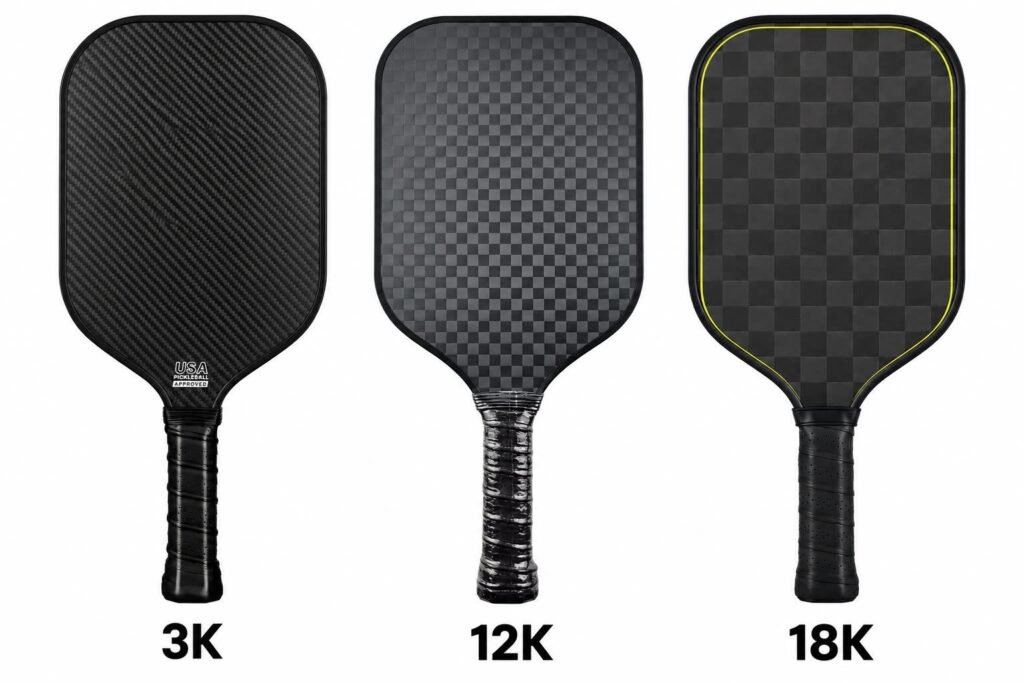
Side-by-side comparison of 3K, 12K and 18K carbon fiber pickleball paddle faces, supplied by Gloperti

3K vs 12K vs 18K Carbon Fiber Pickleball Paddles: A Buyer’s Guide

When comparing 3K vs 12K vs 18K carbon fiber pickleball paddles, it is tempting to assume that a higher number means a better paddle. For brands, importers, and wholesale buyers, that assumption can lead to unnecessary costs and misleading product descriptions. The K number identifies the number of individual carbon filaments in a bundle, known

3K vs 12K vs 18K Carbon Fiber Pickleball Paddles: A Buyer’s Guide Read More »

T700 vs 3K Carbon Fiber Pickleball Paddles: What Buyers Should Know

Quick Answer T700 is a fiber designation. 3K is a tow size. 3K identifies approximately 3,000 filaments per tow. Fiber designation and tow size are separate attributes, but any claimed combination needs the producer’s documentation. For OEM sourcing, compare the face construction, finish, core, handling, and sample results; request material traceability and written acceptance criteria

T700 vs 3K Carbon Fiber Pickleball Paddles: What Buyers Should Know Read More »