Imagine two pre-production pickleball paddles that both weigh 230 g. One is easy to reposition for a backhand block, while the other takes more effort to get moving. Pickleball paddle swing weight helps explain the difference. If you are approving an OEM sample, record the finished paddle’s static weight, balance point, and swing weight, then agree on how the supplier will repeat the measurements.
Quick Summary
What Is Pickleball Paddle Swing Weight?
Pickleball paddle swing weight is the moment of inertia of a paddle about a defined axis near the handle. In practical terms, it describes how much effort it takes to accelerate, slow down, or reposition the paddle during a swing. A lower swing weight generally makes the paddle easier to accelerate and change direction. A higher value can give a more substantial feel through the stroke if the player can maintain their swing speed. [1] [2]
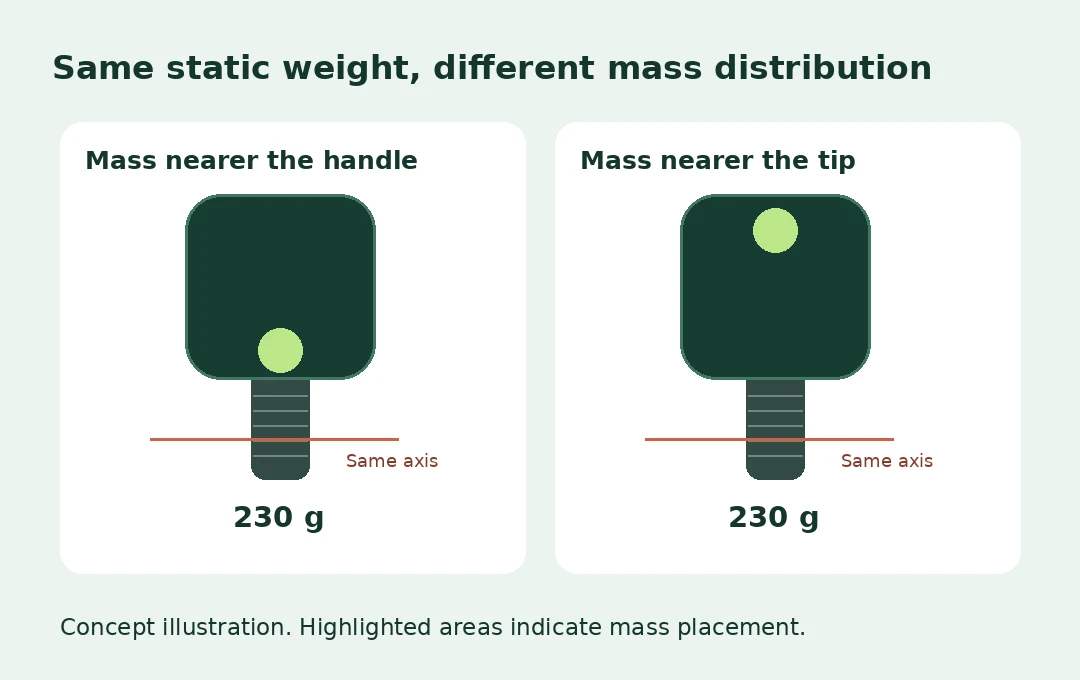
Consider two hypothetical finished paddles that both weigh 230 g (about 8.1 oz). If the designs are otherwise the same and some mass moves from near the handle to near the tip, the paddle’s swing weight increases about the same reference axis. Mass farther from that axis contributes more to rotational inertia. The scale can still show 230 g for both paddles.
Retail paddle benchmark: Pickleball Effect uses a 5 cm reference axis and groups its database readings into 110 kg·cm² or less (light), 111–116 kg·cm² (midrange), and 117 kg·cm² or more (heavy). Lower readings generally make quick repositioning easier at the kitchen line. Higher readings can give more plow-through if the player maintains swing speed. Use these reviewer-defined bands for context and compare on the same reference axis. For stability on off-center contact, also check twist weight. [6]
In Pickleball Effect’s comparison of 16 mm paddles, average swing weight was 117.6 kg·cm² for elongated paddles, 112.9 kg·cm² for hybrids, and 109.2 kg·cm² for widebodies. Average static weight was nearly identical across the three groups, at 8.01–8.02 oz. These figures describe the reviewer’s sample. For an OEM order, both parties should agree on acceptance limits using measurements from the approved reference sample. [2]
Swing Weight vs. Static Weight, Balance Point, and Twist Weight
Each measurement answers a different question. Record the finished setup, including the edge guard and grip. If removable tape or an overgrip is fitted, record whether it was installed during each measurement. [2] [3]
Swipe to see all columns on a small screen.
| Measurement | What it tells you | What to record | Why it matters |
|---|---|---|---|
| Static weight | Total mass of the finished paddle | Grams or ounces and fitted accessories | Checks the specified finished weight |
| Balance point | Where the paddle balances along its length | Distance from the butt end, with units | Helps describe where the paddle carries its mass |
| Swing weight | Resistance to rotation about the specified swing axis | kg·cm², reference axis, instrument and setup | Helps compare how readily samples accelerate or reposition |
| Twist weight | Resistance to rotation about the paddle’s long axis | kg·cm² and twist-weight setup | Helps compare resistance to twisting on off-center hits |
Balance point locates the center of mass along the paddle’s length. Swing weight also depends on how far individual portions of mass are from the reference axis. Two paddles can therefore share a static weight and balance point while having different swing weights. Likewise, comparing 13mm vs. 16mm pickleball paddle thickness tells you the nominal thickness of each design. To compare their swing weight, measure the finished paddles.
How Is Pickleball Paddle Swing Weight Measured?
Use a swing-weight instrument with a documented paddle fixture. One published setup uses the Briffidi SW1 with a pickleball adapter that positions the reference axis 5 cm from the butt end. The maker’s instructions specify taring the empty adapter and securing the paddle in the prescribed orientation. Record the result in kg·cm². A value measured about a different axis answers a different measurement question, so compare readings taken about the same axis with a consistent setup. [4] [5]
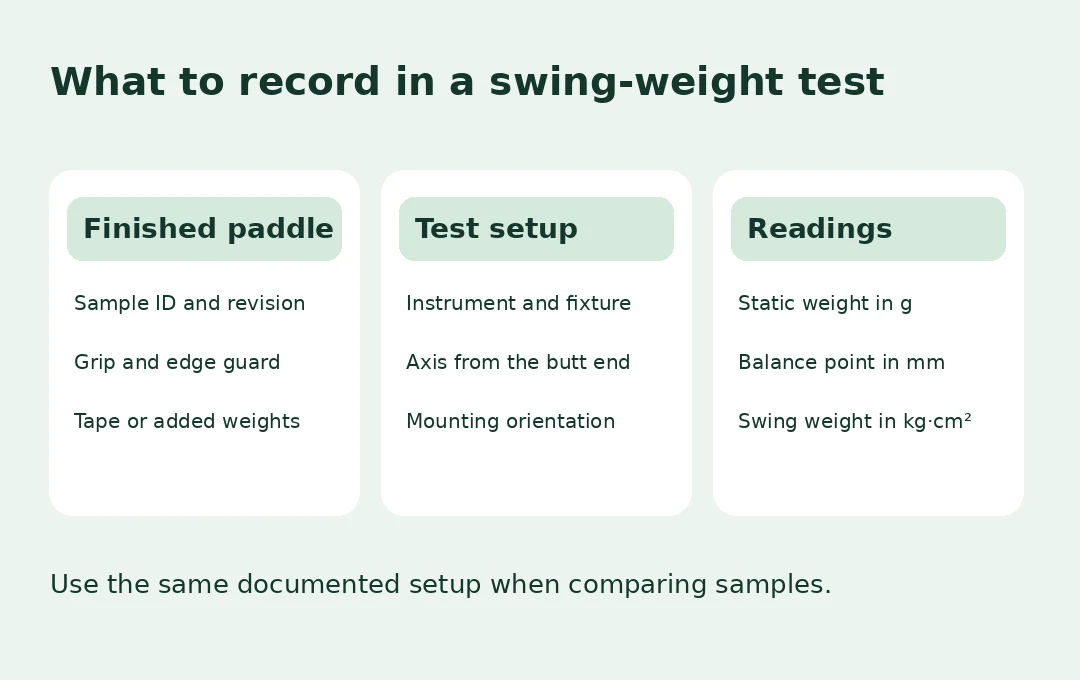
How to Compare Swing Weight Across OEM Paddle Samples
- Identify each finished sample. Record its ID, specification revision, and the accessories fitted. If you compare thermoformed and cold-pressed paddle samples and several details differ, document those differences before attributing a change in swing feel to one variable.
- Measure both samples under the same conditions. Use the same instruments, reference points, and finished configuration. For swing weight, use the same fixture, reference axis, orientation, and measurement procedure. If repeat readings disagree, check calibration, taring, and mounting before making an approval decision. [4]
- Pair the readings with a short play test. Try quick blocks, backhand counters, and full drives. Record which sample is easier to prepare for a fast exchange and which one feels more manageable through a full stroke. Keep those observations with the measurement record.
The table below is a copyable example. The two 230 g entries are hypothetical. Complete both columns with actual values before approving your sample.
Swipe to see all columns on a small screen.
| Test record field | Sample A | Sample B | Recording instruction |
|---|---|---|---|
| Sample ID and revision | Enter ID and revision | Enter ID and revision | Match the sample label and specification. |
| Finished configuration | Enter components | Enter components | List edge guard, grip, overgrip, and added tape or weights. |
| Static weight | 230 g, hypothetical | 230 g, hypothetical | Use the same scale and units. |
| Balance point | Pending measurement | Pending measurement | Record distance from the defined butt-end reference in mm. |
| Swing weight | Pending measurement | Pending measurement | Record the value and units in kg·cm². |
| Instrument and reference axis | Enter instrument and setup | Enter instrument and setup | Include fixture, axis distance from butt end, orientation, and procedure reference. |
| Test date and reviewer | Enter date and name | Enter date and name | Identify who measured each sample and when. |
| Play-test notes | Enter observations | Enter observations | Use comparable drills and record what the player noticed. |
Hypothetical example at a 5 cm reference axis: Sample A (more mass toward the handle) is assigned 112 kg·cm². Sample B (more mass toward the head) is assigned 121 kg·cm². Both weigh 230 g in the example. A would be easier to start and reposition, while B would resist changes in swing speed more. These illustrative swing weights are independent of the 230 g scale reading. The blank measurement fields above are for actual test results.
How to Specify Swing Weight Before Mass Production
If swing weight is an acceptance requirement, put it on the signed specification after selecting a measured reference sample. Agree on the target or acceptable range, test configuration, instrument or verification provider, sampling plan, and what happens when a reading falls outside the limit. Set the tolerance after reviewing measurement repeatability and variation in representative units. A published paddle database can help you understand the metric, but your own approved sample and agreed procedure should guide your production requirement. [6]
Copyable specification line: “Approved sample ID [___], revision [___]. Swing weight [target or range] kg·cm², measured [___] cm from the butt end using [instrument, fixture and orientation]. Measure with [finished components fitted]. Inspect [quantity and selection method]. Report results to [reviewer] and follow [agreed procedure] for any out-of-range unit.”
Need help benchmarking swing weight targets for your next production run? Explore our custom pickleball paddle OEM and sampling capabilities.
If testing is pending, agree who will measure the reference sample and when the result is due. Once both parties approve the value and procedure, include the specification revision in the purchase order. A later change to the grip, edge guard, or other weighted component may require a new check.
Frequently Asked Questions
Can two pickleball paddles with the same static weight have different swing weights?
Yes. Two paddles can weigh the same on a scale and have different swing weights if their mass is distributed differently relative to the measurement axis.
Is a lower swing weight better for a pickleball paddle?
A lower swing weight generally makes a paddle easier to accelerate and reposition. The best value depends on the player, paddle design, and intended use. Compare measured samples and try the shots you hit most often.
What is the difference between swing weight and twist weight?
Swing weight measures resistance to rotation about a specified swing axis near the handle. Twist weight measures resistance to rotation about the paddle’s long axis, which matters when impact is off the centerline.
Can I compare swing-weight numbers from different testers?
First confirm the reference axis, paddle configuration, fixture, and test procedure. When these details differ or are unavailable, measure both finished paddles using the same documented setup before relying on the comparison.
How should I specify swing weight for an OEM order?
Identify the approved sample and its finished configuration, agree on the measurement method and reference axis, then document the target or acceptable range, units, sampling plan, and treatment of out-of-range units.
Conclusion
When two pickleball paddles weigh the same and feel different in motion, compare their swing weight under the same measurement conditions. For an OEM order, document the configuration and reference axis, approve a measured sample, and carry the agreed requirement into the production inspection plan.
Request a Custom Pickleball Paddle Sample
References
- Pickleball Science. Paddle Weight vs. Swing-Weight.
- Matt Reny, Pickleball Effect. Swing Weight vs. Twist Weight: What They Mean for Your Paddle.
- PaddleCompare. Pickleball Weights, Grips & Gear.
- Briffidi. Measuring Racquets/Paddles.
- Briffidi. Pickleball Adapter Five for SW1.
- Pickleball Effect. The Ultimate Pickleball Paddle Stats Database.