How to Pick a Pickleball Paddle: The Complete 2026 Buyer’s Guide for Beginners, Kids & Competitive Players
Choosing a paddle looks simple until you face dozens of shapes, thicknesses, face materials, grip sizes and marketing claims. The right paddle should feel comfortable, support your natural swing and give you enough control to place the ball without forcing you to change your technique. This guide explains how to pick a pickleball paddle using practical criteria rather than hype, so beginners, parents, recreational players and competitive athletes can narrow the market quickly.
There is no single paddle that is best for everyone. A light model may help a junior player react faster, while a heavier elongated paddle may suit an experienced player who wants reach and driving power. A soft, thick core can make resets and blocks easier, whereas a thinner or firmer build may return more pace. Your ideal choice depends on hand size, swing speed, physical comfort, preferred shot patterns and budget.
The buying process becomes much easier when you evaluate paddles in a fixed order: comfort, weight, grip, shape, core thickness, surface, balance and intended use. Brand and appearance should come later. By the end of this guide, you will be able to compare products such as the Joola Perseus Pro V pickleball paddle, Onix Z5 Graphite pickleball paddle, Monarch pickleball paddles, Owl pickleball paddle and Prince pickleball paddles without treating the label as the entire decision.
Table of Contents
- 1. Start With Your Player Profile
- 2. Understand Pickleball Paddle Weights
- 3. Choose the Right Grip Size and Handle
- 4. Compare Standard, Widebody and Elongated Shapes
- 5. Core Thickness: Control, Feedback and Power
- 6. Face Materials and the Search for Spin
- 7. Balance, Swing Weight and Twist Stability
- 8. How Popular Paddle Types Fit Different Buyers
- 9. Choosing a Kids Pickleball Paddle
- 10. Pickleball Paddle Sets vs. Individual Paddles
- 11. Beginner, Intermediate and Pro Paddle Recommendations by Profile
- 12. A Simple In-Store or Demo Testing Protocol
- 13. Common Buying Mistakes
- 14. Final Checklist: How to Pick a Pickleball Paddle
- Frequently Asked Questions
1. Start With Your Player Profile
Before comparing specifications, define who will use the paddle and how that person plays. A first-time recreational player needs forgiveness, comfort and a manageable price. A former tennis player may prefer an elongated shape and a familiar handle. A doubles specialist often values stability, touch and quick hands at the kitchen. A singles player may prioritize reach, power and serve speed.
Ask four questions: How often do you play? Do you generate your own power? Do you have elbow, wrist or shoulder sensitivity? Do you prefer control, spin or pace? Honest answers prevent an expensive mistake. Many players buy a professional-looking paddle that is too demanding, too head-heavy or too stiff for their current technique.
Beginners generally benefit from a balanced, midweight paddle with a comfortable grip and a forgiving sweet spot. Intermediate players can choose more deliberately between control and power. Advanced players may accept a smaller sweet spot or a more demanding balance because they can consistently contact the ball in the center.
2. Understand Pickleball Paddle Weights
Pickleball paddle weights influence swing speed, stability, power, fatigue and maneuverability. Although exact categories vary by seller, paddles are commonly discussed as lightweight, midweight and heavyweight. The number on a product page is only a starting point because two paddles with the same static weight can feel different when one carries more mass toward the head.
Lightweight paddles are easier to move quickly and can help children, new players and anyone who values rapid hand exchanges. The tradeoff is reduced stability against hard drives, and some players must swing harder to create depth. Midweight paddles offer the broadest compromise. They usually provide enough mass for blocks and serves while remaining manageable during long sessions. Heavier paddles can add plow-through and calm the paddle on off-center contact, but they may tire the wrist or shoulder.
Do not choose by a theoretical category alone. Hold the paddle in ready position for thirty seconds, make several shadow volleys and simulate a serve. Notice whether the head drops, the forearm tightens or the grip pressure increases. A paddle that feels impressive for one swing can become uncomfortable after an hour.
3. Choose the Right Grip Size and Handle
Grip comfort is one of the most overlooked parts of how to pick a pickleball paddle. A grip that is too large can reduce wrist freedom and make quick grip changes difficult. A grip that is too small may cause over-squeezing, instability and premature fatigue. Players with smaller hands, including many juniors, often need a narrower circumference rather than simply a shorter paddle.
Handle length also matters. A longer handle provides room for two-handed backhands and can make the transition from tennis feel natural. A shorter handle may leave more area for the paddle face and can feel compact at the net. Check usable grip length, not only total paddle length, because a flared butt cap or throat shape may reduce practical hand space.
When uncertain, a slightly smaller grip can often be built up with an overgrip. Reducing an oversized handle is much harder. The finished grip should allow relaxed fingers, secure control and smooth rotation between forehand and backhand positions.
4. Compare Standard, Widebody and Elongated Shapes
Paddle shape changes reach, sweet-spot location, aerodynamic feel and forgiveness. Standard or classic shapes are versatile and usually easy to control. Widebody paddles create a broad hitting area and can be reassuring for beginners who do not always contact the center. Elongated paddles add reach and often support leverage on serves and groundstrokes, but they may feel slower in fast exchanges and can have a narrower sweet spot.
Former racquet-sport players are often attracted to elongated pro pickleball paddles because the silhouette feels familiar. That does not automatically make them better. A player who spends most of the match blocking and countering at the kitchen may perform more consistently with a compact, stable shape.
Pay attention to total length, face width and handle length together. Two paddles can both be marketed as elongated while feeling very different because one allocates more length to the handle and the other to the hitting surface.
5. Core Thickness: Control, Feedback and Power
Core thickness affects response, dwell time and feel. Thicker cores are commonly associated with a softer response, greater forgiveness and better control on drops, resets and blocks. Thinner cores often feel more direct and can return the ball with extra pace, though they may transmit more vibration and require cleaner contact.
A beginner does not need to chase the thinnest, fastest option. A forgiving core helps develop placement and confidence. Competitive players should match thickness to technique: a powerful athlete may prefer a thicker control-oriented build, while a player with a compact swing may use a firmer paddle to gain depth.
Core material, cell size, face construction and perimeter design also influence performance, so thickness cannot be judged in isolation. Treat it as one part of the full structure rather than a guarantee.
6. Face Materials and the Search for Spin
Players looking for a pickleball paddle for spin should focus on surface texture, consistency and how long the face maintains useful friction. Carbon-fiber faces are popular because they can combine controlled response with spin potential. Graphite-faced models are often crisp and light. Fiberglass or composite faces can feel lively and may suit players seeking easy pace.
Spin is not created by texture alone. Swing path, contact point, paddle speed and ball condition matter enormously. A highly textured face will not replace technique, and aggressive brushing without control can produce more errors than advantage. Choose a paddle that lets you accelerate confidently while keeping the face stable.
When comparing spin claims, look for transparent testing, legal compliance and repeatable performance rather than dramatic language. Surface durability matters because a paddle that starts extremely gritty but wears quickly may not deliver long-term value.
7. Balance, Swing Weight and Twist Stability
Static weight tells you how heavy a paddle is on a scale; balance and swing weight tell you how heavy it feels during motion. Head-heavy paddles can add momentum and depth but may be slower to reposition. Handle-biased or evenly balanced paddles tend to feel quicker. Twist stability describes resistance to rotating when the ball strikes away from the center.
Doubles players who face rapid drives should value a combination of manageable swing weight and sufficient stability. Singles players or baseline-oriented hitters may accept more head weight for reach and power. If your current paddle feels unstable, do not immediately add large amounts of lead or tungsten tape. Small changes can strongly affect balance, and poorly placed weight can create discomfort.
The best test is repeated movement: ready position, forehand volley, backhand counter, overhead preparation and full serve. A well-matched paddle should return to neutral without conscious effort.
8. How Popular Paddle Types Fit Different Buyers
Brand-name examples are useful when treated as reference points rather than universal winners. The Joola Perseus Pro V pickleball paddle is the type of product that attracts competitive players who want a performance-oriented platform and are willing to evaluate shape, balance and response carefully. It should still be tested for personal comfort; a professional endorsement cannot determine your grip size or preferred swing weight.
The Onix Z5 Graphite pickleball paddle is widely recognized by recreational buyers as a familiar graphite option. Players considering it should compare its feel, noise, handle comfort and control with newer alternatives instead of purchasing only because the name appears frequently. Monarch pickleball paddles often appeal to value-conscious shoppers and casual players, so the key questions are consistency, grip comfort and whether the model supports regular play.
An Owl pickleball paddle may be considered by players who care about a quieter playing experience, while Prince pickleball paddles can attract people familiar with the brand from tennis. In every case, confirm that the exact paddle is permitted under the rules of the facility, league or event where you plan to play. Product families change, so evaluate the individual model rather than assuming all paddles under one brand share the same construction.
Professional pickleball paddles are not automatically the best purchase for a developing player. The term usually suggests advanced materials, tighter tolerances, specialized shapes or premium positioning. Those benefits matter only when they align with your technique and playing frequency.
9. Choosing a Kids Pickleball Paddle
A kids pickleball paddle should prioritize safe, comfortable movement. Children need a grip they can hold without squeezing, a weight they can control through the entire swing and a length that does not feel awkward. An adult paddle labeled lightweight may still have a handle that is too thick or a balance that pulls the head downward.
For younger players, durability and confidence are often more important than maximum spin. A broad face and forgiving response help them rally successfully. Bright graphics can increase enthusiasm, but the paddle must still be structurally sound and appropriately sized. Parents should watch for wrist collapse, late contact and frequent grip adjustments, which may indicate that the paddle is too heavy or large.
As skills improve, juniors can move toward more performance-oriented equipment. There is no need to rush. Technique developed with a manageable paddle transfers better than compensations learned with an oversized or head-heavy model.
10. Pickleball Paddle Sets vs. Individual Paddles
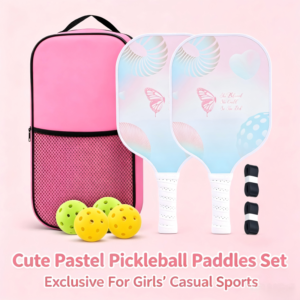
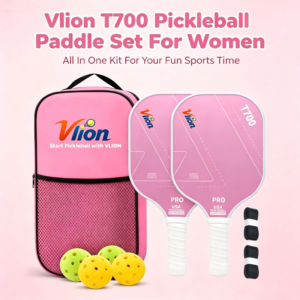
Pickleball paddle sets are practical for families, schools, clubs, vacation homes and beginners who need everything at once. A typical bundle may include two or four paddles, pickleball paddles and balls, and a carrying bag. Sets reduce the cost per player and make it easy to start immediately.
The tradeoff is specialization. Bundled paddles may use basic materials, identical grip sizes and one-size-fits-all weights. This is fine for casual play but less suitable when players have different hand sizes or performance goals. Check whether the balls are designed for indoor or outdoor use, how many are included and whether replacement balls are easy to source.
Buy a set when convenience and group access matter most. Buy individual paddles when fit, comfort and long-term improvement are the priority. A household can also combine approaches: keep a durable set for guests and purchase a fitted paddle for the main player.
11. Beginner, Intermediate and Pro Paddle Recommendations by Profile
For a beginner, look for a midweight, balanced paddle with a medium grip, broad sweet spot and forgiving core. Avoid extreme head weight and excessively stiff response. The goal is to learn reliable contact, serve depth, dinks and blocks.
For an intermediate control player, prioritize touch, stability and confidence on third-shot drops and resets. A thicker core and textured face may help, but the paddle should still produce enough depth without a full-power swing. For an intermediate power player, consider a firmer response or slightly more forward balance while protecting maneuverability.
For advanced and professional players, the decision becomes highly personal. Pro pickleball paddles may offer elongated shapes, advanced carbon layups, thermoformed construction or tuned perimeter weighting. These features can enhance performance, but they also magnify differences in technique. Competitive players should demo multiple models under match conditions rather than relying on a few warm-up hits.
12. A Simple In-Store or Demo Testing Protocol
Use the same sequence for every paddle. First, check grip comfort and edge shape. Second, make slow swings to sense balance. Third, hit controlled dinks and resets. Fourth, test blocks against pace. Fifth, hit serves, returns and drives. Finally, play several points without thinking about the equipment.
Record three scores from one to five: comfort, control and confidence. Power and spin can be noted separately, but they should not outweigh pain or inconsistency. A paddle that produces one spectacular drive but causes ten missed resets is probably not the best match.
Whenever possible, test with the same ball, court and partner. Changing multiple variables makes comparisons unreliable. Demo for at least one full session because fatigue and timing problems may not appear in the first few minutes.
13. Common Buying Mistakes
The first mistake is buying only by brand or professional sponsorship. The second is choosing the heaviest paddle for power. The third is ignoring grip size. The fourth is assuming that maximum texture guarantees spin. The fifth is paying for advanced construction before developing consistent contact.
Another common error is treating all paddles in a product family as identical. Versions may differ in thickness, shape, weight range and handle. Read the exact listing and confirm the exact model. Buyers should also distinguish normal production variation from advertised specifications, especially when a few tenths of an ounce materially change feel.
Finally, do not overlook return policies and warranty coverage. A demo or trial period is valuable because fit cannot be fully predicted from specifications.
14. Final Checklist: How to Pick a Pickleball Paddle
Use this checklist before purchasing: the grip fits without over-squeezing; the weight remains comfortable after repeated swings; the balance supports quick recovery; the shape matches your need for reach or forgiveness; the core response suits control or power; the face supports your spin goals; and the price reflects how often you play.
Beginners should choose comfort and forgiveness. Children need proper grip and manageable weight. Social players may prefer complete pickleball paddle sets. Spin-focused players should combine a durable textured face with sound technique. Competitive players should demo professional pickleball paddles and judge them under pressure.
The best paddle is the one that disappears during play. When your hand stays relaxed, your timing remains consistent and you trust the paddle on both soft and fast shots, you have probably found the right fit.
Frequently Asked Questions
What weight pickleball paddle is best for beginners?
A balanced midweight paddle is the safest starting point for many beginners because it combines stability and maneuverability. Players with limited strength or joint sensitivity may prefer a lighter option, while stronger players can test slightly heavier models.
How do I choose a pickleball paddle for spin?
Look for a durable textured face, stable contact and a weight you can accelerate comfortably. Carbon-fiber and other textured composite faces are common choices, but technique and swing path remain essential.
Are expensive professional pickleball paddles worth it?
They can be worthwhile for frequent or competitive players who benefit from specialized construction, consistency and performance tuning. Casual players may gain more from a comfortable mid-priced paddle and additional court time.
What is the best kids pickleball paddle?
The best kids paddle has a small comfortable grip, manageable weight, forgiving face and durable construction. Fit matters more than brand. The child should be able to hold ready position and swing without wrist collapse.
Should I buy pickleball paddle sets or separate paddles?
Choose a set for convenience, group play and lower cost per player. Choose separate paddles when users need different weights, grip sizes or performance characteristics.
How important are pickleball paddle weights?
Weight strongly affects maneuverability, stability, power and fatigue. Balance and swing weight are equally important, so test movement rather than relying only on the scale number.
Is an elongated paddle better?
An elongated paddle offers reach and leverage but may be less forgiving or slower in hand battles. It is better only when those tradeoffs suit your technique and playing style.
How often should I replace a pickleball paddle?
Replace it when the surface, edge, core response or handle deteriorates enough to affect consistency or safety. Frequency depends on play volume, construction and care rather than a fixed calendar.
Conclusion
Choosing well is a process of matching the paddle to the player. Start with comfort and weight, then evaluate grip, balance, shape, core and face. Use brand examples as comparison points, not shortcuts. A thoughtful demo and a simple checklist will lead to a better purchase than chasing the loudest claim.
Ready to Source the Right Paddle?
Whether you need OEM/ODM manufacturing, wholesale pricing, or a custom branded paddle – we’re here to help. Get a free quote within 24 hours.