Meta Title: How to Choose a Pickleball Paddle Factory: Training, T700, Thermoformed, Wholesale, Wooden, Youth & Custom Options
Meta Description: Source training, T700, thermoformed, pink, wooden, youth, wholesale, and professional pickleball paddles from a reliable OEM factory in China.
Focus keyword: pickleball training paddle factory
A practical buyer’s guide to selecting a professional pickleball paddle factory for training, T700 carbon fiber, thermoformed, wholesale, wooden, pink, youth, and custom paddle programs.
Table of Contents
- Introduction
- Why Factory Capability Matters More Than a Low Unit Price
- 1. Pickleball Training Paddle Factory Programs
- 2. Pink Pickleball Paddle Factory Options for Retail Collections
- 3. Professional and Recommended Pickleball Paddle Factory Selection
- 4. RTS Pickleball Paddle Factory: When Ready-to-Ship Makes Sense
- 5. Selkirk Pickleball Paddles Factory Searches and Brand-Safe Sourcing
- 6. T700 Pickleball Paddle Factory and T700 Carbon Fiber Benefits
- 7. T700 Thin Core Pickleball Paddle Factory Programs
- 8. Thermoformed Pickleball Paddle Factory Advantages
- 9. Wholesale Pickleball Paddle Factory Planning
- 10. Wooden Pickleball Paddle Factory Products
- 11. Youth Pickleball Paddle for Kids Factory Requirements
- 12. Customization, Sampling, and Quality Control
- Supplier Evaluation Checklist
- Conclusion
- Frequently Asked Questions
Introduction
The pickleball market has moved far beyond one-size-fits-all paddles. Buyers now need products for coaching, junior programs, retail collections, promotional campaigns, tournament players, and private-label brands. That makes factory selection one of the most important commercial decisions in the sourcing process. A capable pickleball training paddle factory should not only manufacture a paddle that looks attractive; it should also control weight, balance, core thickness, surface texture, handle geometry, edge protection, printing quality, packaging, and batch consistency.
This guide explains how importers, distributors, sporting-goods brands, clubs, schools, and e-commerce sellers can evaluate a supplier across multiple product categories. It covers pink pickleball paddles, professional models, recommended product structures, ready-to-ship programs, Selkirk-style market references, T700 carbon fiber, thin-core thermoformed designs, wholesale sourcing, wooden paddles, and youth paddles for children. The goal is not to promote a single specification, but to help you build a product line that matches the right player, price point, and sales channel.
Why Factory Capability Matters More Than a Low Unit Price
A low quotation can be tempting, but the cheapest factory is rarely the lowest-risk supplier. Paddle performance depends on a chain of manufacturing variables. The face material must bond evenly to the core. The honeycomb cell structure must remain stable. The handle should not twist under load. The edge guard must fit tightly without excess glue. Printed graphics should remain aligned on both sides, and finished weight should stay within an agreed tolerance.
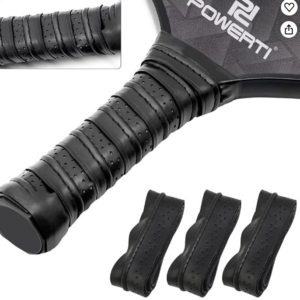
A professional pickleball paddle factory should be able to explain its incoming-material inspection, lamination process, curing method, trimming accuracy, handle assembly, surface finishing, final inspection, and packaging checks. Ask for written tolerances for length, width, thickness, weight, grip circumference, and balance point. This is especially important when one order contains several models, because inconsistent specifications can create returns, negative reviews, and costly rework after the goods arrive.
1. Pickleball Training Paddle Factory Programs
Training paddles are designed for repetition, skill development, and coach-led drills. Depending on the training objective, a paddle may use a smaller sweet spot, increased weight, a narrower face, or a special shape that encourages clean contact. When sourcing from a pickleball training paddle factory, clearly define whether the product is intended for beginners, advanced hand-speed drills, strength training, or accuracy practice.
For club and academy buyers, durability often matters more than premium cosmetic finishing. A balanced specification may use a fiberglass or entry-level carbon face, polypropylene honeycomb core, reinforced handle, and abrasion-resistant edge guard. For premium training tools, T700 carbon fiber and thermoformed construction can improve stability and create a more serious performance feel. A good supplier should be able to prototype different face dimensions, swing weights, and grip lengths so coaches can test the training effect before mass production.
2. Pink Pickleball Paddle Factory Options for Retail Collections
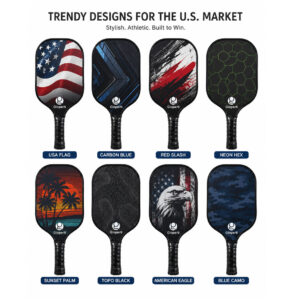
Color-led products continue to perform well in gift, lifestyle, and women-focused retail segments. A pink pickleball paddle factory should offer more than a single solid color. Commercially useful options include pastel pink, coral, rose, neon pink, gradient graphics, floral patterns, geometric designs, and coordinated paddle-bag sets.
The important issue is print repeatability. Request Pantone references or approved digital color standards and confirm whether the graphic is produced by UV printing, heat transfer, decal application, or another method. Pink shades can shift under different coatings, so a physical pre-production sample is strongly recommended. Retailers should also coordinate grip color, edge-guard color, ball color, and packaging artwork to create a complete shelf-ready collection rather than a generic paddle with a pink face.
3. Professional and Recommended Pickleball Paddle Factory Selection
A professional pickleball paddle factory is usually distinguished by engineering control, documentation, communication, and sampling speed. The supplier should understand the difference between control, all-court, power, elongated, wide-body, junior, and training models. It should also be able to recommend a structure based on target retail price and player level instead of simply quoting whatever is already in stock.
When buyers search for a recommended pickleball paddles factory, they should evaluate real evidence: sample quality, production photos, test reports, response accuracy, packaging capability, export experience, and the clarity of quality-control procedures. References to successful market products can be useful, but copying a competitor’s dimensions or appearance is not a product strategy. The better approach is to identify the performance attributes customers value and then build a differentiated specification with its own graphic design, grip feel, packaging, and brand story.
4. RTS Pickleball Paddle Factory: When Ready-to-Ship Makes Sense
An RTS pickleball paddle factory offers ready-to-ship or low-minimum-order models that can help new sellers test demand quickly. This can be a practical route for market validation, seasonal promotions, club orders, and smaller e-commerce launches. Buyers may add a simple logo, sleeve, sticker, or custom carton while keeping the paddle structure unchanged.
The trade-off is limited exclusivity. Other customers may buy the same mold, face material, or graphic base. Before choosing an RTS program, confirm current stock, color consistency, available quantities, replenishment lead time, logo method, packaging choices, and whether the supplier can reserve inventory. Once a model proves successful, the next step is often a semi-custom or fully custom version with unique artwork and upgraded materials.
5. Selkirk Pickleball Paddles Factory Searches and Brand-Safe Sourcing
Some buyers use phrases such as Selkirk pickleball paddles factory when researching premium product benchmarks. Selkirk is an established brand, so responsible sourcing requires clear respect for trademarks, patented features, copyrighted graphics, and trade dress. A legitimate manufacturer should not claim to produce unauthorized branded goods or offer counterfeit packaging.
Instead, use leading brands as market references for broad performance categories such as elongated shape, control-focused thickness, handle length, surface texture, or premium presentation. Then ask the factory to develop an original product that meets your own positioning. This brand-safe approach reduces legal risk and creates long-term value because the resulting paddle belongs to your product program rather than depending on another company’s identity.
6. T700 Pickleball Paddle Factory and T700 Carbon Fiber Benefits
T700 carbon fiber is widely used in performance paddle programs because it can provide a firm, stable face with good texture potential and consistent response. A T700 pickleball paddle factory should disclose whether the face uses raw carbon fiber, a coated carbon surface, a woven carbon layer, or a decorative carbon pattern. These are not the same, and the terminology should be confirmed in the sample and specification sheet.
For private-label buyers, the key benefits of T700 include premium market perception, reliable stiffness, spin-friendly surface engineering, and compatibility with several core thicknesses. However, the material name alone does not guarantee performance. Resin content, layup direction, surface treatment, core quality, pressing conditions, and final weight all influence the finished paddle. Request side-by-side samples if you are comparing T700 with fiberglass, 3K carbon, 18K carbon, or graphite-style faces.
7. T700 Thin Core Pickleball Paddle Factory Programs
A T700 thin core pickleball paddle factory typically serves players who want faster hand speed, a direct ball response, and a more power-oriented feel. Thin-core models are commonly developed around approximately 10 mm or 13 mm constructions, although exact finished thickness should be stated in the technical sheet.
Thin cores can feel lively, but they also demand careful control of face stiffness, perimeter reinforcement, and vibration. A factory should help balance power with stability by adjusting face layup, foam placement, edge construction, handle reinforcement, and overall weight. Buyers should test blocking, resets, drives, serves, and off-center hits rather than judging a sample only by appearance. For retail success, explain the intended player profile clearly so customers understand that a thinner paddle is a performance choice, not automatically an upgrade for every player.
8. Thermoformed Pickleball Paddle Factory Advantages
Thermoforming has become a major construction method in higher-performance paddles. In a typical process, heat and pressure are used to integrate the face and perimeter more tightly, often with foam reinforcement around the edge. A thermoformed pickleball paddle factory should be able to describe its mold control, curing temperature, pressure stability, foam consistency, and delamination-prevention checks.
Potential advantages include improved structural rigidity, stronger edge stability, a larger effective sweet spot, and a more powerful response. The process also requires disciplined quality control. Poor bonding, trapped air, inconsistent foam, excess resin, or uneven heating can produce hidden defects. Ask for destructive test samples, cut-section photos, drop testing, dimensional reports, and batch records. A premium construction method only adds value when the production process is repeatable.
9. Wholesale Pickleball Paddle Factory Planning
A wholesale pickleball paddle factory should support both product development and commercial execution. Beyond the paddle itself, buyers need carton optimization, barcode labels, instruction cards, polybags or paddle covers, master-carton markings, spare grips, and sometimes set packaging with balls and a carry bag.
Before placing a wholesale order, create a clear purchase specification covering model number, material, core thickness, dimensions, target weight, weight tolerance, grip circumference, handle length, graphic files, color references, logo placement, packaging, carton quantity, inspection standard, and shipping terms. Confirm whether the quotation is EXW, FOB, CIF, or DDP and identify which costs are excluded. A reliable supplier will also discuss realistic lead times for artwork approval, sampling, material preparation, mass production, inspection, and export documentation.
10. Wooden Pickleball Paddle Factory Products
Wooden paddles remain relevant for schools, community centers, rental programs, recreational sets, and entry-level promotions. A wooden pickleball paddle factory may use plywood constructions with printed or painted surfaces and wrapped or molded grips. These products are usually heavier than composite paddles, but they can be economical and robust for group use.
Buyers should pay attention to wood thickness, moisture control, edge sanding, handle smoothness, coating safety, print durability, and splinter prevention. For children or school programs, rounded edges and consistent finishing are particularly important. Wooden paddle sets can be combined with outdoor balls, indoor balls, a net, or a carry bag to create a complete recreational package.
11. Youth Pickleball Paddle for Kids Factory Requirements
A youth pickleball paddle for kids factory should design around smaller hands and lower strength levels rather than simply applying a children’s graphic to an adult paddle. Important variables include reduced weight, shorter handle, smaller grip circumference, manageable overall length, balanced swing weight, rounded profile, and durable edge protection.
For younger players, comfort and control matter more than maximum power. Request age-range recommendations and verify the actual finished weight of production samples. Bright graphics, school colors, animal themes, and custom club logos can make the paddle more engaging, but safety and ergonomics come first. Packaging should include age guidance and basic use instructions. For large school or academy orders, serial colors can help coaches organize different groups or skill levels.
12. Customization, Sampling, and Quality Control
A custom paddle program normally begins with a product brief. State your target customer, price range, sales channel, preferred shape, face material, core thickness, dimensions, weight, grip size, logo method, packaging, certification needs, and expected order quantity. The factory can then recommend an existing mold, a modified structure, or a fully custom development path.
Sampling should follow a controlled approval sequence: digital artwork, color proof, structural sample, printed pre-production sample, and signed golden sample. During mass production, inspection should compare the goods against that approved sample. Useful checks include dimensions, weight, balance point, cosmetic finish, print alignment, edge-guard fit, grip installation, sound consistency, adhesion, packaging, barcode scan, and carton drop resistance.
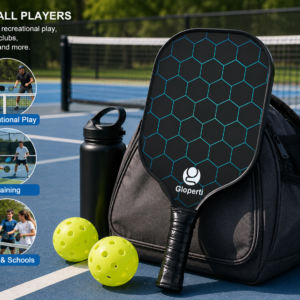
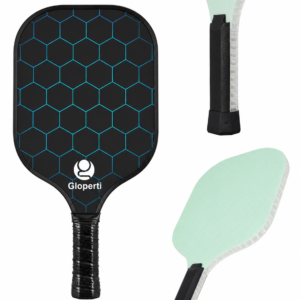
For buyers developing an OEM or private-label range, Gloperti provides custom paddle options including carbon fiber and fiberglass faces, several core thicknesses, two-sided UV logo printing, low-volume customization, and design support. Explore our custom pickleball paddle manufacturing program for OEM and private-label projects.
Supplier Evaluation Checklist
Use a structured checklist before approving a supplier: confirm business identity and export experience; review product samples; verify material descriptions; define tolerances; inspect print quality; test grip comfort; request packaging samples; review production capacity; confirm lead time; clarify intellectual-property responsibility; agree on inspection criteria; and document all details in the purchase order.
It is also wise to start with a manageable first order. A pilot order reveals how the factory handles artwork, communication, production updates, quality problems, packing, and delivery. Strong suppliers do not avoid questions. They provide clear answers, identify risks early, and document changes before production begins.
Conclusion
Choosing the right factory is not just a sourcing exercise; it is the foundation of your pickleball product strategy. A capable manufacturer can help you build training paddles, pink lifestyle collections, professional carbon-fiber models, ready-to-ship products, T700 thin-core paddles, thermoformed performance lines, wholesale sets, wooden paddles, and youth paddles for kids.
The best results come from matching construction to the intended player, defining specifications in writing, approving physical samples, and using measurable quality standards. When those steps are in place, buyers can move from generic products to a coherent private-label collection with stronger differentiation, fewer quality disputes, and better long-term growth.
Frequently Asked Questions
What is the normal MOQ for a custom pickleball paddle factory?
MOQ depends on the construction and level of customization. Logo-only programs may start at a relatively low quantity, while custom molds, special materials, or exclusive packaging usually require a higher order volume.
Is T700 carbon fiber better than fiberglass?
T700 carbon fiber usually provides a firmer, more premium feel and stronger spin-oriented positioning. Fiberglass can offer good power and value. The best choice depends on target player, price point, and desired response.
What is the difference between a thin-core and a thick-core paddle?
Thin cores generally feel faster and more direct, while thicker cores commonly emphasize control, stability, and a softer response. Face material, shape, and weight also influence performance.
Are thermoformed paddles always more powerful?
Thermoformed construction often increases rigidity and perimeter stability, which can support power. Actual performance still depends on face layup, core, foam, shape, weight, and manufacturing quality.
Can a factory make youth paddles with smaller grips?
Yes. A proper youth program can use reduced grip circumference, shorter handles, lower weight, and child-friendly graphics. These dimensions should be confirmed with physical samples.
Can I legally copy a famous branded paddle?
No. Buyers should avoid unauthorized use of trademarks, patented features, copyrighted artwork, and distinctive trade dress. Use market products as general performance references and create an original design.
What files are needed for custom printing?
Factories typically request vector artwork in AI, EPS, PDF, or editable SVG format, together with Pantone colors, logo dimensions, placement instructions, and packaging artwork.
How should I inspect a wholesale paddle order?
Use a written inspection checklist covering quantity, dimensions, weight, finish, print alignment, edge guard, grip, packaging, barcodes, carton marks, and functional sampling against the approved golden sample.
Target Keywords Covered
pickleball training paddle factory, pink pickleball paddle factory, professional pickleball paddle factory, recommended pickleball paddles factory, rts pickleball paddle factory, selkirk pickleball paddles factory, t700 pickleball paddle factory, t700 thin core pickleball paddle factory, thermoformed pickleball paddle factory, wholesale pickleball paddle factory, wooden pickleball paddle factory, youth pickleball paddle for kids factory.
Looking for a reliable OEM/ODM pickleball paddle manufacturer?
Gloperti specializes in custom pickleball paddle manufacturing — logos, colors, packaging, and specs fully customized for brands, clubs, and retailers.
Ready to Source the Right Paddle?
Whether you need OEM/ODM manufacturing, wholesale pricing, or a custom branded paddle – we’re here to help. Get a free quote within 24 hours.