Meta Title: Fiberglass Pickleball Paddle Manufacturer for Kids | OEM Guide
Meta Description: Choose a reliable fiberglass pickleball paddle manufacturer for beginner, junior, and kids OEM projects. Compare materials, sizes, safety, printing, MOQ, and quality control.
Focus Keyword: fiberglass pickleball paddle manufacturer
Buyer takeaway: A successful junior or beginner paddle is defined by measurable specifications, not just colorful graphics. Control weight, grip size, balance, bonding, edge finish, print quality, and batch consistency.
Table of Contents
- Introduction
- Why Fiberglass Works Well for Entry-Level Paddle Programs
- Beginner, Junior, and Kids’ Paddles Are Not the Same Product
- Recommended Product Specifications
- Core, Face, Handle, and Edge-Guard Construction
- Surface Graphics, Logo Customization, and Branding
- Quality Control for Mass Production
- Safety, Compliance, and Market Claims
- MOQ, Sampling, Pricing, and Lead Time
- How to Evaluate a Manufacturer
- Private-Label Product Opportunities
- Why Work With Gloperti for Custom Paddle Projects
- Conclusion
- Frequently Asked Questions
Introduction
Fiberglass pickleball paddles remain one of the most practical product categories for beginner programs, junior sports lines, school kits, promotional sets, and value-focused retail collections. Compared with premium raw carbon fiber models, fiberglass paddles can deliver a lively response, colorful surface graphics, comfortable playability, and an accessible price point. That combination makes them especially attractive to importers and brands that need a dependable entry-level product without making the paddle feel like a toy.
Selecting the right fiberglass pickleball paddle manufacturer is not simply a matter of finding the lowest quotation. Buyers must evaluate construction, weight consistency, grip size, edge protection, print durability, packaging, compliance, and the supplier’s ability to control mass production. For junior and children’s products, these details become even more important because an oversized grip, excessive swing weight, sharp edge finish, or inconsistent balance can reduce comfort and confidence.
This guide explains how to plan a commercial fiberglass paddle project for beginners, juniors, and kids. It is written for sports brands, distributors, clubs, schools, promotional companies, e-commerce sellers, and private-label buyers looking for an OEM or ODM partner.
Why Fiberglass Works Well for Entry-Level Paddle Programs
A fiberglass face is made from woven glass fibers combined with resin and laminated over a core. The surface tends to feel responsive and slightly springy, helping new players generate depth without perfect technique. This accessible power profile is one reason many buyers choose fiberglass for starter paddles and family sets.
Fiberglass also accepts bright UV printing and a wide range of decorative treatments. Brands can create colorful youth graphics, school themes, club logos, geometric patterns, or coordinated two-paddle sets. The face can be matte, semi-gloss, or glossy depending on the desired appearance and friction specification.
Cost is another advantage. A well-designed fiberglass model can provide reliable performance while leaving room for retail packaging, accessories, freight, marketplace fees, and distributor margin. The goal, however, should be value engineering rather than aggressive cost cutting. Thin edge guards, weak adhesive systems, low-density cores, and poor handle reinforcement may reduce the quotation but often create returns and damage the brand.
Beginner, Junior, and Kids’ Paddles Are Not the Same Product
The phrase fiberglass beginner pickleball paddle manufacture usually refers to a full-size or slightly compact paddle designed for adults who are learning the game. These paddles typically prioritize a generous sweet spot, medium-light weight, comfortable grip, and forgiving response.
A junior paddle should be engineered around smaller hands and lower strength levels. Buyers working with fiberglass junior pickleball paddle manufacturers should specify total length, face width, handle length, grip circumference, static weight, balance point, and target age range. Simply printing a cartoon graphic on an adult paddle does not create a true junior product.
A kids’ paddle may be shorter and lighter still, especially for school programs or ages roughly six to ten. The specification should support easy handling while remaining durable enough for repeated group use. For very young players, the manufacturer should avoid unnecessarily long handles and head-heavy balance. For older juniors, a transitional model closer to adult dimensions may offer better long-term value.
Recommended Product Specifications
A commercially successful specification starts with the intended user. For adult beginners, a common target is approximately 220 to 235 grams, though the final range depends on shape, core thickness, edge guard, handle assembly, and market positioning. A 13 mm or 16 mm polypropylene honeycomb core can provide a comfortable balance of control, stability, and durability.
For juniors, many buyers target approximately 190 to 220 grams. A shorter overall length, moderate face width, and smaller grip circumference can improve maneuverability. Kids’ models may be lighter, but the supplier must still maintain sufficient structural strength. Extremely low weight achieved by reducing core quality or handle reinforcement is usually a false economy.
Grip circumference deserves special attention. A grip that is too large makes it difficult for children to adjust the paddle angle or use relaxed wrist movement. Buyers should request actual circumference measurements after the grip is installed, not only the nominal handle mold dimension. The grip material should be non-slip, comfortable, and free from strong odor.
Balance point and swing weight should be controlled together with static weight. Two paddles can weigh the same but feel very different if one is head-heavy. A manufacturer with good process control will establish a tolerance range and sort finished paddles accordingly.
Core, Face, Handle, and Edge-Guard Construction
Most modern value-oriented fiberglass paddles use a polypropylene honeycomb core. Buyers should confirm cell size, density, thickness tolerance, flatness, and bonding compatibility. A stable core supports consistent rebound and reduces the risk of soft spots or premature delamination.
The fiberglass face layup must be uniform. Resin content, curing temperature, pressure, and surface preparation all influence strength and appearance. Ask the factory how it controls bubbles, dry spots, wrinkles, print distortion, and face-to-core adhesion. Finished panels should be checked before cutting so defects do not move further into production.
The handle is a frequent failure point in low-cost paddles. A reliable fiberglass pickleball paddles manufacturer should explain the handle reinforcement method, foam or filler system, end-cap installation, grip wrapping, and pull-strength testing. For school and rental use, buyers may request additional handle reinforcement because paddles are often dropped or struck against the floor.
The edge guard should sit evenly around the paddle, with clean joints and no sharp corners. Adhesive coverage and fit must be consistent. Junior and kids’ paddles should be checked carefully for protrusions, rough trimming, or loose components.
Surface Graphics, Logo Customization, and Branding
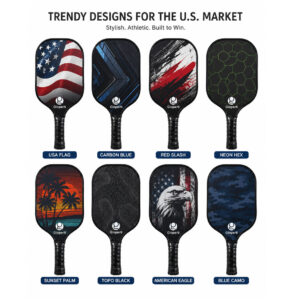
Fiberglass is ideal for visually distinctive collections. UV printing can reproduce detailed patterns and multiple colors on both faces. Buyers can add a brand logo, model name, specification icons, safety wording, and coordinated packaging artwork. Before production, the factory should provide a digital mockup and, for important projects, a physical pre-production sample.
Artwork files should be prepared with bleed and safe zones that account for paddle cutting and edge-guard coverage. Small text should not be placed too close to the perimeter. Colors may appear different on fiberglass than on a computer screen, so buyers should use Pantone references where color accuracy is commercially important.
Print durability should be evaluated through adhesion, abrasion, and cleaning tests. A beautiful sample is not enough; the production process must reproduce the same color and registration. When sourcing fiberglass pickleball paddle for kids manufacture services, also review whether the graphics are age-appropriate and whether any licensed characters or third-party marks require authorization.
Quality Control for Mass Production
A strong quality plan begins before the purchase order. The approved sample, bill of materials, artwork, packaging specification, tolerance table, test method, and inspection standard should all be documented. Verbal agreements are difficult to enforce when production is underway.
Incoming materials should be checked for fiberglass quality, core thickness, grip consistency, edge-guard dimensions, adhesives, and printing consumables. During production, the factory should monitor lamination, curing, panel flatness, cutting accuracy, drilling, handle assembly, edge installation, and printing.
Finished-product inspection should include appearance, dimensions, weight, balance, grip circumference, sound, face flatness, edge fit, logo position, packaging, barcode accuracy, and carton markings. Buyers may also request drop tests, handle strength tests, adhesion tests, and limited destructive testing from each batch.
Weight grouping is particularly useful for beginner and junior lines. A clear tolerance, such as a defined gram range per SKU, prevents customers from receiving paddles that feel noticeably different. Retail sets should be paired intentionally rather than packed randomly.
Safety, Compliance, and Market Claims
Children’s sporting goods require careful risk assessment. The exact legal obligations depend on the destination market, product classification, materials, age grading, packaging, and claims. Buyers should work with qualified testing laboratories or compliance professionals instead of relying only on a supplier’s general statement that a product is safe.
Request material information for coatings, inks, adhesives, grips, plastics, and packaging when relevant. Check for sharp points, detachable small components, strong odors, rough surfaces, and packaging hazards. Warning labels and age recommendations should be reviewed for the target market.
Tournament-approval claims must also be handled accurately. A paddle should not be marketed as approved merely because it resembles an approved shape. When official approval is part of the sales strategy, confirm the current governing-body process, testing requirements, brand authorization, and model listing before printing claims on products or cartons.
MOQ, Sampling, Pricing, and Lead Time
MOQ depends on the level of customization. A factory may offer a lower quantity for an existing mold with custom surface graphics and standard packaging, while a new shape, custom handle, special edge color, unique grip, or fully customized retail box may require more units. Buyers should ask for separate MOQ information for the paddle, printing, grip, bag, box, and accessories.
Sampling normally progresses through a digital artwork confirmation, one or more physical samples, testing, revisions, and a signed golden sample. Pay attention to whether the sample uses the same materials and process planned for mass production. A hand-finished sample that cannot be reproduced consistently provides little protection.
Pricing should be compared on a like-for-like basis. Confirm core material, thickness, fiberglass layup, weight tolerance, handle structure, edge guard, printing, grip, packaging, accessories, inspection, carton size, and Incoterms. A small unit-price difference may disappear after adding replacements, repacking, or higher freight caused by inefficient cartons.
Lead time should include material preparation, printing, lamination, assembly, inspection, and packing. Seasonal launches need buffer time for sample revisions, laboratory testing, shipping, customs, and marketplace receiving appointments.
How to Evaluate a Manufacturer
Start by checking whether the supplier actually manufactures paddles or mainly trades finished products. A capable fiberglass pickleball paddle manufacturer should be able to discuss materials, lamination, cutting, handle assembly, printing, testing, and production capacity in practical detail.
Ask for product examples relevant to your project, not only premium carbon models. A factory experienced in fiberglass junior pickleball paddle manufacture should understand small-grip construction, weight control, colorful artwork, set packaging, school-use durability, and age-appropriate positioning.
Review communication quality during sampling. Good suppliers identify unclear specifications, provide measurable options, document changes, and explain trade-offs. Poor suppliers often agree to every request without confirming feasibility, then improvise during production.
Use a supplier scorecard covering technical ability, quality system, compliance support, responsiveness, sample accuracy, capacity, price transparency, delivery performance, and corrective-action capability. A trial order can validate the relationship before a larger launch.
Private-Label Product Opportunities
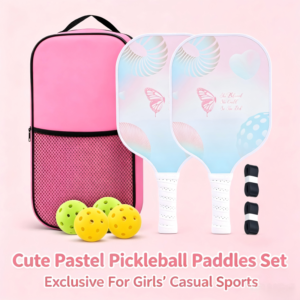
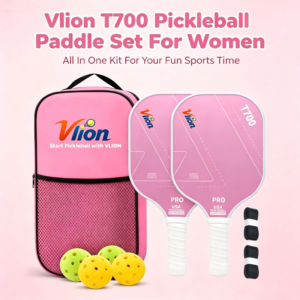
A basic beginner paddle can be expanded into several commercial formats: a single paddle with cover, a two-paddle family set, a junior coaching kit, a school pack, a club demo set, a promotional gift set, or a beginner bundle with balls and a carry bag. The same core platform can support different graphics and packaging for multiple channels.
Retailers can segment the line by age, weight, color, grip size, or playing environment. For example, a compact kids’ model may serve schools, while a full-size lightweight fiberglass model serves adult beginners. A coordinated design family reduces artwork costs and strengthens brand recognition.
Accessories should be chosen with the user in mind. Soft indoor or outdoor balls, a simple instruction card, name labels, and protective covers may add more value to a junior set than premium technical accessories. Packaging should clearly explain what is included and who the product is designed for.
Why Work With Gloperti for Custom Paddle Projects
Gloperti supports private-label pickleball paddle development for sports brands, distributors, clubs, and promotional buyers. Customization can include fiberglass or carbon-fiber face materials, multiple core thicknesses, custom logos, two-sided UV printing, grip options, edge colors, paddle covers, bags, retail boxes, and set configurations.
For suitable existing structures, custom-logo projects can begin from a practical MOQ, and visual mockups can be prepared before sampling. Buyers can provide their target market, age group, price position, artwork, packaging requirements, and expected order quantity so the product can be engineered around the commercial objective.
A clear development process—from specification and artwork confirmation to sampling, inspection, and shipping—helps reduce surprises and protects launch timing. Visit the custom pickleball racket page to discuss an OEM or ODM project with the Gloperti team.
Conclusion
The right fiberglass paddle program combines accessible playability with disciplined manufacturing. Beginner, junior, and kids’ models should be treated as distinct products, each with appropriate weight, grip, dimensions, balance, durability, and artwork.
When comparing fiberglass junior pickleball paddle manufacturers, look beyond the quotation. Evaluate engineering knowledge, material control, sample accuracy, printing consistency, safety awareness, quality documentation, and production reliability. A well-managed supplier relationship can turn a simple entry-level paddle into a scalable product family for retail, schools, clubs, and promotional channels.
Frequently Asked Questions
Are fiberglass pickleball paddles good for beginners?
Yes. Fiberglass faces generally provide accessible power, a lively response, colorful customization, and competitive cost. A beginner model should also have a forgiving shape, comfortable grip, controlled weight, and consistent balance.
What weight is suitable for a junior pickleball paddle?
Many junior projects target roughly 190 to 220 grams, but the correct range depends on age, paddle dimensions, balance point, and intended use. The manufacturer should validate both static weight and swing feel.
Can a fiberglass paddle be customized with a logo on both sides?
Yes. Two-sided UV printing is commonly used for logos, patterns, model names, and full-face graphics. Buyers should approve artwork placement, color references, and a physical sample before mass production.
What is the typical MOQ for a custom fiberglass paddle?
MOQ varies with the structure and customization. Existing molds with custom graphics usually allow lower quantities than new molds, custom grips, special edge guards, or fully customized packaging.
What core is commonly used in fiberglass pickleball paddles?
Polypropylene honeycomb is widely used because it can provide a useful combination of control, sound, weight, durability, and manufacturing consistency.
How should buyers inspect kids’ pickleball paddles?
Inspection should cover dimensions, weight, balance, grip circumference, edge finish, handle strength, surface flatness, print adhesion, odor, packaging, labels, and any applicable safety or compliance requirements.
Can one factory make both kids’ and adult beginner paddles?
Yes, provided it can control different dimensions, grip sizes, weights, balance targets, artwork, and packaging. Buyers should require separate approved specifications for every SKU.
How long does custom production take?
Timing depends on materials, artwork, sampling, testing, order quantity, packaging, and factory capacity. Buyers should plan for sample approval plus mass production, inspection, shipping, customs, and receiving time.
Develop Your Custom Fiberglass Paddle Line
Share your target users, paddle dimensions, weight range, grip size, artwork, packaging, and order quantity. Gloperti can help turn the brief into a production-ready OEM or ODM specification.
Looking for a reliable OEM/ODM pickleball paddle manufacturer?
Gloperti specializes in custom pickleball paddle manufacturing — logos, colors, packaging, and specs fully customized for brands, clubs, and retailers.
Ready to Source the Right Paddle?
Whether you need OEM/ODM manufacturing, wholesale pricing, or a custom branded paddle – we’re here to help. Get a free quote within 24 hours.