Meta Title: Pickleball Paddle Manufacturer Guide: Kids, T700, 12K & 16mm
Meta Description: Compare kids, Power Pro, T700 thin-core, 12K tournament, 13mm and 16mm pickleball paddles, plus key OEM manufacturing and sourcing criteria.
Choosing the right pickleball paddle manufacturer is no longer a simple matter of comparing price and logo options. Buyers now need clear product segmentation, repeatable performance, reliable quality control, and a development partner that can translate a market idea into a commercially viable paddle. This is especially true when a product line includes junior fiberglass paddles, Power Pro constructions, T700 thin-core models, 12K tournament paddles, and multiple core thicknesses.
Key Takeaways
- Match construction to player profile and sales channel.
- Control measurable specifications, not just material labels.
- Approve separate samples for junior, 13mm, 16mm, T700, 12K, and Power Pro models.
- Use golden samples and documented quality tolerances for repeat orders.
Introduction
This guide explains how distributors, private-label brands, sports retailers, clubs, and promotional-product buyers can evaluate a factory across these categories. It also shows how face material, core thickness, shape, weight, grip, thermoforming, edge protection, artwork, packaging, and testing affect the final product. The goal is not keyword-level sourcing. The goal is a product family that fits real players and can be reordered with consistent specifications.
1. Start With the Player, Not the Material Label
A strong sourcing project begins with a defined player profile. A junior paddle for an eight-year-old should not be treated as a smaller version of an adult tournament paddle. Likewise, a 16mm control paddle and a 13mm speed paddle may use similar carbon-face language while delivering very different handling.
Before requesting a quotation, define the target age, skill level, desired swing weight, balance point, grip circumference, handle length, paddle shape, price tier, sales channel, and required certification. This information helps the manufacturer recommend a construction instead of simply quoting the cheapest available shell.
For a coherent range, many brands use three levels: an accessible fiberglass youth model, a performance-oriented 3K or T700 model, and a premium 12K or Power Pro tournament model. This ladder makes the differences understandable to customers and gives the factory a stable platform for production planning.
2. Fiberglass Pickleball Paddle for Kids Manufacturers: What Matters Most
When reviewing fiberglass pickleball paddle for kids manufacturers, prioritize safety, handling, durability, and age-appropriate dimensions. Fiberglass is often a practical choice for junior paddles because it supports colorful graphics, offers a comfortable response, and can meet value-focused price points.
A suitable kids paddle should normally be lighter than a standard adult paddle, with a smaller grip circumference and a manageable overall length. The exact dimensions should be selected around the intended age group rather than copied from a generic adult mold. Rounded edge protection, secure end caps, clean surface finishing, and stable bonding are essential.
A capable youth pickleball paddle for kids manufacturer should offer sample validation for weight tolerance, balance, grip size, artwork adhesion, and edge-guard fit. Ask whether the factory can sort finished paddles into narrower weight bands. Even modest weight variation feels significant in a child-sized product.
Packaging should also be designed for the channel. Retail sets may need balls and a carry bag, while school or club orders may prefer bulk cartons and simple identification labels. Clear age guidance and adult-supervision language can be included on packaging where appropriate.
3. Power Pro Pickleball Paddle Manufacturing
The phrase Power Pro usually describes a performance concept rather than one universal construction. A power-focused paddle may combine a rigid carbon face, perimeter reinforcement, foam injection, thermoformed edges, an elongated shape, or a thinner core. The correct combination depends on the desired launch, sweet spot, stability, and swing speed.
A power pro pickleball paddle manufacture project should begin with measurable targets. Specify total weight, swing weight, twist weight, balance point, core thickness, face material, peel-ply texture, handle length, and tolerance limits. Without these controls, two samples that look identical can feel noticeably different.
For private-label development, ask the supplier to document the bill of materials and process route. This reduces the risk of silent substitutions after the first order. It is also useful to compare a control sample with pre-production and production samples under the same test method.
Power should not come at the expense of structural integrity. Inspect the throat, handle joint, edge wall, core-to-face bond, and surface texture after impact and environmental conditioning. A reliable manufacturer will discuss these tradeoffs openly instead of promising maximum power, maximum control, maximum spin, and maximum durability from one unchanged construction.
4. T700 Thin-Core Pickleball Paddle Manufacture
T700 carbon fiber is widely used in performance paddle programs because it can provide a crisp response, good stiffness-to-weight efficiency, and a surface suitable for textured finishes. However, the words T700 alone do not guarantee performance. Fiber grade, weave or unidirectional layout, resin system, surface treatment, laminate thickness, and process control all matter.
For a T700 thin core pickleball paddle manufacture program, the core is commonly selected to create faster rebound and quicker hand speed. Thin-core models can feel lively and direct, making them attractive to aggressive players and doubles specialists who value rapid exchanges. The tradeoff may be a firmer impact feel and a smaller margin for off-center contact.
When comparing T700 thin core pickleball paddle manufacturers, ask for the nominal and actual thickness after pressing, core density, cell size, face layup, edge construction, and finished weight distribution. A 13mm label is useful for marketing, but the full assembly and tolerance control determine how the paddle performs.
Texture durability is another key point. Request an agreed method for checking initial roughness and wear after repeated ball contact. Decorative texture that disappears quickly is not the same as a controlled performance surface.
5. 12K Tournament Pickleball Paddle Manufacturers
A 12K carbon face uses a visually distinctive broader weave, which can support a premium product story. For tournament-oriented paddles, though, appearance must be matched by consistent playability and compliance with the rules of the target market.
Experienced 12K tournament pickleball paddle manufacturers should be able to explain whether the 12K layer is structural, cosmetic, or part of a hybrid laminate. They should also define the resin, surface finish, core, perimeter reinforcement, and handle structure. Ask for traceable samples and written tolerances rather than relying on weave appearance alone.
Tournament products benefit from tighter quality windows. Weight, dimensions, flatness, surface condition, deflection-related performance, and branding placement should be checked against an approved golden sample. If certification is required, confirm who manages submission, sample selection, fees, and change control after approval.
A premium 12K model should also have packaging that protects the face and edge. A fitted cover, molded insert, or reinforced retail box can prevent cosmetic damage during international transport and preserve the premium presentation.
6. Choosing Between 13mm and 16mm Pickleball Paddles
Core thickness is one of the clearest ways to position a paddle line. A 13mm pickleball paddles manufacturer will usually target players who want faster response, quick hands, and a more direct feel. A 16mm pickleball paddles manufacturer will often emphasize control, stability, comfort, and a more forgiving response.
These are general tendencies, not absolute rules. Face stiffness, core density, shape, perimeter construction, total weight, and balance can shift the result. A well-designed 16mm paddle can still produce strong power, while a carefully tuned 13mm model can offer more control than expected.
For sourcing, do not approve both thicknesses based only on one visual sample. Test them separately for static weight, swing weight, balance, rebound feel, torsional stability, edge durability, and player feedback. Keep the artwork and shape consistent if you want consumers to understand thickness as the primary choice.
A useful merchandising approach is to label 13mm as speed or attack and 16mm as control or all-court, while avoiding exaggerated claims. This gives buyers a simple decision framework without pretending thickness is the only performance variable.
7. 16mm Thickness Carbon Fiber Pickleball Paddle Manufacturing
A 16mm thickness carbon fiber pickleball paddle manufacturer should control more than the nominal honeycomb core. The complete structure includes face sheets, adhesive layers, possible foam or reinforcement, edge guard, handle assembly, grip, and finishing. Each component influences weight, balance, vibration, and durability.
For a control-oriented 16mm model, buyers often request a broad sweet spot, stable blocks, comfortable resets, and predictable spin. Achieving this consistently requires even bonding pressure, controlled resin and adhesive application, flatness checks, and careful final weight sorting.
Thermoformed 16mm constructions may add perimeter rigidity and power, but they also require process discipline. Ask the factory how it controls temperature, pressure, dwell time, cooling, foam distribution, and handle integration. Inconsistent processing can create delamination, crushed core areas, warping, or variable feel.
For repeat orders, keep a signed specification sheet that lists every approved material and measurable tolerance. Color references, logo dimensions, UV print placement, grip wrapping direction, end-cap branding, cover type, carton quantity, and barcode location should all be included.
8. 3K Sport-Leisure Pickleball Paddle Manufacture
A 3K carbon weave is a versatile option for sport-leisure and intermediate product lines. It offers a recognizable carbon appearance and can be positioned above entry-level fiberglass without the cost or complexity of a flagship tournament build.
In a 3K sport leisure pickleball paddle manufacture project, the best value often comes from balanced specifications: moderate weight, comfortable grip, dependable edge protection, attractive surface graphics, and a core tuned for easy all-around play. The product should feel meaningfully better than a basic promotional paddle while remaining accessible to recreational players.
Factories can often use one proven mold with different face finishes and packaging to create club, retail, corporate, and e-commerce versions. This reduces tooling risk and supports lower development cost. However, the internal construction should still be documented so that marketing variants do not drift into inconsistent products.
For sets, validate ball quality, bag stitching, zipper durability, handle protection, and carton drop performance. A good paddle can still receive poor reviews when the accessory bundle feels cheap or arrives damaged.
9. Factory Evaluation Checklist for OEM and Private Label Buyers
The strongest manufacturer is not necessarily the one with the lowest unit price. Evaluate communication speed, engineering support, sample accuracy, material traceability, testing capability, production capacity, quality systems, artwork control, packaging support, and after-sales response.
Request a quotation that separates tooling, samples, paddle cost, printing, grip options, covers, bags, retail packaging, testing, certification, and freight assumptions. This makes offers easier to compare and reduces later surprises.
During sampling, use an approval checklist. Record dimensions, thickness, weight, swing feel, balance, grip circumference, handle length, face finish, logo position, color, edge fit, sound, and packaging. Photograph and retain the approved sample. For production, define an inspection plan and acceptable quality limits appropriate to the order.
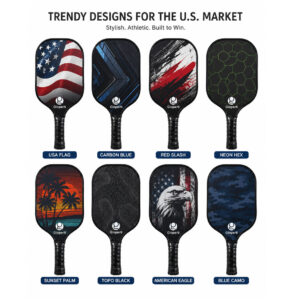
For custom development, work with a supplier that can convert a design brief into a controlled specification. Gloperti provides OEM and private-label support for carbon fiber, fiberglass, junior, 13mm, 16mm, printed, and packaged paddle programs. Buyers can review customization options at the custom pickleball racket page.
10. Building a Commercially Coherent Paddle Collection
A successful collection should make sense at a glance. Instead of launching many nearly identical models, define a clear role for each paddle. A junior fiberglass paddle can serve schools and families. A 3K sport-leisure paddle can target recreational and intermediate players. A T700 13mm model can focus on speed. A 16mm carbon model can emphasize control. A 12K or Power Pro model can anchor the premium tier.
Use consistent naming, graphic systems, grip branding, packaging hierarchy, and product comparison charts. Keep claims tied to real construction differences. This improves retailer training, online conversion, and customer satisfaction.
The final step is reorder discipline. Approved specifications, color standards, artwork files, packaging dielines, inspection records, and golden samples should be maintained for every SKU. A manufacturer that supports this documentation becomes a long-term supply-chain partner rather than a one-off vendor.
Conclusion
Selecting a pickleball paddle manufacturer requires a structured review of the player, product architecture, materials, process, quality controls, certification needs, and commercial positioning. Fiberglass kids paddles, Power Pro builds, T700 thin-core models, 12K tournament paddles, 13mm speed paddles, 16mm control paddles, and 3K sport-leisure products each need different priorities.
The best results come from clear specifications, measurable tolerances, realistic performance targets, and disciplined sample approval. With those foundations, a brand can build a differentiated paddle range that is easier to market, safer to reorder, and more consistent for players.
Frequently Asked Questions
What should buyers check when choosing fiberglass pickleball paddle for kids manufacturers?
Check age-appropriate weight, grip circumference, overall dimensions, rounded edge protection, secure bonding, artwork durability, weight tolerance, packaging, and the supplier's ability to validate samples before mass production.
What does Power Pro mean in pickleball paddle manufacturing?
Power Pro is usually a positioning term, not one fixed construction. It may involve a rigid carbon face, thinner core, elongated shape, thermoformed perimeter, foam reinforcement, or another combination designed for stronger rebound and stability.
Is T700 carbon fiber always better for a thin-core paddle?
Not automatically. T700 can support a high-performance build, but the layup, resin, surface treatment, core, bonding process, shape, and weight distribution determine the finished paddle's quality.
What is the difference between 13mm and 16mm pickleball paddles?
A 13mm paddle generally feels faster and more direct, while a 16mm paddle generally offers more control, stability, and comfort. The final result also depends on face stiffness, core density, shape, and perimeter construction.
What should buyers ask 12K tournament pickleball paddle manufacturers?
Ask whether the 12K layer is structural or cosmetic, request material and process specifications, define tight tolerances, confirm certification responsibilities, and approve a traceable golden sample.
Can one manufacturer produce junior, recreational, and tournament paddle lines?
Yes, provided the supplier has suitable molds, material sourcing, process controls, testing, artwork capability, and documented specifications for each category.
What is a practical MOQ for custom pickleball paddles?
MOQ varies by mold, material, artwork, packaging, and customization level. Gloperti commonly supports custom programs starting from 50 paddles for suitable configurations, subject to final specification confirmation.
How can buyers reduce quality variation between orders?
Use a signed specification sheet, approved golden sample, fixed bill of materials, measurable tolerances, pre-production confirmation, production inspection plan, and change-control procedure.
Develop Your Custom Pickleball Paddle Line
Work with Gloperti on junior fiberglass, carbon fiber, T700, 3K, 12K, 13mm, 16mm, logo printing, packaging, and private-label programs.
Looking for a reliable OEM/ODM pickleball paddle manufacturer?
Gloperti specializes in custom pickleball paddle manufacturing — logos, colors, packaging, and specs fully customized for brands, clubs, and retailers.
Ready to Source the Right Paddle?
Whether you need OEM/ODM manufacturing, wholesale pricing, or a custom branded paddle – we’re here to help. Get a free quote within 24 hours.