Quick Answer
T700 is a fiber designation. 3K is a tow size.
3K identifies approximately 3,000 filaments per tow. Fiber designation and tow size are separate attributes, but any claimed combination needs the producer’s documentation. For OEM sourcing, compare the face construction, finish, core, handling, and sample results; request material traceability and written acceptance criteria before ordering.
When comparing carbon fiber paddle quotations, an OEM buyer may receive one offer emphasizing T700 fiber and another emphasizing a 3K woven face. This guide shows how to compare the actual constructions, samples, and acceptance criteria. For the broader face-and-core overview, see our pickleball paddle materials guide.
Four Terms to Read in a Carbon Fiber Specification
- Fiber designation: identifies the claimed fiber product, such as a specified T700 variant.
- Tow size: identifies filament count per bundle, such as 3K.
- Fabric architecture: describes how reinforcement is arranged, such as plain weave, twill, or unidirectional layers.
- Surface finish: describes the exposed playing surface, including texture, resin, coatings, and graphics.
What Does T700 Mean in a Pickleball Paddle?
A T700 carbon fiber pickleball paddle is marketed as using a T700-designated carbon reinforcement in its construction. The label needs further detail: who produced the fiber, which exact product is used, where it appears in the laminate, and what documents support the claim?
For a direct product reference, consult the official TORAYCA T700S carbon fiber data sheet (PDF). It identifies T700S as the fiber product and separately lists 6K, 12K, and 24K tow sizes. The sheet does not list a standard 3K option, so it should not be cited as evidence that Toray supplies a T700S/3K combination.
This data sheet describes a specific raw material. It does not establish which fiber a supplier used in a finished paddle or predict that paddle’s spin, power, or durability. Confirm the actual producer, exact product variant, and available batch traceability for your order.
T700 Does Not Automatically Mean Toray-Supplied Fiber
A T700 listing does not prove Toray origin. Before naming a fiber manufacturer on packaging, obtain documentation linking that producer’s material to the supplied paddle.
T700 Does Not Specify the Finished Surface
When discussing T700 pickleball paddle manufacturing, define the reinforcement and the surface process separately. This makes artwork review and repeat-order control much clearer.
What Does 3K Carbon Fiber Mean?
3K means approximately 3,000 individual carbon filaments in one tow. It describes bundle size, not a universal strength grade. Toray’s T300 technical data sheet, for example, identifies a 3,000-filament configuration separately from the fiber type.
In paddle marketing, “3K carbon” often appears alongside a visible woven face. However, 3K alone does not specify plain weave versus twill, the fabric weight, the fiber manufacturer, the resin content, or the number of structural layers.
A Visible Carbon Pattern Is Not a Complete Material Verification
Use appearance to approve cosmetics, not hidden layers. Distinguish printed carbon-look graphics from genuine reinforcement, and identify the structure beneath a woven outer ply.
For custom carbon fiber pickleball paddles, ask whether the quoted 3K layer is part of the structural face, a cosmetic outer ply, or one component of a hybrid laminate. Those arrangements should be identified clearly in the sample specification.
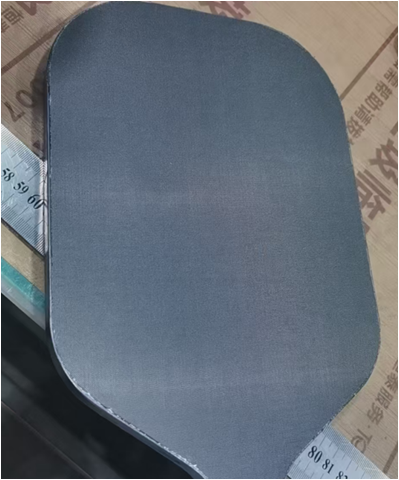
Real Sample Photographs: Appearance and Material Identity
The face sample below illustrates surface appearance before printing.
T700 vs 3K Carbon Fiber: A Buyer’s Comparison Table
This table compares what the labels mean and what buyers need to verify. It does not rank measured paddle performance.
| Comparison point | T700 label | 3K label | What buyers should verify |
|---|---|---|---|
| Primary meaning | Fiber designation or claimed grade | Approximately 3,000 filaments per tow | Exact fiber identity and tow specification |
| Manufacturer origin | Not established by the label alone | Not established by the label alone | Producer identity and supporting records |
| Fabric structure | Not fully specified | Not fully specified | Weave or unidirectional format, fabric weight, and layer arrangement |
| Surface texture | Not guaranteed | Not guaranteed | Finished texture, graphics coverage, and wear behavior |
| Spin, power, and control | Cannot be ranked from the name | Cannot be ranked from the name | Matched samples and a documented evaluation method |
| Durability | Not established by fiber identity alone | Not established by tow size alone | Bonding, curing, edge construction, and finished-product testing |
| Price | Depends on the complete specification | Depends on the complete specification | Equivalent bill of materials, order terms, packaging, and inspection scope |
What Actually Affects Spin, Power, Control, and Durability?
Surface Texture and Finishing
For a spin-oriented product, examine the actual hitting surface. Texture, surface resin, coatings, graphics, wear, and ball contact all matter. An attractive weave pattern is not a measurement of spin, and a rougher feel by hand does not establish competitive legality or long-term performance.
Raw carbon fiber vs woven carbon fiber is another comparison that needs care. “Raw” is commonly used to describe a surface presentation or finishing approach, while “woven” describes reinforcement architecture. The terms do not necessarily identify mutually exclusive materials. Ask the supplier to describe the process behind each marketing term.
Face Laminate and Core Construction
Face thickness, layer orientation, resin, and bonding influence how the face behaves as part of the paddle. Core material, cell structure, thickness, and perimeter design also contribute to the finished response. A T700 label cannot compensate for an unsuitable core or inconsistent lamination.
For comparison testing, keep the core and geometry as similar as practical. If the core, face, shape, and molding process all change together, the test evaluates two whole products; it does not isolate the effect of a carbon fiber label.
Weight Distribution and Handling
Static weight alone does not describe maneuverability. Balance point and swing weight help explain how a paddle feels during acceleration, while twist weight relates to resistance to rotation on off-center impacts. Handle length and grip circumference also influence player fit.
Manufacturing Consistency
Bond quality, curing control, trimming, edge assembly, and grip installation affect the product customers receive. A convincing prototype is useful, but buyers also need evidence that production units will match it within agreed tolerances.
How to Compare OEM Paddle Specifications and Quotes
Start with an Equivalent Product Brief
Send both suppliers the same target specification. Include shape, dimensions, core, thickness, weight range, balance direction, handle, graphics, packaging, quantity, and destination. Ask each supplier to identify departures from that brief rather than silently substituting a standard model.
Request a Written Specification Matrix
| Specification group | Information to request |
|---|---|
| Carbon reinforcement | Producer, exact designation, tow size, fabric format, and available traceability |
| Face construction | Approved laminate description, outer-ply role, hybrid materials, and agreed change controls |
| Surface and artwork | Texture process, coatings, graphic placement, and approved finish sample |
| Core and perimeter | Core type, thickness, molding method, edge guard, and foam where applicable |
| Finished dimensions | Length, width, thickness, handle dimensions, and agreed tolerances |
| Handling | Weight range, balance, swing weight, and twist weight where measured |
| Commercial terms | MOQ, tooling, sample charges, packaging, delivery basis, lead time, and defect remedy |
Some detailed laminate information may be proprietary. In that case, agree on a controlled supplier specification, material identity, approved sample, measurable acceptance criteria, and a requirement for written approval before substitutions.
Compare Total Project Cost
The unit price may exclude artwork revisions, sampling, tooling, laboratory work, covers, retail boxes, freight, or inspection. Compare the same quantity and delivery basis before deciding one option is cheaper. Our guide to pickleball paddle manufacturing costs explains the broader sourcing considerations.
What Material Documents and Sample Tests Should Buyers Request?
1. Material Identity and Traceability
Request the material data sheet and available records linking the claimed fiber to the supplied material, such as batch labels or conformity documentation.
A generic data sheet or roll photograph does not link material to a finished paddle. Review the traceability chain and consider independent inspection for commercially important claims.
2. Representative Finished Samples
Compare multiple representative samples for handling, surface consistency, dimensions, and assembly quality.
Retain the approved sample with its specification revision.
Real Inspection Photographs: Weight and Dimensions
The printed paddle below illustrates three basic sample checks: weight, width, and overall length.
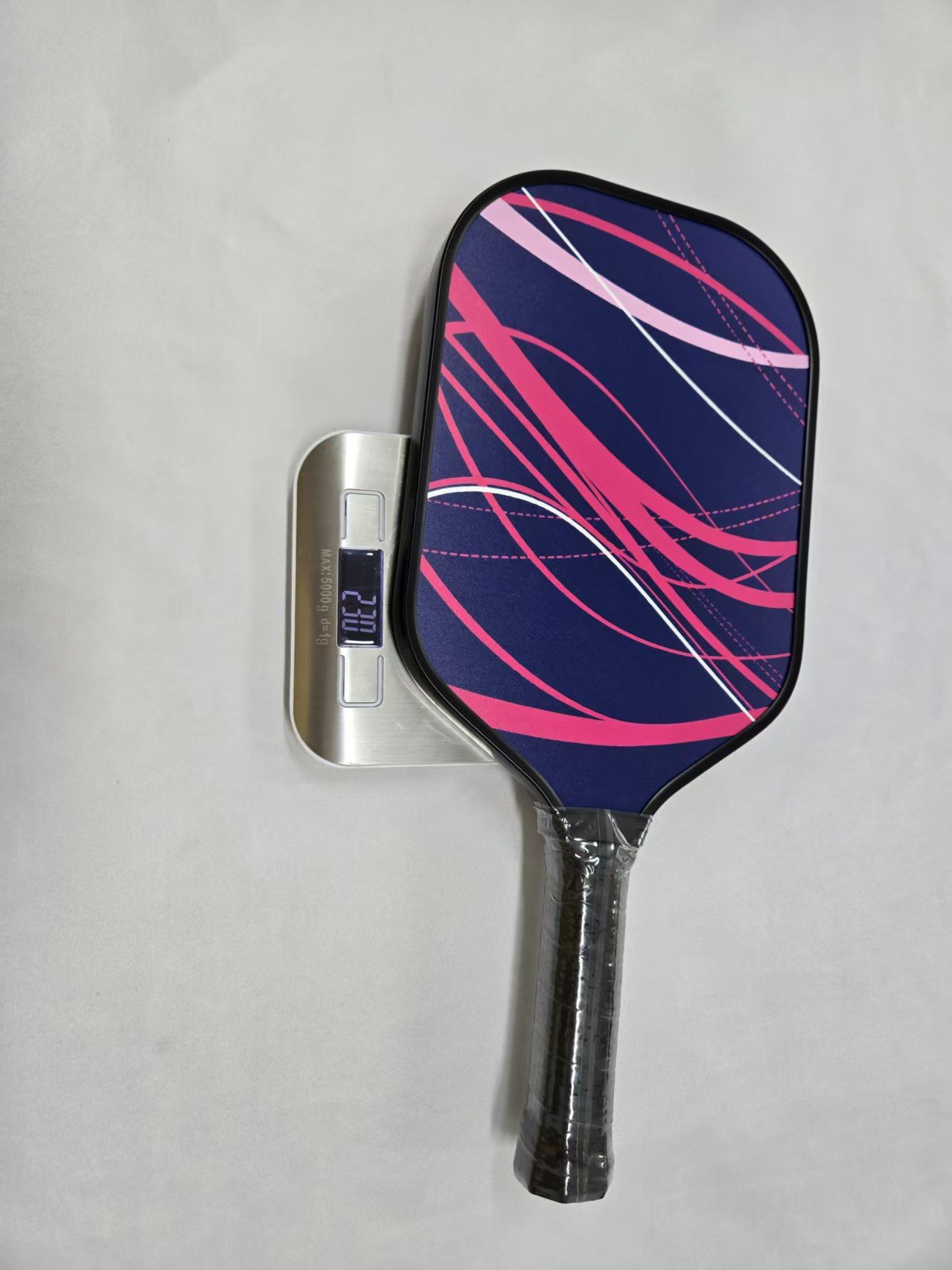
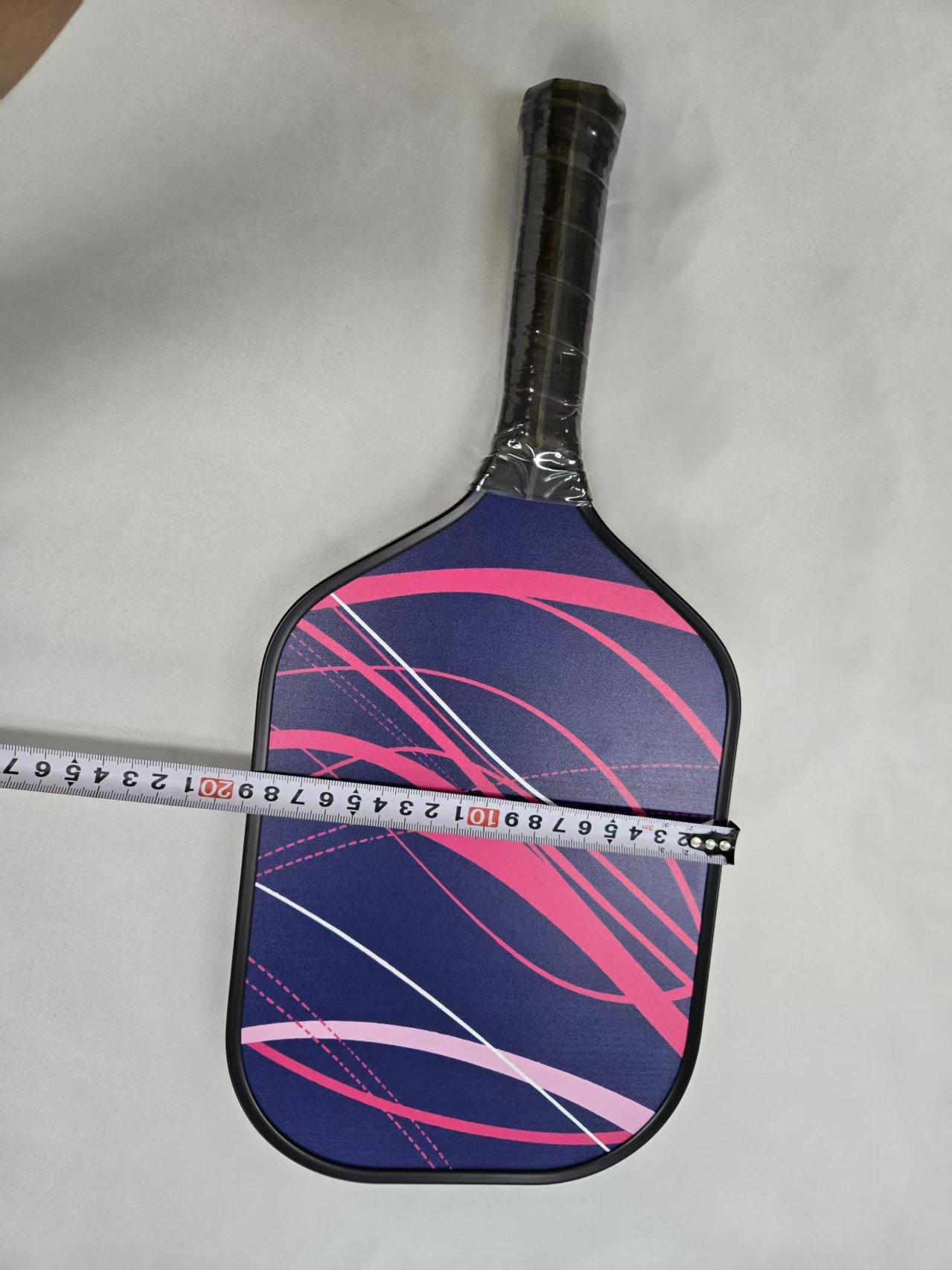
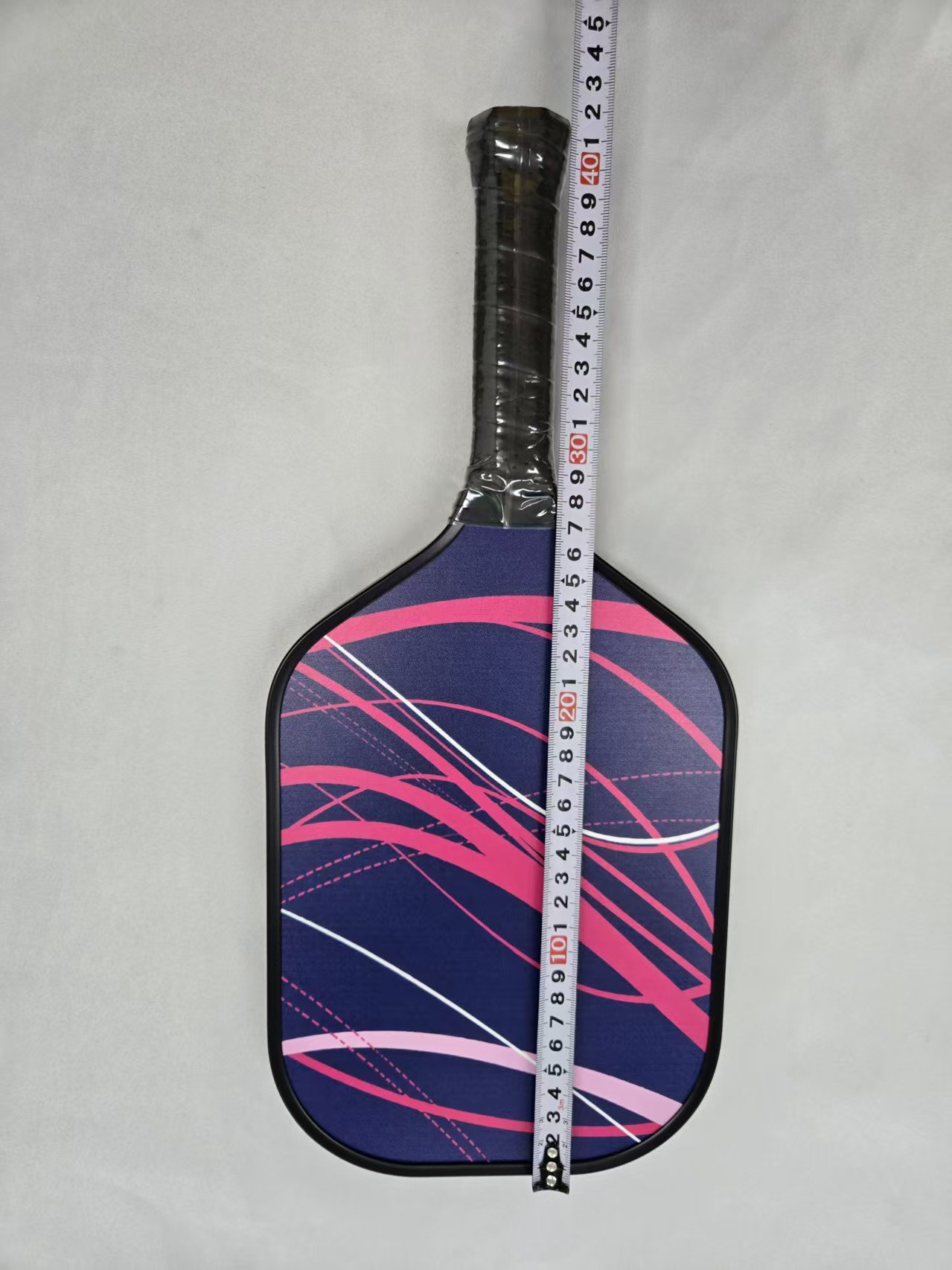
About these photographs: These photographs illustrate appearance and basic checks; they do not verify fiber grade, origin, comparative performance, or batch conformity. The images are not signed acceptance records.
A Short Checklist Before Sample Approval
- Material: confirm the producer, exact fiber designation, tow size, and available supporting documents.
- Construction: match the proposed face, surface treatment, core, shape, and target handling.
- Sample: check appearance, weight, dimensions, and fit against the agreed specification.
- Approval: retain the accepted sample and require approval before material or construction substitutions.
For production inspection and measurement-record guidance, see our pickleball paddle quality control checklist. Keep detailed inspection forms with your project records.
3. A Consistent Performance Evaluation
Compare samples using the same ball type, similar conditions, and structured feedback; conceal material labels where practical.
Distinguish measurements from impressions: “more bite” is feedback, not a spin result. Use repeatable methods for any spin or durability claim.
4. Batch Acceptance and Change Control
Reference the approved specification on repeat orders and agree which changes require a new sample and written approval.
5. Competition Claims
A material label does not establish tournament eligibility. If you intend to market a paddle for sanctioned competition, verify the applicable governing body’s current requirements and the exact model’s approval status before making claims. Check the finished configuration, including any changes to surface treatment or construction.
How to Choose a Carbon Fiber Paddle Specification for Your Brand
Use your product goal to decide what to inspect and which sample to approve. The table below turns the terminology comparison into practical purchasing steps.
| Buyer’s goal | What to verify first | Next purchasing step |
|---|---|---|
| Highlight a visible carbon weave | Actual weave appearance, the outer ply’s structural or cosmetic role, printing coverage, and cosmetic consistency | Review physical samples with the intended artwork; approve a reference finish and acceptable visual variation. |
| Develop a spin-focused product | Actual surface treatment, repeatable finished-paddle testing, and surface behavior after use | Agree on a comparison method and wear-check procedure; choose using documented results rather than the carbon label. |
| Develop a control-oriented product | Whole-paddle construction, weight distribution, handle fit, and structured play-test feedback | Compare representative samples under similar conditions; approve the handling targets and preferred configuration. |
| Maintain consistency across repeat orders | Approved sample, controlled specification, acceptance criteria, and material-substitution approval | Reference the approved revision on each order; require written authorization for changes and inspect against agreed criteria. |
Develop Your Specification with Gloperti
Explore our custom pickleball paddle manufacturing service for your brand’s configuration and packaging requirements. The minimum order quantity depends on the confirmed construction, material, graphics, and packaging; request the applicable MOQ with your quotation.
Frequently Asked Questions
Is T700 better than 3K carbon fiber?
There is no universal ranking. T700 identifies a fiber designation, while 3K describes tow size. Compare the actual face construction, finish, core, handling, and finished-paddle test results before deciding which specification suits your product.
Does 3K mean the paddle uses T300 carbon fiber?
No. A 3K label specifies approximately 3,000 filaments per tow; it does not identify a universal fiber grade or producer. Ask the supplier for the exact material designation and supporting records.
Can T700 and 3K appear in the same specification?
Fiber designation and tow size are separate attributes, but a particular combination is not automatically available. Toray’s published T700S data sheet lists 6K, 12K, and 24K, not a standard 3K option. Verify the actual producer and exact product documentation before accepting a T700/3K claim; different attributes do not prove that a named manufacturer offers that combination.
Is raw carbon fiber the same as T700?
No. Raw carbon commonly describes a surface presentation or finishing approach in paddle marketing. T700 refers to a claimed fiber designation. Ask for both the underlying reinforcement specification and the surface process.
Which has more spin: T700 or 3K?
The labels alone cannot answer that question. Evaluate the finished surface and use comparable samples under a documented test method. Surface wear and the rest of the paddle construction should also be considered.
Are 3K carbon fiber pickleball paddles always cheaper?
No. Price depends on the complete material system, laminate, core, manufacturing process, quality requirements, packaging, quantity, and delivery terms. Compare equivalent quotations instead of relying on a label-based price hierarchy.
Does T700 mean a paddle is approved for competition?
No. Material identity and competition approval are separate matters. Verify the exact finished model’s status with the relevant governing body before advertising it as approved.
What should an OEM buyer request before placing an order?
Request a controlled specification, material identity and available traceability records, representative samples, agreed inspection criteria, commercial terms, and written approval requirements for material or process changes.
Technical References
- Toray: T700S Carbon Fiber Data Sheet — direct product reference distinguishing T700S identity from the listed 6K, 12K, and 24K tow sizes.
- Toray Composite Materials America: TORAYCA Carbon Fiber — reference for distinguishing fiber products and available tow sizes.
- Toray: T300 Carbon Fiber Data Sheet — example of a manufacturer identifying fiber type and filament count separately.
These references explain material terminology. They do not verify the composition, performance, approval status, or material supplier of a Gloperti paddle or any other finished product.