You have a pickleball paddle sample you like, a supplier quote, and a target launch date. Before you place your first bulk order, can the supplier identify the exact sample and files the production team will use? Could an inspector use those same records to decide whether the shipment passes?
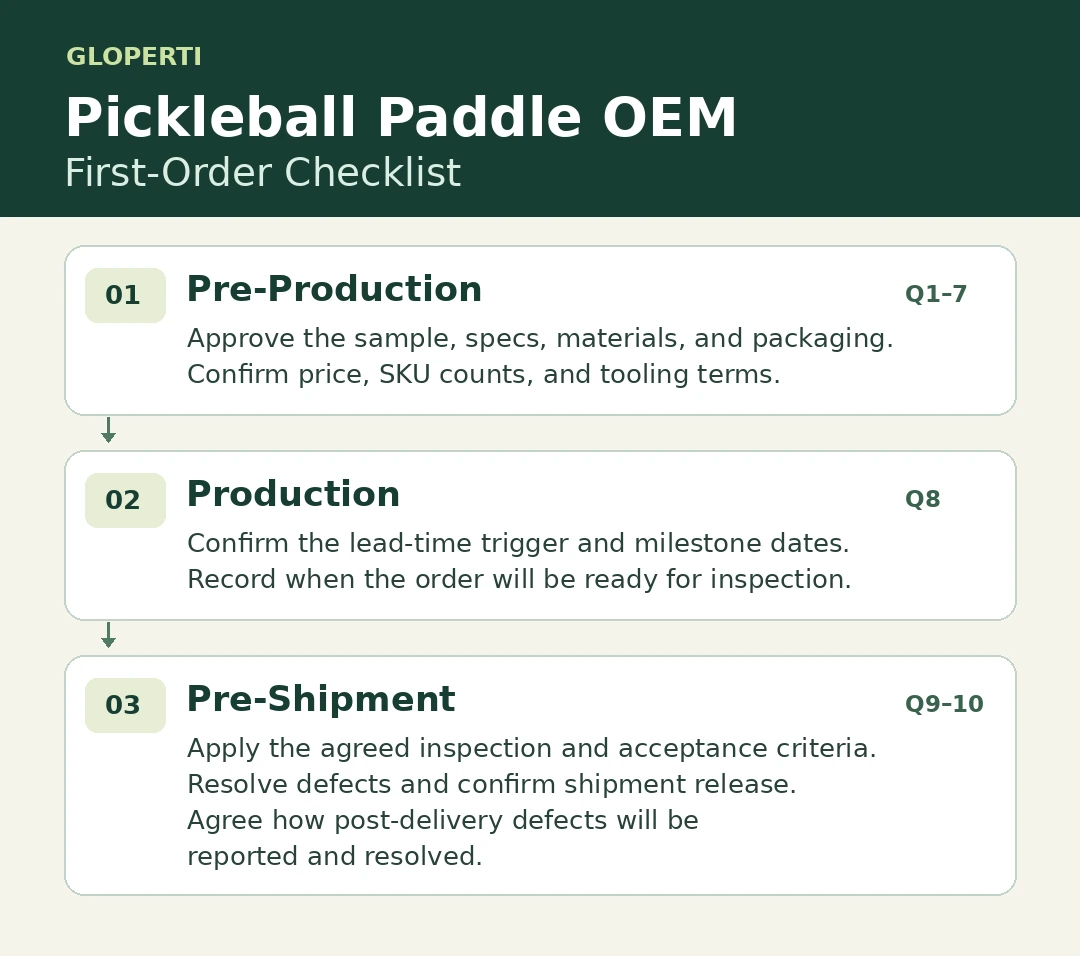
Before placing your first pickleball paddle OEM order, record three decisions in writing. Confirm which sample and specification the factory will follow, what starts the production schedule, and what inspection results are required before shipment. For each open item, name an owner, set a due date, and identify the step that depends on approval.
If you are still shortlisting suppliers, start with how to compare pickleball paddle factories.
Confirm the Sample, Specifications, and Artwork
1. Which sample will bulk production follow?
Identify the approved pre-production sample by model or SKU, sample ID, revision, and approval date. Record which features you approved, including construction, surface finish, and grip. If the sample uses temporary artwork or packaging, identify the final files and who will approve them before printing or packing begins. Keep a labeled reference sample where practical and agree where it will be available during inspection.
Document to Request: A sample approval record with photos, the specification revision, and any outstanding approvals.
Email Template:
Please confirm that model [SKU] will follow approved sample [ID and revision], dated [date], and that [outstanding items] require separate approval before the relevant production step.
2. What finished-paddle dimensions, weight, and tolerances will you guarantee for this order?
Write down the acceptable range for finished weight, overall length and width, paddle thickness, and handle dimensions. Separate nominal core thickness from finished paddle thickness. Define where thickness is measured and whether the paddle is weighed with its production grip and without removable accessories. Add balance point or other measurements if they matter to this SKU and both parties agree on how to check them.
A first-order specification might set a finished-weight tolerance of ±0.2 oz (about ±5.7 g). If your target is exactly ±5 g, write that metric limit into the PO and use it for inspection. Typical nominal core options include 13 mm, 14 mm, and 16 mm. Record the finished paddle thickness separately.
For USA Pickleball (USAP) play, the combined overall length and width must be at most 24 inches (60.96 cm), including the edge guard and butt cap, and overall length must be at most 17 inches (43.18 cm). Allow room for production variation when setting the dimensions. The USA Pickleball rulebook sets no paddle weight or thickness limit.
Document to Request: A finished-product specification with limits, measurement locations, and test conditions.
Email Template:
Please confirm the finished weight range and thickness limits in specification [revision], including the measurement locations and whether the production grip is fitted during weighing.
3. Which materials and components are locked, and who approves a change?
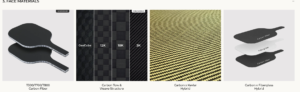
For a build specified with T700 raw carbon fiber, record the fiber designation, face layup, and finish. Specify the agreed manufacturing route, such as thermoformed or cold-pressed, and record the PP honeycomb core thickness and construction and the TPU edge guard material, where applicable. If the face uses a peel-ply texture, identify the agreed finish or process reference. A texture change can affect ball grip and measured surface properties, so agree when it calls for new roughness or friction testing. Ask the supplier to flag an unavailable component before making a substitution. Agree when an updated specification is sufficient and when the change requires a new sample or review of an approval claim for the finished model.
Document to Request: A revision-controlled materials list with the face, core, edge guard, manufacturing route, and change-approval process.
Email Template:
Please submit any proposed material, component, or construction change in writing and obtain our approval before using it in production. Confirm whether the change requires a new sample.
4. Which artwork, barcodes, and packaging files will be used for each SKU?
Match the front and back artwork to each SKU and confirm the logo placement on the face, edge guard, or end cap where applicable. Check the expected appearance on the selected paddle finish. Record whether the unit includes a cover, how many paddles go in a retail pack, and which barcode belongs on each unit or set. Confirm master carton quantities and shipping marks before packing starts.
Document to Request: An approved artwork and packaging proof, a SKU-to-barcode list, and a packing specification.
Email Template:
Please confirm the artwork and packaging revisions for each SKU, including barcode, pack contents, and units per master carton.
Confirm the Price, Quantity, and Production Schedule
5. What exactly is included in the final quote?
Compare the quote with your PO line by line. Check currency, unit price by SKU, packaging and accessories, one-time charges, and any sample fee credit that both parties agreed to. Confirm the shipping term and named place, who arranges freight, and what triggers each payment. Ask for a revised quote if the approved configuration differs from the original quotation. For background, see what an OEM paddle quote includes.
Document to Request: A dated final quotation or pro forma invoice that references the approved configuration.
Email Template:
Please confirm that quote [number and revision] covers the agreed specification, packaging, and accessories, and list any separate charges and payment milestones.
6. How many units of each model and design will you deliver?
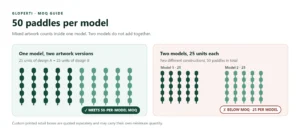
A total of 100 paddles leaves the artwork split open. If you need 60 units of one design and 40 of another, record both quantities next to their SKUs. Check whether minimum quantities apply per model, per artwork, or to a packaging component such as a printed box. Agree how any shortage or surplus will be approved and invoiced.
Document to Request: A confirmed SKU breakdown with quantities, unit prices, and any agreed overrun or underrun terms.
Email Template:
Please confirm the quantities on each PO line and request written approval before shipping or invoicing any quantity outside the agreed limits.
7. If this order uses custom tooling, what does the tooling fee cover?
Identify whether the order uses an existing mold or requires new tooling. For custom tooling, record the mold ID, one-time fee, ownership, permitted use, storage, and maintenance responsibilities. Confirm whether the tooling fee includes trial samples and what happens if the design changes after the first trial. For details, see custom paddle mold ownership and tooling costs.
Document to Request: A tooling quote and written terms linked to the PO, if applicable.
Email Template:
Please confirm which mold will be used and, for new tooling, specify the fee, ownership, permitted use, and trial-sample scope.
8. When does production lead time start, and when will the order be ready for inspection?
Ask the supplier to name the event that starts the schedule. It may be deposit receipt, sample approval, final artwork approval, or completion of several prerequisites. Record the target dates for production completion, inspection, and dispatch or pickup. A factory-ready date and an estimated arrival date serve different planning decisions, so capture both if the supplier handles freight.
Document to Request: An order schedule with the start conditions, milestone dates, and a named contact for updates.
Email Template:
Please confirm when lead time begins, the planned inspection-ready date, and the expected dispatch or pickup date. Notify us if any milestone moves.
Agree on Inspection and Shipment Release
9. How will the bulk order be inspected and accepted?
At Gloperti, we check paddle weight and dimensions as well as printing and packing. Recording these checks against the approved specification gives the production team and buyer a common reference.
Agree who inspects, which units are sampled, and which checks apply to each SKU. Link the inspection plan to the approved specifications, artwork, and packaging. Capture defect categories, acceptance criteria, and the report format. For acceptance sampling, specify the applicable standard (such as ISO 2859-1), edition, inspection level, lot size, and defect classes. AQL (acceptance quality limit) values of 2.5 for major defects and 4.0 for minor defects are an example. Agree the critical-defect policy separately and record the acceptance and rejection counts for the selected plan.
When USA Pickleball approval is required, verify the exact brand and finished model on the USA Pickleball Approved Paddle List. For the hitting surface, ask which report covers surface roughness and kinetic coefficient of friction (CoF), and confirm that it covers the agreed finish. The equipment standards manual describes these as separate measurements. See the pickleball paddle inspection checklist for inspection items to discuss with your supplier.
Document to Request: A written inspection plan and a report template that ties readings, defect photos, and carton counts to the relevant SKUs.
Email Template:
Please confirm the sampling plan, acceptance criteria, inspection responsibility, and the report we will review before authorizing shipment.
10. What happens if inspection fails or defects are found after delivery?
Agree who can put the order on hold or authorize shipment. If inspection fails, document when the supplier will present a correction plan, who pays for reinspection, and what evidence is needed before release. For defects found after delivery, agree the reporting window, required evidence, and how remedies such as replacement or credit will be handled. Make sure the PO and supplier acknowledgement refer to the same terms.
Document to Request: Written terms for corrective action, reinspection, shipment release, and post-delivery claims.
Email Template:
If inspection fails, please hold shipment, submit a correction plan, and obtain written release after the agreed follow-up. Confirm the claim window and remedies for defects found after delivery.
First-Order Risks and Documents to Confirm
Swipe to see all four columns.
| Checklist Area | Key Risk if Unconfirmed | Required Document | Sign-off Timing |
|---|---|---|---|
| Approved sample and specification | Bulk paddles follow an earlier sample or a different measurement method | Signed sample record and finished-product specification | Before production release |
| Materials and construction | Unapproved changes to the face texture, core, or edge guard | Revision-controlled materials list and change approval record | Before material release or any substitution |
| Artwork and packaging | Wrong barcode, logo version, or carton quantities | Approved proofs, SKU-to-barcode list, and packing specification | Before printing or packaging production |
| Price and order quantities | Missing charges or incorrect quantities by design | Final quote or pro forma invoice and PO line items | Before PO acknowledgement and deposit |
| Custom tooling, if applicable | Unexpected tooling charges or disputed use rights | Tooling quote, mold ID, and ownership and use terms | Before tooling authorization |
| Production schedule | Launch plan relies on the wrong start or dispatch date | Production schedule with start criteria and milestones | Before production release |
| Inspection and shipment release | No clear basis for accepting, reworking, or holding a lot | Inspection plan, defect and remedy terms, and completed report | Agree criteria before production and approve release before dispatch |
Copy and Send This First-Order Confirmation Checklist
Fill in the references and ask your supplier to reply against each line. For pending items, add an owner, a due date, and the step that depends on approval.
Subject: First pickleball paddle order confirmation — PO [number]

1. Approved sample ID, revision, and date:
2. Finished-product specification and measurement method:
3. Materials list and written change-approval process:
4. Artwork, barcode, and packing file revisions:
5. Final quote, included items, and payment milestones:
6. Quantity and unit price by SKU and design:
7. Tooling ID, fee, and ownership terms, if applicable:
8. Lead-time trigger, inspection-ready date, and dispatch date:
9. Inspection sampling plan, acceptance criteria, and report:
10. Reinspection, shipment release, and post-delivery claim terms:

Please confirm each item in writing and flag any differences
between the PO, quotation, approved sample, and referenced files.
First-Order FAQs
What is the typical MOQ for a first custom pickleball paddle order?
MOQ depends on the paddle platform, artwork split, and packaging. At Gloperti, selected projects can start at 50 paddles. Ask your supplier to confirm in writing whether the minimum applies per model, per design, or per packaging component. A new mold or printed retail box may carry a separate minimum.
How long does bulk production take for OEM pickleball paddles?
Gloperti’s published estimate for mass production is normally 4–15 working days after sample approval and deposit. Confirm the schedule for your own order, especially if it requires new tooling, sourced materials, or printed packaging. Ask for the production start conditions, inspection-ready date, and planned dispatch date. Allow separately for transit.
Should I pay 100% upfront for my first OEM pickleball paddle order?
For a first bulk order, consider asking for a deposit and a balance tied to an agreed milestone, such as acceptance of the pre-shipment inspection report. Confirm payment terms and the shipment release process in writing before sending funds. Ask the supplier to itemize any sample or tooling charges that are due earlier.
For a custom project with Gloperti, share your target market, estimated quantity by SKU, preferred paddle specifications, and packaging requirements. If you already have a sample or product brief, include the latest revision when you discuss your first custom pickleball paddle order.