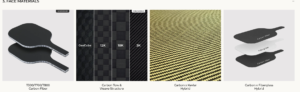
In pickleball paddle manufacturing, thermoforming generally means using heated tooling and pressure to shape or consolidate a paddle assembly. Before approving an OEM sample, ask for the process window, a cross-section showing the core and perimeter, and an inspection plan tied to the quoted model revision.
By Seaner Luo · Gloperti
Quick Summary
- Approved process window. Check the mold temperature, pressure or force and dwell against the qualified cure schedule for the quoted material.
- Edge cross-section drawing. Check the core, perimeter foam location and placement method, and the specified density tolerance or injection shot mass.
- Finished-paddle inspection plan. Check measurement points, weighing configuration, tolerances, sampling and lot disposition for the quoted revision.
Plastic Sheet Thermoforming and Paddle Tooling
In plastics, sheet thermoforming heats a flat thermoplastic sheet, shapes it against a mold, cools it and trims it. The comparison below shows what to verify when the same word appears on a composite paddle quote.
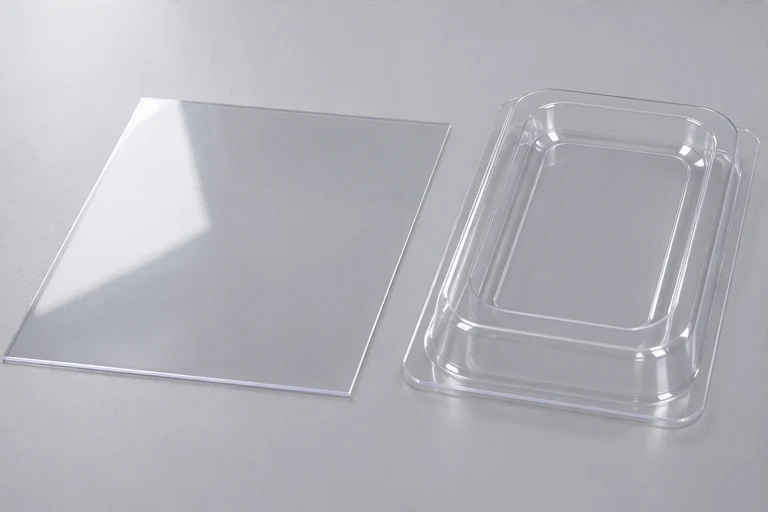
Suppliers may use “hot-pressed,” “thermoformed” and “unibody” in the same quote. Ask what each term describes on that model. For example, request a drawing that shows whether laminate wraps around the edge and whether foam sits at the perimeter, in the center, or in both locations. Compare foam core and honeycomb paddle constructions to see how the center and perimeter can differ.
On mobile, scroll sideways to see all columns.
| Comparison point | Plastic sheet thermoforming | Thermoformed pickleball paddle |
|---|---|---|
| Starting material | Pre-made thermoplastic sheet or film | Composite face layers, a specified core and any perimeter materials |
| What the tool does | Controls the shape of the softened sheet | Shapes or consolidates the assembly specified for the model |
| What to inspect | Wall thickness in drawn areas, trim and part fit | Finished thickness, mass, balance, flatness, edge and face condition |
| What to request | Material grade, gauge and minimum local thickness | Layer stack, edge detail, sample revision and acceptance criteria |
For help choosing a construction and on-court comparisons, see thermoformed vs. cold-pressed pickleball paddles.
Hot-Press Parameters to Request From the Factory
Ask for the approved process window for the quoted resin, core and tool. A change to any of these can require revalidation. The example below describes a specific commercial prepreg and helps show why comparing setpoints alone can be misleading.
Temperature, pressure and time
Toray lists a cure range of 120–135°C for its 2500 prepreg system. Its neat resin gel time falls from 320 seconds at 130°C to 110 seconds at 150°C. These are Toray material data. Gel time measures resin gelation, while press dwell is an approved production setting. Use the Toray prepreg data sheet as an example of the records to request for your quoted material.
- Temperature in °C. Request the controller setpoint, allowable mold temperature range, sensor location and actual temperature record. Ask which reading starts the dwell clock.
- Pressure in MPa or force in kN. Ask where the value is measured. If the supplier converts force to nominal pressure, request the loaded area and calculation. Have the factory record the pressure or force window and cycle trace.
- Dwell and release. Request the dwell window in minutes, any staged loading or cooling, and the release temperature if the process specifies one.
Perimeter foam and molded edge structure
Request a cross-section at the paddle shoulder and sidewall. Have the factory identify the center core, perimeter foam, laminate wrap, and external edge guard. Ask whether the specific model uses an injected material, a preformed insert, or another placement method. Record the foam grade, target density in kg/m³ and its tolerance, or the controlled shot mass in grams where applicable. Ask which stage controls foam location and which sections are inspected for voids or gaps.
Record the qualified tool revision and confirm who owns it. See the guide to custom pickleball paddle molds and tooling.
Three Ways to Verify a Thermoformed Paddle Quote
1. Compare construction options before committing to tooling
Xiamen SiPinTengYue Sport Co., Ltd. (Gloperti) manufactures thermoformed T700 carbon fiber pickleball paddles. For LVN 01, a Canadian brand compared five nominal 16 mm hot-pressed T700 configurations, ordered samples and selected T700-5+EPP+EVA. Gloperti’s case study reports an approximate finished weight of 230 ± 5 g for the comparison platform and a positive customer response at the sample stage. See the LVN 01 T700 paddle case study.
For projects specifying USA Pickleball certification, request the exact model and revision, the applicable PBCoR documentation and the active equipment listing. Certification evidence for LVN 01 was unavailable in the published project record. See USA Pickleball’s paddle certification update and the approved equipment database.
2. Measure finished samples at the same points
Use the same scale, caliper and reference points for each sample. Record finished mass, overall length and width, thickness at the agreed locations and balance point measured from the butt end. Photograph each setup and tie the record to the sample ID and revision.
Put the measurement locations, units, tolerances, inspection sample size and lot disposition rule on the signed inspection plan. Agree on visual criteria for edge gaps, loose guards, face defects and warpage. If thickness is required at three points, record all three readings individually. Hold a lot that fails the agreed criteria for disposition before shipment.
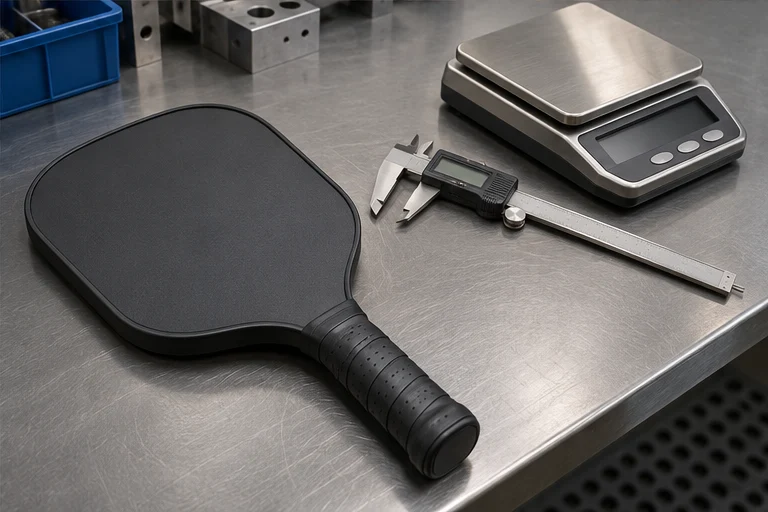
Gloperti inspection record: NY-261114
This Gloperti sample inspection record and reference photos illustrates how to document individual checks. The published record does not identify the sample’s manufacturing process, the weighing configuration or the exact thickness reference point.
| Sample ID | Measurement point | Spec limit | Recorded result | Disposition |
|---|---|---|---|---|
| NY-261114 | Paddle weight, configuration undocumented | 230 g max | 225 g per inspection record. Reference photo shows 230 g. | Meets the recorded upper limit |
| NY-261114 | Paddle section, exact point undocumented | 16.5 mm max | 16.1 mm recorded | Meets the recorded upper limit |
The caliper photo displays 16.10 mm at the pictured section. Each disposition applies only to its recorded measurement. Overall approval requires the full inspection plan.
3. Tie the production order to the approved sample
Ask for the face layup, center core, perimeter reinforcement, tooling arrangement and sample ID on the same specification. Set measurement points and tolerances with the supplier. Agree on what requires a new sample, such as a change to resin, core, perimeter material or layup. Use the pickleball paddle OEM first-order checklist to record approvals before production.
Xiamen SiPinTengYue Sport Co., Ltd. (Gloperti) manufactures thermoformed T700 carbon fiber pickleball paddles for OEM projects. Request a thermoformed pickleball paddle sample. In your message, include your target thickness, finished weight range, intended market and first-order quantity. Ask which existing platform fits your brief, what the sample will cost and which inspection documents are available.
Conclusion
Thermoforming is a sheet-shaping process in plastics manufacturing. In a paddle quote, the term usually describes a heated molding or consolidation step for a composite assembly. When a supplier writes “thermoformed,” ask what goes into the mold, what comes out, and which checks the finished sample must pass.
References
- Occupational Safety and Health Administration. Plastics Machinery: Thermoforming Machines.
- Toray Industries. 2500 Prepreg System.
- University of Michigan, Visual Encyclopedia of Chemical Engineering Equipment. Thermoforming.
- Formlabs. Introduction to Vacuum Forming.
- A. Aroujalian, M. O. Ngadi and J.-P. Emond. Wall Thickness Distribution in Plug-Assist Vacuum Formed Strawberry Containers. Polymer Engineering & Science, 1997.
- Peter Martin and P. Duncan. The Role of Plug Design in Determining Wall Thickness Distribution in Thermoforming. Polymer Engineering & Science, 2007.
- USA Pickleball. Paddle Certification Updates, 2024.
- Gloperti. Canadian Pickleball Brand Selects T700-5+EPP+EVA Paddle for LVN 01.
Frequently Asked Questions
What is thermoforming in simple terms?
Thermoforming uses heat to soften a thermoplastic sheet so a mold can shape it. The material cools in its new shape, and excess sheet is trimmed away.
What is the difference between thermoforming and vacuum forming?
Thermoforming is the broader group of sheet-forming processes. Vacuum forming is one method that removes air between the heated sheet and the mold so the pressure difference draws the sheet into shape.
What does thermoformed mean on a pickleball paddle?
It usually refers to molding or consolidating a paddle assembly in heated tooling under pressure. Ask the supplier which layers are involved and how the perimeter is constructed.
Do thermoformed pickleball paddles always have a foam core?
No. A thermoformed paddle may use a honeycomb core, a foam core or another specified construction. Perimeter foam and the center core are separate features to confirm on the specification.
What should buyers verify on a thermoformed paddle inspection report?
Check the model revision, lot ID, measurement locations, thickness and weight tolerances, edge and face defect criteria, sample size and lot disposition. Match the report to the approved specification and reference sample.