Choosing between fiberglass and carbon fiber paddle faces is one of the first decisions brand owners and importers make when developing a new pickleball paddle line. This guide compares fiberglass vs carbon fiber pickleball paddles across playing feel, sample evaluation, cost, and product positioning.
For OEM buyers, fiberglass is a practical starting point for value-priced starter sets and recreational lines. Carbon fiber is worth sampling for performance ranges that call for a specific texture, feel, or finish. Compare finished paddles with similar cores, weights, and construction, then request quotes at the same quantity and packaging specification.
Fiberglass vs Carbon Fiber Pickleball Paddles at a Glance
| Buying factor | Fiberglass paddle face | Carbon fiber paddle face |
|---|---|---|
| Face construction | Glass fiber reinforcement in the face laminate | Carbon fiber reinforcement in the face laminate, with options such as woven or textured finishes |
| Product positioning | Starter sets, recreation, and value-focused retail | Performance ranges and premium models sold on a specific playing feel |
| Playing feel | Some builds feel lively. Check drives, blocks, and soft shots. | Some builds feel firm, while others are tuned for a softer response. Test the complete paddle. |
| Spin | Depends on the finished surface. Test the printed or coated sample. | Textured carbon faces are worth testing. Confirm the texture on the finished sample. |
| Graphics | A candidate for colorful designs. Approve the actual print and finish. | Visible weave or texture can be part of the design. Check artwork contrast on the finished face. |
| Cost | Often a starting point for a lower unit cost | Varies with material specification, layup, finish, and manufacturing process |
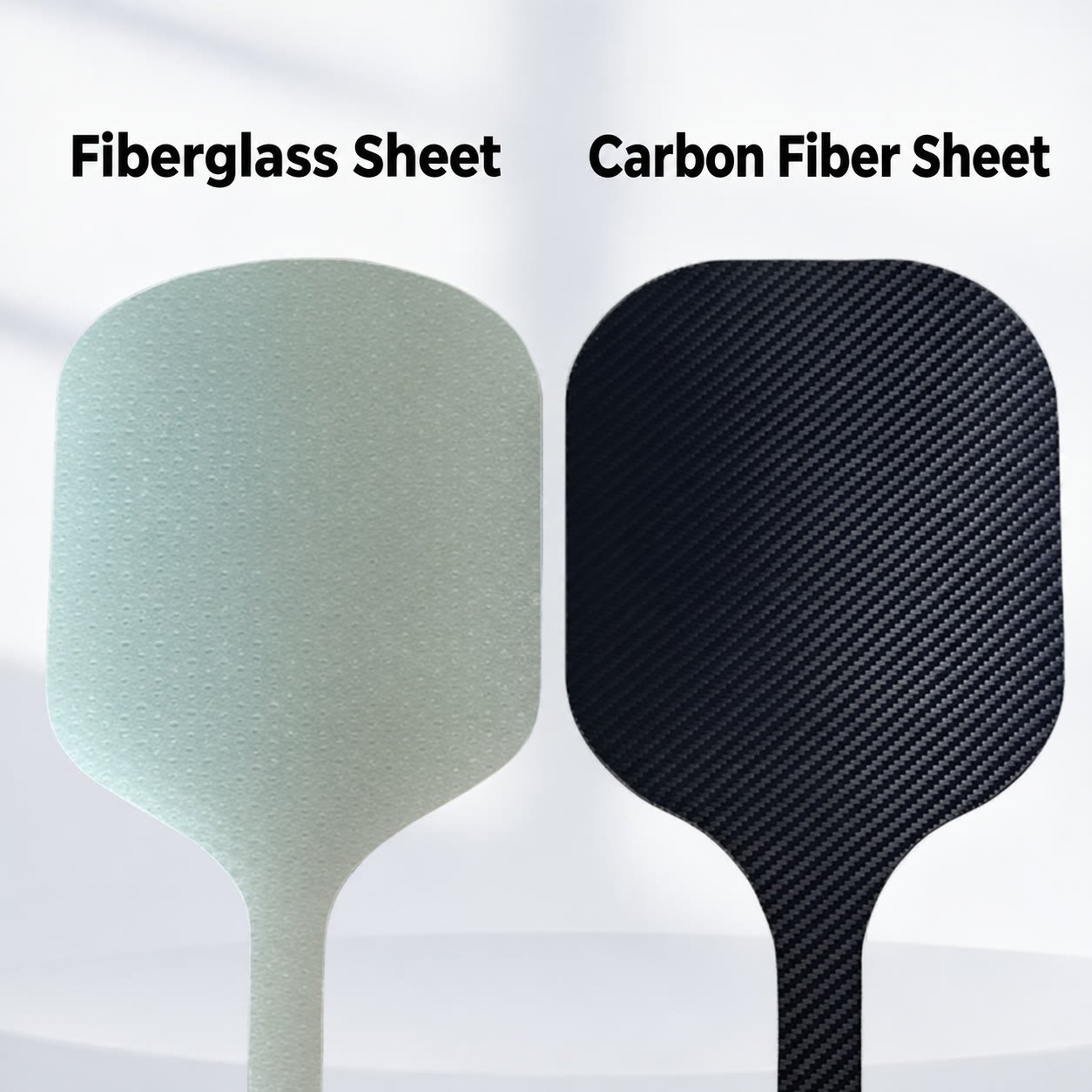
The face is one part of the paddle. Core thickness, shape, weight distribution, and surface finish all influence how it plays. Explore our guide to pickleball paddle materials and core options for a broader look at construction.
Fiberglass Pickleball Paddle Pros and Cons
Where fiberglass works well
Fiberglass is worth quoting when a product needs to reach a target retail price or include accessories within a fixed budget. Examples include two-paddle starter sets, family recreation kits, club programs, and promotional projects. For these products, comfortable grips, consistent weight, and complete packaging can all influence customer satisfaction.
If artwork carries much of the product’s appeal, ask for a sample with your actual logo, colors, and finish. Check fine text, solid color areas, and artwork edges. Use the digital mock-up to approve placement and the finished sample to approve appearance.
What buyers should verify
Test the response on soft shots and off-center contact, especially for beginner models. If your product description promises a specific feel or grip on the ball, evaluate the surface after printing and coating. For a set, handle both paddles side by side and check for consistency in weight and grip.
Carbon Fiber Pickleball Paddle Pros and Cons
Where carbon fiber works well
Carbon fiber is worth sampling when the paddle has a defined role in a performance range. You might want a control-oriented model with a particular touch at the net or a premium model with a visible weave that complements understated artwork. Give the factory a target playing feel, weight range, and finish so it can propose a construction to evaluate.
If you are comparing woven options, see our guide to 3K, 12K, and 18K carbon fiber paddle faces for what the designations describe and what to verify on the sample.
What buyers should verify
Ask which reinforcement the factory uses, where it sits in the layup, and how the hitting surface is finished. Use a visible weave to approve appearance and match the material specification and build sheet to the sample ID to confirm the agreed construction.
Check artwork contrast on the finished face, particularly with small lettering or thin lines. If you plan to market the model around spin or control, evaluate those qualities with the proposed graphics and surface treatment in place. Record the conditions and observations before using them in product copy.
How to Compare Fiberglass and Carbon Fiber Paddle Samples
Start with two builds that are as similar as your supplier can make them. Match the shape, core material and thickness, grip dimensions, and target weight range where possible. Record any differences in molding process, perimeter construction, or finish so you can interpret the results as a comparison of the complete builds.
Record the finished specifications
| What to record | How to use it |
|---|---|
| Sample ID and revision | Match each paddle to its photos, quote, and specification sheet. |
| Face material and finish | Record the specified reinforcement, visible texture, coating, and print method. |
| Core and construction | Note the core material, thickness, molding process, and perimeter reinforcement. |
| Weight and balance | Weigh each finished paddle and measure balance from the same handle reference point. |
| Grip and dimensions | Measure overall length, width, grip length, and grip circumference using the same method. |
| Artwork and packaging | Photograph both faces and check the colors, logo placement, and packaging against approved artwork. |
Test the shots your target customers play
Use the same ball type and court conditions. Ask the same testers to alternate paddles on serves, drives, blocks, resets, and dinks. Record specific observations, such as how easily a tester keeps a block low or how the paddle feels on contact toward the edge. For an entry-level set, include testers who resemble the intended buyers.
Report informal spin comparisons as tester observations. Numerical spin claims need a repeatable measurement method. Once you choose a build, record the approved sample ID, revision, and tolerances so the factory and your inspection team can refer to them during production and repeat orders.
Fiberglass vs Carbon Fiber Pickleball Paddle Cost
Fiberglass is a sensible starting point for a price-sensitive project. The price gap depends on the complete build. A printed fiberglass starter paddle and a textured, thermoformed carbon model differ in several cost drivers at once.
Ask for two quotes at the same order quantity, artwork scope, accessories, packaging, and trade terms. Keep the shape, core, and production process comparable where possible. Ask the supplier to list any construction or finish changes separately.
| Quote item | What to confirm |
|---|---|
| Paddle unit price | Face, core, thickness, process, and weight tolerance included in the build |
| Artwork | Printing on both sides and how multiple graphics affect the order |
| Packaging and accessories | Single paddle or set, balls, covers, and retail box |
| MOQ | Minimum per model and any separate requirements for graphics or packaging |
| Sample and tooling | Sample fee, freight, order credit, and any separate mold charge |
| Delivery terms | Quoted terms and additional costs needed to calculate landed cost |
See our pickleball paddle manufacturing cost breakdown for more detail on the choices that affect pricing.
Which Paddle Face Fits Your Product Line?
Entry-level sets and promotional programs
Start by sampling fiberglass if you need an accessible retail price with room for balls, covers, or a printed box. Set a target price for the complete kit and check grip comfort, paddle weight, and print quality against first-time buyers’ expectations.
Everyday retail and private-label ranges
Sample both options if you are deciding where to position your main retail model. Evaluate what the carbon build adds in playing feel or finish and how it affects landed cost. If you carry both, a fiberglass two-paddle set can serve new players and a carbon fiber single paddle can serve players looking for a specific feel or surface.
Premium and performance models
Start with the playing characteristics you want. Carbon fiber may fit the brief if you want a defined texture or visible weave. Confirm the material specification, finished appearance, and playing feel through samples. If your channel requires an approved paddle, verify the status of the exact finished model before making an approval claim.
For carbon-specific projects, explore our custom carbon fiber pickleball paddle manufacturing options.
Frequently Asked Questions
Is fiberglass or carbon fiber better for beginner pickleball paddles?
Fiberglass is a practical starting point for budget-friendly beginner sets, and either material can suit a beginner. Compare the finished paddle’s grip size, weight, balance, and ease of use on short shots.
Do carbon fiber pickleball paddles always generate more spin?
Either face material can produce spin, depending on the finished surface and how the player strikes the ball. Test printed or coated samples under the same conditions.
Can fiberglass and carbon fiber paddles use the same core?
Yes. Both can use a polypropylene honeycomb core. For a useful side-by-side comparison, confirm the core grade, thickness, and molding process as well.
Does a visible carbon weave confirm the face material?
A visible weave confirms the appearance. Verify the reinforcement using the supplier’s material specification and the build sheet for that sample.
What should I send a factory for a comparable quote?
Send the same quantity, paddle specification, artwork, packaging, and trade terms for both materials. Include your target market and landed price, and ask the factory to list any construction differences separately.