How to Choose a Pickleball Paddle Manufacturer Supplier: Complete OEM & Sourcing Guide
A practical sourcing guide for choosing a reliable pickleball paddle manufacturer supplier for OEM, ODM and private-label production.
Focus Keyword: pickleball paddle manufacturer supplier
Commercial Intent: OEM, ODM, private label and wholesale sourcing
Introduction
Finding a capable pickleball paddle manufacturer supplier is one of the most important decisions behind a successful paddle brand. The supplier affects far more than the factory price. It influences product consistency, development speed, packaging quality, compliance, delivery reliability, customer reviews and the ability to reorder the same model months later.
This guide is designed for sports brands, distributors, wholesalers, ecommerce sellers, clubs and promotional-product companies that want OEM, ODM or private-label pickleball paddles. It explains how to compare suppliers, prepare a clear specification, evaluate samples, understand quotations, control production and build a dependable long-term sourcing relationship.
A strong supplier should operate as an extension of the buyer’s product team. That means asking the right technical questions, documenting every approved detail, warning the buyer about unrealistic choices and protecting quality from raw material through final shipment.
Manufacturer, Supplier or Trading Company: What Is the Difference?
A manufacturer owns or directly controls production processes such as lamination, cutting, thermoforming, printing, handle assembly and packaging. A supplier may be a factory, a trading company or a hybrid organization that coordinates several specialized facilities. A trading company can still be useful when it provides strong project management, technical knowledge and quality control, but buyers should understand who performs each process.
For basic logo printing on an existing model, a supplier with access to a stable factory may be sufficient. For exclusive construction, tighter tolerances or a long-term product family, direct process control becomes more important. Ask which operations are completed in-house, which are outsourced and who is responsible when a defect occurs.
The correct choice depends on the project. A large direct factory may have higher minimums and less flexibility, while an experienced smaller supplier may manage low-volume customization more effectively. The goal is not to choose a label; it is to choose a partner with transparent control, documentation and accountability.
Define Your Product Before Requesting Quotes
Suppliers cannot provide comparable quotations when the product brief is vague. Before contacting a pickleball paddle manufacturer supplier, define the target customer, expected retail price, sales market, construction, face material, thickness, shape, handle size, target weight, graphics, packaging and order quantity.
A useful request-for-quotation document should state whether the paddle is recreational, junior, intermediate, performance or tournament-oriented. It should also describe the intended sales channel, because retail stores, Amazon fulfillment, club programs and promotional campaigns can require different packaging and labeling.
Include measurable information wherever possible. “Lightweight” is subjective, while “220 to 230 grams” is clear. “Long handle” is vague, while a 140-millimeter handle is measurable. Precise information reduces quotation changes and shortens the sampling process.
Evaluate Technical Knowledge, Not Just Sales Responses
A reliable supplier should be able to explain how face material, core thickness, shape, balance and construction affect the finished paddle. The sales team does not need to be a laboratory, but it should be supported by engineers or production managers who can answer technical questions accurately.
Ask why a particular material is recommended for the target player. Ask what changes when moving from 13 millimeters to 16 millimeters, from fiberglass to raw carbon fiber, or from traditional sandwich construction to thermoforming. The quality of these answers reveals whether the supplier is simply quoting available models or genuinely understands product development.
Be cautious when every request receives an immediate “yes.” Responsible suppliers identify risks, explain minimums, request clarification and document trade-offs before sampling.
Compare Paddle Materials and Construction Options
Polypropylene honeycomb is widely used for modern pickleball paddle cores because it offers a useful combination of weight, feel, durability and manufacturing consistency. However, cell size, density, core thickness, adhesive distribution and lamination quality all influence performance.
Fiberglass faces can provide lively rebound and accessible pricing. Graphite can support low weight and a responsive feel. Carbon fiber is commonly selected for stiffness, durability, premium positioning and textured spin surfaces. Terms such as T300, T700, 3K, 12K and 18K should be supported by a complete material and layup specification rather than used only as marketing language.
Thermoformed paddles can deliver a more integrated perimeter and a firmer response, but the process requires controlled heat, pressure, curing and inspection. Traditional construction may be better for some control-focused or value-oriented products. The right choice depends on the target player and retail strategy.
Check the Supplier’s Customization Capability
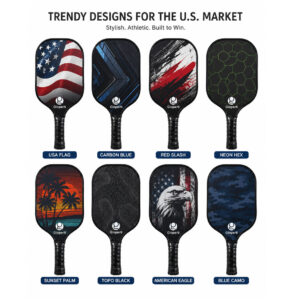
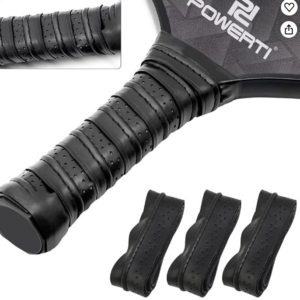
Customization ranges from simple logo printing to a fully exclusive product. Common options include two-sided UV graphics, custom face material, thickness, outline, grip color, edge-guard color, end cap, weight range, handle length, packaging, labels and accessories.
A custom pickleball paddle manufacturer should provide an accurate artwork template with bleed, safe zones and alignment references. The template must match the approved paddle drawing. Artwork should not be finalized until dimensions and handle position are confirmed.
Ask which changes are cosmetic and which require tooling or structural development. Cosmetic changes generally support lower minimums and faster delivery. Exclusive molds, unusual layups or custom thermoforming can require higher quantities, engineering work and additional testing.
MOQ: Understand What Drives Minimum Order Quantity
MOQ is influenced by material purchasing, printing setup, tooling, production scheduling, packaging and the level of customization. A stock paddle with a custom logo can normally be produced in a smaller quantity than a new shape or exclusive structure.
When comparing MOQs, confirm whether the number applies per model, per color, per graphic or per thickness. A quotation for 500 pieces may still require 250 pieces per design. Packaging suppliers may also have separate minimums for color boxes, printed bags or custom inserts.
Gloperti supports selected private-label paddle programs from approximately 50 pieces, subject to construction and packaging. Low MOQ is useful for market testing, but buyers should also compare the expected price at 100, 300, 500 and 1,000 pieces to plan future reorders.
How to Read and Compare Supplier Quotations
A professional quotation should identify the exact model, specification, unit price, quantity, packaging, sample cost, tooling, lead time, payment terms, Incoterm and quotation validity. It should also state whether taxes, testing, inspection and shipping are included.
Do not compare only the headline unit price. One supplier may include a cover and retail box while another quotes a bare paddle in a polybag. Another may use a different carbon layer or grip. Build a comparison sheet that standardizes every component and commercial term.
Ask for carton dimensions, gross weight and quantity per carton. These details affect freight, storage and fulfillment cost. The cheapest ex-factory price can become the most expensive landed cost when packaging is inefficient or defects create returns.
Sample Development and Approval Process
Sampling should follow a controlled sequence: written brief, specification confirmation, artwork mockup, physical sample, evaluation, revision and signed approval. Avoid approving only by photos when performance or fit matters.
Inspect the sample for dimensions, static weight, balance, handle length, grip circumference, edge fit, surface finish, print alignment, color, sound, feel and packaging. Test several paddles when possible, because one sample cannot demonstrate production consistency.
Write feedback in measurable terms and identify the version clearly. Approved samples should be retained by both buyer and supplier. The final specification, artwork and approval record must be linked to the purchase order.
Quality Control Before, During and After Production
Quality control begins with incoming materials. Core sheets, carbon fiber, fiberglass, adhesives, grips, edge guards and packaging should match the approved sample and specification. Substitution should require written buyer approval.
In-process checks should cover cutting, lamination, curing, thermoforming, handle assembly, edge bonding, printing and grip installation. Finished-goods inspection should verify appearance, dimensions, weight, balance, flatness, handle security, edge fit and packaging accuracy.
The buyer should define tolerances and defect classifications. Critical defects may include structural separation, sharp edges, loose handles, incorrect branding or safety issues. Major defects may include severe print misalignment, incorrect weight or obvious cosmetic damage. A pre-shipment inspection is especially valuable for large or first-time orders.
Production Capacity and Lead-Time Reliability
Capacity claims should be evaluated carefully. Ask about normal monthly output, peak-season workload, key equipment, number of production lines and how urgent orders are managed. A supplier with huge theoretical capacity may still miss deadlines if materials or packaging are not scheduled correctly.
Lead time should be divided into sample development, material preparation, production, packaging and inspection. Confirm when the clock starts. In most projects, production lead time begins only after deposit, artwork approval and final sample confirmation.
Reliable suppliers communicate delays early and provide a recovery plan. Buyers can reduce risk by placing orders before peak season, approving packaging quickly and maintaining realistic forecasts.
Packaging, Covers and Accessory Coordination
Packaging is part of the product, not a final afterthought. Options include neoprene paddle covers, Oxford-cloth bags, PVC bags, drawstring bags, kraft boxes, color boxes, header cards, manuals and ecommerce cartons.
A pickleball paddle cover manufacturer should receive the approved paddle outline and edge thickness so the cover fits correctly. Zippers, seams, handle openings and logo positions should be sampled with the actual paddle.
For bundles, confirm balls, grip tape, edge tape, bags and inserts before finalizing carton size. Packaging should protect the surface during transport, communicate key specifications and scan correctly through the intended retail or fulfillment system.
Compliance, Testing and Claims
Tell the supplier where the product will be sold and how it will be marketed. Tournament approval, retailer requirements, country-of-origin marking, chemical compliance and packaging labels may differ by market.
If formal governing-body approval is required, the exact submitted model must complete the applicable process. A supplier can manufacture to stated dimensional requirements, but approval should not be claimed until it is officially granted.
Marketing claims should be supported by evidence. Avoid guaranteed spin, power or professional-performance statements without a documented test method. Accurate claims reduce returns and protect the brand.
Communication and Change Control
Many sourcing problems are communication problems disguised as factory defects. Use one controlled specification, one current artwork file and one clear approval channel. Important decisions should be confirmed in writing.
Every change should identify the affected model, version, quantity, cost and delivery impact. A color adjustment that looks minor may require new printing plates or another sample. A grip change can alter total weight and balance.
Good suppliers maintain records and repeat the approved product. Buyers should avoid sending conflicting instructions through multiple chat groups or staff members.
Payment Terms, Incoterms and Shipping
Common payment structures include a deposit before production and balance before shipment. Terms vary according to relationship, order value and risk. Make sure the purchase order identifies payment milestones and the conditions for releasing the balance.
Incoterms define cost and responsibility. EXW, FOB, CIF and DDP quotations cannot be compared directly without understanding what is included. Ask for the loading port, shipping method, destination charges and required customs documents.
Before shipment, confirm the commercial invoice, packing list, carton marks, product labels, HS code guidance and final carton data. Keep enough time for inspection and document correction.
Red Flags When Selecting a Supplier
Red flags include quotations that lack specifications, prices far below the market without explanation, refusal to provide samples, frequent changes in material descriptions, unclear production responsibility and promises that ignore technical limitations.
Also watch for poor version control, slow answers to quality questions, inconsistent company names on documents and unwillingness to confirm tolerances. A polished website cannot replace traceable process control.
One mistake does not automatically disqualify a supplier. The key question is how the supplier identifies the cause, communicates the problem and prevents recurrence.
How to Build a Long-Term Supplier Relationship
Long-term sourcing becomes easier when both sides share forecasts, document standards and review performance. Track on-time delivery, defect rate, response speed, sample accuracy and corrective-action quality.
Provide realistic order plans and consolidated feedback. Pay according to agreed terms and communicate market changes early. In return, expect stable materials, transparent pricing, production records and continuous improvement.
A dependable supplier can help expand a product line with related thicknesses, junior paddles, covers, sets and accessories while maintaining a consistent brand identity.
Why Work With Gloperti
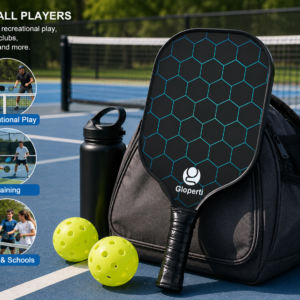
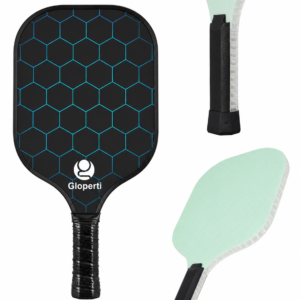
Gloperti, operated by Xiamen ShiPinTengYue Sports Co., Ltd., supports OEM, ODM and private-label sports-product projects for brands, distributors and ecommerce sellers. Available pickleball paddle options include carbon fiber and fiberglass faces, multiple thicknesses, standard and elongated shapes, two-sided UV printing, custom grips, edge colors and packaging.
The team can assist with visual mockups, sample development, low-MOQ programs, coordinated covers and export packaging. Specifications are confirmed according to the target player, price point and sales market.
Prepare your logo, preferred material, thickness, quantity and packaging idea, then visit Gloperti Custom Pickleball Racket Manufacturing to request a proposal.
Conclusion
The best pickleball paddle manufacturer supplier is not simply the company offering the lowest price. It is the partner that understands the product, documents the specification, produces consistent samples, controls production and communicates honestly.
Buyers can reduce risk by defining the product clearly, comparing quotations on the same basis, approving measurable standards and inspecting production before shipment. This approach protects margin, brand reputation and reorder consistency.
Whether the project is a low-MOQ private-label launch or a complete performance paddle range, disciplined supplier selection turns sourcing into a repeatable commercial system rather than a series of surprises.
Frequently Asked Questions
What is the difference between a pickleball paddle manufacturer and supplier?
A manufacturer directly controls production, while a supplier may be a factory, trading company or hybrid project manager. The important factors are transparency, technical capability, quality control and accountability.
What MOQ should I expect for custom pickleball paddles?
MOQ depends on the model and customization. Existing platforms with custom graphics can support lower quantities, while exclusive molds, structures and packaging require higher minimums.
Can a supplier make both carbon fiber and fiberglass paddles?
Yes. Many OEM suppliers offer fiberglass, graphite and carbon-fiber constructions in several thicknesses and shapes.
How should I compare paddle quotations?
Compare the exact material, construction, weight tolerance, printing, packaging, accessories, Incoterm, lead time and inspection terms rather than comparing unit price alone.
Should I order a sample before production?
Yes. A physical sample should be checked for dimensions, weight, balance, grip, print, performance and packaging before mass production is approved.
Can suppliers provide custom covers and retail boxes?
Yes. Neoprene covers, Oxford bags, PVC packaging, drawstring bags, color boxes, labels and instruction cards can be coordinated with the paddle order.
How can I reduce quality risk?
Use a written specification, retain an approved sample, define tolerances and defects, require in-process checks and arrange pre-shipment inspection.
How long does production take?
Lead time varies by materials, quantity, customization and packaging. It should be confirmed after the sample, artwork and deposit are approved.
Request a Custom Paddle Proposal
Send Gloperti your target model, material, quantity and artwork requirements.
Ready to Source the Right Paddle?
Whether you need OEM/ODM manufacturing, wholesale pricing, or a custom branded paddle – we’re here to help. Get a free quote within 24 hours.