Wholesale and Private Label Carbon Fiber Pickleball Paddle Supplier Guide
The pickleball market has moved far beyond simple recreational paddles. Retailers, sports brands, clubs, academies, distributors, promotional-product companies, and e-commerce sellers now expect paddles that combine attractive design, consistent performance, dependable quality, and commercially practical pricing. That is why choosing the right wholesale carbon fiber pickleball paddle supplier has become a critical sourcing decision rather than a basic purchasing task.
A strong supplier does more than quote a unit price. The right partner should help you select face materials, core thickness, shape, edge construction, grip dimensions, surface texture, packaging, logo application, testing standards, and order quantities. For buyers launching a new brand, a capable private label pickleball paddle supplier can also shorten development time and reduce costly mistakes before mass production.
This guide explains how to evaluate suppliers, compare paddle specifications, plan customization, manage quality, and build a scalable purchasing program for carbon fiber pickleball paddles.
Why Carbon Fiber Paddles Dominate the Premium Market
Carbon fiber has become one of the most requested face materials in the modern pickleball category because it offers a strong balance of stiffness, durability, control, and surface consistency. Compared with basic wood or entry-level fiberglass models, a well-developed carbon paddle can provide a more refined feel and support premium positioning.
For wholesale buyers, carbon fiber also creates useful product segmentation. A supplier can build different collections around:
- 3K woven carbon fiber for a visible textile pattern
- T700 raw carbon fiber for control and spin-oriented models
- 12K carbon fiber for a larger weave appearance
- 18K carbon fiber for distinctive visual merchandising
- Hybrid carbon and fiberglass constructions
- Cold-pressed and thermoformed paddle structures
- 13 mm, 14 mm, and 16 mm core platforms
However, “carbon fiber” alone does not guarantee performance. The face layup, resin system, core density, surface treatment, pressing process, edge reinforcement, and final weight tolerance all influence the result. This is why buyers should compare complete construction details rather than selecting a paddle only from a material label.
What a Wholesale Carbon Fiber Pickleball Paddle Supplier Should Provide
A professional supplier should offer a repeatable product-development and production system. At minimum, buyers should expect clear specifications, transparent sampling, documented quality checks, and stable communication.
1. Multiple Construction Platforms
A useful supplier portfolio should include several proven platforms instead of one generic model. Common options include:
- Standard honeycomb-core carbon paddles
- Elongated paddles for reach and leverage
- Wide-body paddles for a larger sweet spot
- Hybrid-shape paddles for balanced play
- Thin-core power models
- Thick-core control models
- Thermoformed paddles with reinforced perimeter construction
- Paddle sets for retail, training, or family recreation
This allows a buyer to develop good-better-best pricing without starting every model from zero.
2. Clear Bill of Materials
A reliable supplier should be able to explain the paddle’s main components, including face material, core material, core thickness, handle construction, edge guard, grip, end cap, adhesive system, and surface finish.
Vague answers create risk. For example, “carbon paddle, 16 mm” is not enough information for serious product comparison. Buyers need to know whether the face is woven carbon, raw T700 carbon, a carbon-fiberglass blend, or a printed cosmetic layer over another substrate.
3. Private Label and OEM Support
A capable private label carbon fiber pickleball paddle supplier should support brand-specific development, including:
- Custom logo placement
- Full-surface graphic design
- UV printing on both paddle faces
- Custom grip colors
- Branded end caps
- Custom edge-guard colors
- Individual paddle covers
- Retail boxes, sleeves, hangtags, and instruction cards
- Barcode and label application
- Set packaging with balls and accessories
For many buyers, packaging and brand presentation are almost as important as the paddle itself. A technically good product can still underperform at retail if the packaging looks generic or fails to communicate the value clearly.
Understanding Carbon Fiber Face Options
Different carbon face materials serve different price points and customer expectations.
T700 Raw Carbon Fiber
T700 raw carbon fiber is widely used in control-oriented and spin-focused paddles. The textured face can create a premium tactile impression and is often chosen for serious recreational or competitive product lines.
When sourcing from a T700 carbon fiber pickleball paddle supplier, buyers should verify whether the texture comes from the actual face construction or from a temporary surface coating. They should also ask how texture consistency is checked between production batches.
3K Carbon Fiber
3K carbon fiber has a recognizable woven appearance and works well for products where visible material presentation matters. It can be used in mid-range or premium collections depending on the overall construction.
A glossy 3K paddle may look visually dramatic, while a matte finish can create a more technical feel. The supplier should provide finish samples because website photos do not always show reflections and weave depth accurately.
12K and 18K Carbon Fiber
12K and 18K carbon surfaces use larger tow patterns that create a bold visual identity. These options can be valuable for brands seeking differentiation in product photography and retail displays.
The larger weave does not automatically mean a paddle performs better. Buyers should treat 12K and 18K primarily as part of a complete design and construction strategy rather than as a stand-alone performance claim.
Hybrid Carbon Composites
Some paddles combine carbon fiber with fiberglass or other reinforcing layers. Hybrid structures can help tune rebound, stiffness, sound, and price. They are also useful for creating product lines that feel different without changing the entire mold or shape.
Core Thickness: 13 mm, 14 mm, or 16 mm
Core thickness strongly influences how a paddle feels in the hand and performs during play.
13 mm Core
A 13 mm paddle often feels quicker and more direct. It can appeal to players who prefer fast handling and a more responsive strike. For wholesale programs, 13 mm models are commonly positioned as power-oriented or speed-oriented products.
14 mm Core
A 14 mm core offers a middle ground. It can provide a balanced combination of maneuverability, power, and control. This thickness is useful for broad-market models where the target user is not highly specialized.
16 mm Core
A 16 mm paddle is commonly associated with a softer feel, improved control, and greater stability. It is a popular platform for intermediate and advanced paddles, especially when combined with raw carbon fiber.
The best supplier should not simply recommend the most expensive option. It should help match core thickness to the intended customer, selling price, paddle shape, weight, and brand message.
Cold-Pressed vs. Thermoformed Construction
The construction method is another key sourcing decision.
Cold-Pressed Paddles
Traditional cold-pressed paddles can offer dependable performance and competitive pricing. They are suitable for entry-level, intermediate, club, and general retail collections. They also make sense for buyers that need lower development risk or smaller opening quantities.
Thermoformed Paddles
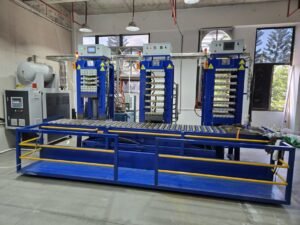
Thermoformed paddles are produced with heat and pressure to create a more integrated structure. Many models also include perimeter reinforcement or foam-injected edges. This can increase stiffness, stability, and power, although the exact result depends on design execution.
When evaluating a thermoformed pickleball paddle supplier, ask about:
- Perimeter reinforcement method
- Foam density and consistency
- Delamination prevention
- Heat and pressure controls
- Handle-to-body connection
- Weight distribution
- Batch testing procedures
Thermoforming should not be treated as a marketing word alone. The supplier needs a controlled process and clear inspection criteria.
Paddle Shape and Playing Position
A custom carbon fiber pickleball paddle should be designed around the target player.
Elongated Shape
Elongated paddles offer extra reach and can support leverage on drives and serves. They are popular in premium and competitive lines. The trade-off may be a narrower hitting area, so weight distribution and sweet-spot tuning matter.
Wide-Body Shape
Wide-body paddles can provide a more forgiving face and are often suitable for beginners, recreational players, and doubles-focused users. They are also practical for paddle sets.
Hybrid Shape
Hybrid paddles combine elements of elongated and wide-body designs. They are useful for buyers seeking a versatile flagship product that can appeal to a broad audience.
Junior and Youth Shapes
Youth paddles should not simply be adult paddles with child graphics. A thoughtful youth platform may use lower weight, a shorter handle, smaller grip circumference, and a more manageable balance point.
Weight, Balance, and Tolerance
Two paddles with the same listed weight can feel very different because balance point matters. A head-heavy paddle may feel powerful but slower, while a handle-biased paddle may feel faster and easier to maneuver.
For production, buyers should define an acceptable weight range. A broad tolerance can create inconsistent customer experiences, especially when consumers purchase multiple paddles or compare online reviews.
A professional supplier should be able to sort finished paddles by weight range when required. For premium programs, buyers may request tighter grouping, such as:
- Lightweight range
- Standard weight range
- Heavy or power range
The tighter the tolerance, the more inspection and sorting may be required, so buyers should discuss cost implications before confirming the purchase order.
Grip Size, Handle Length, and Comfort
Grip construction is often overlooked during sourcing, but it strongly affects user satisfaction.
Key variables include:
- Grip circumference
- Handle length
- Grip material
- Cushion thickness
- Moisture resistance
- Wrap consistency
- End-cap shape
- Butt-cap branding
A larger grip may suit players with bigger hands, while a smaller circumference can be more comfortable for youth, women, or players who prefer to add overgrip. Longer handles may support two-handed backhands, but they also change balance and usable face area.
Samples should be tested by multiple users. A handle that looks correct in a specification sheet may still feel too square, too round, too thick, or too slippery during actual play.
Custom Graphics and Brand Presentation
For private label projects, graphic development should begin after the paddle platform is selected. The mold, face outline, edge guard, and handle dimensions determine the printable area.
Common decoration methods include UV printing, screen printing, water-transfer graphics, decals, and surface coatings. UV printing is popular because it supports detailed full-color artwork and efficient customization.
Buyers should provide vector logos whenever possible and request a digital mockup before sampling. The physical sample should then be checked for:
- Color accuracy
- Logo placement
- Fine-line clarity
- Front-and-back alignment
- Surface feel
- Print adhesion
- Edge coverage
- Barcode readability on packaging
A strong custom pickleball paddle factory should also warn buyers when artwork contains details that are too small or colors that may shift during production.
Packaging Options for Wholesale Programs
Packaging should match the sales channel.
E-Commerce Packaging
E-commerce packaging should protect the paddle while controlling shipping volume. A paddle cover, protective sleeve, compact carton, and strong master carton may be more practical than an oversized retail box.
Retail Packaging
Retail stores may need hangable packaging, visible product information, multilingual warnings, barcode placement, and stronger shelf impact.
Paddle Set Packaging
A pickleball paddle set supplier may offer two-paddle or four-paddle sets with balls, covers, towels, grip tape, or carry bags. Set packaging should include internal separators so paddle faces and edge guards do not rub during transit.
Promotional and Corporate Programs
Promotional buyers may prioritize logo visibility, presentation boxes, event deadlines, and lower per-unit complexity. In these projects, delivery reliability may matter more than advanced performance tuning.
Quality Control: What Buyers Should Inspect
Quality control should be defined before production rather than after problems appear.
Incoming Material Checks
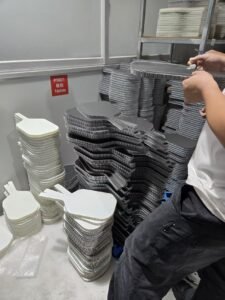
The factory should verify major materials such as carbon sheets, honeycomb cores, edge guards, grips, adhesives, and packaging components.
In-Process Checks
In-process inspection may include:
- Core and face alignment
- Adhesive coverage
- Pressing conditions
- Handle assembly
- Edge-guard bonding
- Surface flatness
- Logo position
- Weight and balance
Final Inspection
Finished paddles should be checked for cosmetic and functional defects, including scratches, bubbles, edge gaps, print errors, loose grips, uneven end caps, abnormal sound, warping, and incorrect packaging.
Buyers should agree on inspection standards and defect classifications. They can also use third-party inspection for larger orders or new supplier relationships.
Sampling Before Mass Production
Sampling is the most important stage for reducing risk. A useful sample process may include:
- Selecting an existing construction platform
- Confirming target shape, thickness, weight, and grip
- Creating a digital artwork mockup
- Producing a physical sample
- Testing appearance and playability
- Revising artwork or specification
- Approving a final pre-production sample
- Starting mass production
Buyers should keep an approved reference sample. This becomes the benchmark for production appearance and basic feel.
For a completely new structure or mold, development time, tooling cost, and testing requirements will be higher. For faster market entry, many brands begin with a validated supplier platform and customize graphics, grip, packaging, and weight range.
MOQ and Order Planning
Minimum order quantity varies according to construction, customization, packaging, and material availability. A simple logo customization on an existing platform may support a lower MOQ than a new mold, special edge guard, custom grip color, or fully customized retail box.
For new brands, a practical launch order often includes a limited number of carefully selected SKUs rather than too many colors and shapes. For example:
- One 16 mm control paddle
- One 13 mm power paddle
- Two graphic colorways
- One two-paddle recreational set
This approach concentrates inventory, simplifies photography, and makes advertising easier to manage.
As demand grows, the buyer can add new materials, shapes, and price tiers.
Lead Time and Production Scheduling
A supplier should separate sample lead time, material preparation, mass production, packaging, inspection, and shipping. Buyers should also account for artwork approval and holiday capacity.
A realistic schedule may include:
- Digital mockup preparation
- Sample production
- Sample shipping and evaluation
- Final specification approval
- Deposit and material preparation
- Mass production
- Final inspection
- Sea, air, rail, or courier delivery
Launching too close to a fixed sales date creates unnecessary risk. Retail promotions, tournaments, crowdfunding campaigns, and seasonal inventory should include schedule buffers.
Compliance, Testing, and Market Claims
Buyers must ensure that marketing claims match actual product construction and testing. Do not use unsupported statements such as “professional grade,” “tournament approved,” or specific performance guarantees without appropriate evidence.
For brands seeking official approval or competition eligibility, confirm the current requirements of the relevant governing body and coordinate documentation, samples, and testing before mass production. Approval rules and product lists may change, so this should be handled as a separate compliance project rather than assumed from the supplier’s generic product description.
Packaging may also need country-specific labeling, importer information, material warnings, recycling marks, or language requirements.
How to Compare Supplier Quotations
The lowest quotation is not always the lowest total cost. Compare quotations line by line.
Important comparison points include:
- Face material and layup
- Core type and thickness
- Construction method
- Paddle dimensions
- Weight tolerance
- Grip specification
- Printing method
- Paddle cover
- Retail packaging
- Included accessories
- Sample cost
- Tooling or setup fees
- MOQ per design
- Carton quantity
- Production lead time
- Quality inspection
- Shipping terms
A cheap quote may exclude covers, retail boxes, logo setup, sorting, testing, or export packaging. Ask every supplier to quote against the same written specification.
Red Flags When Choosing a Supplier
Watch for suppliers that:
- Refuse to provide detailed specifications
- Use the same sample photos as unrelated companies
- Change material descriptions during negotiation
- Promise every option at an unrealistically low price
- Cannot explain their quality-control process
- Avoid discussing weight tolerance
- Rush buyers into mass production without sample approval
- Provide inconsistent answers about production location
- Cannot support packaging or barcode requirements
- Offer unsupported approval claims
Good suppliers are usually willing to explain trade-offs. They may not agree to every request, but they should communicate what is technically practical and commercially realistic.
Building a Long-Term Private Label Program
The strongest sourcing relationships develop through repeatable systems. After the first successful order, document all approved details:
- Product specification sheet
- Artwork files and color references
- Packaging dielines
- Label locations
- Weight range
- Inspection standard
- Carton dimensions
- Spare-parts policy
- Reorder lead time
This makes repeat orders faster and reduces variation. It also allows the buyer and supplier to plan improvements, new colors, seasonal graphics, and upgraded models.
A long-term OEM pickleball paddle manufacturer should be able to support product evolution rather than only duplicate a single order.
Why Work With a Carbon Fiber Pickleball Paddle Supplier in China
China remains a major sourcing base for sporting goods because suppliers can combine composite-material processing, printing, molding, grip production, sewing, retail packaging, and export logistics within established industrial networks.
A capable carbon fiber pickleball paddle supplier in China can support:
- OEM and ODM development
- Low-to-medium MOQ private label programs
- Multiple carbon face options
- Custom graphics
- Paddle covers and bags
- Set packaging
- Pre-shipment inspection
- Consolidated export shipments
The key is supplier qualification. Buyers should evaluate the actual factory capability, sample quality, communication, process control, and commercial reliability rather than choosing only by country or price.
A Practical Supplier Evaluation Checklist
Before placing an order, confirm the following:
- Is the company a manufacturer, trading company, or hybrid supplier?
- Which processes are completed in-house?
- What carbon materials and core thicknesses are available?
- Can the supplier provide construction details?
- Are sample and production specifications documented?
- What is the MOQ per design and per color?
- Can the supplier control weight tolerance?
- Which custom printing methods are available?
- Can it produce custom packaging and paddle covers?
- How are finished paddles inspected?
- What is the sample lead time?
- What is the mass-production lead time?
- Which shipping terms are available?
- Can the supplier support third-party inspection?
- How are quality claims or approval requirements handled?
A supplier that answers these questions clearly is more likely to support a stable commercial program.
Conclusion
Choosing a wholesale carbon fiber pickleball paddle supplier is a product-development decision, a quality-control decision, and a brand decision at the same time. The best partner will help you understand materials, core thickness, construction, shape, grip, graphics, packaging, tolerances, and production planning.
For private label buyers, the goal is not simply to place one order. It is to create a repeatable supply system that can deliver consistent paddles, protect the brand, and support future product expansion.
Start with a detailed specification, approve a physical sample, define inspection standards, and compare complete quotations rather than headline prices. With a capable supplier and disciplined development process, brands can build carbon fiber pickleball paddle collections that are visually distinctive, commercially practical, and suited to their target customers.
For OEM and private label development, visit our custom pickleball paddle page: Custom Pickleball Racket Solutions.
Frequently Asked Questions
What is the best carbon fiber for a private label pickleball paddle?
There is no single best option for every product. T700 raw carbon fiber is commonly selected for control and texture, while 3K, 12K, and 18K carbon can provide different visual and structural characteristics. The right choice depends on target price, construction, player type, and brand positioning.
What is a typical MOQ for custom carbon fiber pickleball paddles?
MOQ depends on the paddle platform, artwork, packaging, material, and level of customization. Logo printing on an existing model usually supports a lower MOQ than a new mold, custom grip, special edge guard, or fully customized box.
Can I put my own logo and graphics on both sides?
Yes. Many suppliers support double-sided UV printing, logo placement, custom colors, branded end caps, paddle covers, and retail packaging. A digital mockup and physical sample should be approved before mass production.
Is a 13 mm or 16 mm paddle better?
A 13 mm paddle often feels quicker and more direct, while a 16 mm paddle generally offers a softer, more stable, control-oriented feel. The best thickness depends on the target player and the rest of the paddle construction.
What is the difference between cold-pressed and thermoformed paddles?
Cold-pressed paddles use a traditional lamination and pressing process. Thermoformed paddles use heat and pressure to create a more integrated structure and may include perimeter reinforcement. Actual performance depends on the complete design and process quality.
How can I verify a supplier’s quality before ordering?
Request detailed specifications, physical samples, production photos or videos, quality-control procedures, weight-tolerance information, and references when available. For larger orders, consider a third-party pre-shipment inspection.
Can a supplier produce paddle sets with balls and bags?
Yes. Many wholesale suppliers can produce two-paddle or four-paddle sets with pickleballs, covers, bags, towels, grip tape, and custom packaging.
How long does private label production take?
Lead time depends on sample approval, material availability, order size, packaging, and factory capacity. Buyers should request a written schedule that separates sampling, mass production, inspection, and shipping.
Should I choose the cheapest supplier?
Not automatically. Compare the complete specification, quality controls, packaging, tolerances, communication, and delivery reliability. A lower unit price can become more expensive if it creates returns, delays, or inconsistent quality.
Can a China supplier support small brands?
Many Chinese suppliers support emerging brands with existing paddle platforms, custom graphics, reasonable MOQs, packaging services, and international shipping. The buyer should still qualify the supplier carefully and approve samples before production.
Looking for a reliable OEM/ODM pickleball paddle manufacturer?
Gloperti specializes in custom pickleball paddle manufacturing — logos, colors, packaging, and specs fully customized for brands, clubs, and retailers.
Ready to Source the Right Paddle?
Whether you need OEM/ODM manufacturing, wholesale pricing, or a custom branded paddle – we’re here to help. Get a free quote within 24 hours.