Meta Title: Pickleball Paddle Manufacturer in China: OEM Buying Guide
Meta Description: Learn how to evaluate a pickleball paddle manufacturer in China for materials, tooling, sampling, quality control, MOQ, certifications, packaging, and reliable OEM production.
How to Choose a Pickleball Paddle Manufacturer in China: A Complete OEM and ODM Buying Guide
Choosing the right pickleball paddle manufacturer in China can determine whether a new paddle line becomes a repeatable, profitable product or an expensive sequence of samples, delays, and quality complaints. Buyers are not simply purchasing a paddle. They are selecting a production partner that must convert a performance concept into a stable commercial product, protect branding, manage material consistency, pass inspections, and deliver on time.
China remains one of the most important sourcing locations for private-label and custom pickleball paddles because its supply chain combines composite materials, honeycomb cores, molding, printing, grip assembly, packaging, and export logistics. However, factories vary significantly. Some specialize in entry-level fiberglass paddles, while others focus on thermoformed carbon fiber models, elongated shapes, edge foam, raw carbon surfaces, or complete retail sets.
This guide explains how importers, sports brands, promotional companies, distributors, and online sellers can evaluate a manufacturer before placing a bulk order.
Why Manufacturer Selection Matters
A paddle may look simple from the outside, but its playing characteristics depend on several interacting variables:
- face material and fiber orientation;
- core material, density, and thickness;
- adhesive system;
- molding pressure and temperature;
- edge construction;
- handle reinforcement;
- total weight and balance;
- surface texture;
- grip dimensions;
- printing and finishing.
Two paddles with the same dimensions can perform differently if the factory changes the core density, resin ratio, curing cycle, edge-wall construction, or final weight tolerance. A reliable manufacturer must control the complete process rather than merely assemble purchased parts.
For a commercial buyer, manufacturer selection affects product reviews, warranty rates, reorder consistency, compliance documentation, launch timing, and brand reputation. The lowest quotation is rarely the lowest total cost when poor sampling, inconsistent production, rework, or late shipment is included.
Define Your Product Before Contacting Factories
Factories give better quotations when the buyer provides a clear product specification. Before requesting prices, prepare a product brief covering the intended customer, price position, performance target, materials, dimensions, packaging, and order volume.
A useful specification should include:
- paddle shape: standard, widebody, hybrid, or elongated;
- face material: fiberglass, graphite, 3K carbon fiber, T700 raw carbon fiber, 12K, 18K, or another composite;
- core thickness: commonly 10 mm, 13 mm, 14 mm, or 16 mm;
- handle length and circumference;
- target weight and acceptable tolerance;
- surface finish and texture;
- edge guard or edgeless construction;
- desired color and artwork;
- logo location;
- packaging type;
- target order quantity;
- required testing or approval;
- expected launch date.
A manufacturer cannot provide an accurate cost for “a high-quality carbon paddle” because that description leaves too many variables undefined. Precise specifications also make quotations from different suppliers easier to compare.
OEM, ODM, and Private-Label Manufacturing
A professional supplier should clearly explain whether it offers OEM, ODM, or private-label production.
OEM manufacturing means the factory produces according to the buyer’s design and specifications. The customer normally controls the branding, artwork, shape, material selection, packaging, and performance requirements.
ODM manufacturing uses an existing factory-developed platform that can be modified. Buyers may change the face artwork, grip, surface, thickness, packaging, or other details without paying for a completely new product design.
Private-label production usually involves selecting a standard paddle and applying the buyer’s logo and packaging. This is often the fastest route for testing a market.
For a new brand, an ODM or private-label platform may reduce development cost and speed up sampling. Established brands may prefer OEM development to create a more differentiated shape, construction, balance, or playing profile.
Evaluate the Manufacturer’s Real Capabilities
A trading company can still be a useful sourcing partner, but buyers should know whether the quoted supplier owns the production line, outsources key steps, or coordinates several factories.
Ask for information about:
- factory location and operating history;
- main product categories;
- production capacity per month;
- number of molding presses;
- printing and finishing equipment;
- quality inspection process;
- engineering and sampling team;
- material suppliers;
- export markets;
- certifications and audit reports;
- recent paddle projects.
Video calls and production videos are helpful, but they should show actual processes rather than only a showroom. A capable pickleball paddle manufacturing factory should be able to explain how it controls core cutting, layup, bonding, pressing, trimming, edge installation, handle assembly, grip wrapping, printing, weight sorting, and final inspection.
Compare Paddle Face Materials
Material choice is one of the biggest cost and performance decisions.
Fiberglass
Fiberglass is common in beginner and recreational paddles. It can provide a lively response and allows colorful graphics at a competitive cost. It is suitable for starter sets, school programs, promotional products, and value-focused retail lines.
Graphite
Graphite paddles are often positioned as lightweight and responsive. Buyers should ask the factory to clarify the actual laminate structure because “graphite” can describe several constructions.
3K Carbon Fiber
A 3K carbon surface has a recognizable woven appearance and can support a premium visual presentation. Performance depends on the complete laminate and core construction, not only the visible weave.
T700 Raw Carbon Fiber
T700 raw carbon fiber is widely requested for spin-oriented paddles. The factory should specify the carbon source, surface treatment, peel-ply process, texture method, and production controls. Buyers should not assume every product described as T700 has the same durability or friction performance.
12K and 18K Carbon Fiber
Larger tow carbon materials can create distinctive visual patterns and different stiffness characteristics. Marketing terms such as 12K or 18K should be supported by actual material specifications.
The best manufacturer will discuss trade-offs instead of claiming that one material is ideal for every user.
Select the Right Core Construction
Most modern composite paddles use a polypropylene honeycomb core. Important variables include core thickness, cell size, density, bonding quality, and edge support.
A thinner core generally feels faster and more direct, while a thicker core often provides more stability and a softer response. However, face stiffness, perimeter weighting, shape, and molding method also influence performance.
Ask the manufacturer:
- What is the core material and source?
- What thickness tolerance is maintained?
- How is the core bonded to the face?
- Is the paddle cold pressed or thermoformed?
- Is foam injected around the perimeter?
- How is the handle connected to the paddle body?
- What destructive tests are performed?
- How does the factory prevent delamination and core crush?
A good supplier should be able to provide construction diagrams or sample cut sections where appropriate.
Understand Thermoformed Paddle Production
Thermoforming has become popular for high-performance paddles because it can create a more integrated perimeter and improve structural rigidity. Yet the term is used loosely in the market.
A buyer should confirm whether the paddle uses:
- a unibody carbon wrap;
- perimeter foam;
- a sealed edge wall;
- hot pressing;
- molded handle reinforcement;
- post-molding surface treatment.
Thermoformed construction requires disciplined temperature, pressure, resin, and curing control. Poor processing can cause delamination, excessive stiffness, inconsistent weight, or premature surface failure. Ask for production records, sample testing, and batch traceability.
Review Shape, Dimensions, and Handle Design
Paddle shape affects reach, sweet spot, maneuverability, and packaging.
Common formats include:
- standard shape;
- widebody shape;
- hybrid shape;
- elongated shape;
- junior shape;
- compact-handle shape;
- long-handle shape.
For each design, confirm total length, maximum width, face length, handle length, grip circumference, thickness, edge-guard width, and corner radius.
Handle construction deserves particular attention. A weak handle joint can loosen or break even when the paddle face remains intact. Ask whether the handle uses a molded extension, carbon reinforcement, inserted structure, foam filling, or another method.
The grip should match the target user. Junior paddles and paddles for small hands normally need a smaller circumference, while large-grip models require a thicker finished handle. Grip size should be measured after final wrapping, not only at the bare handle.
Sampling: What a Good Process Looks Like
Sampling is not just for checking artwork. It is the stage where the buyer and manufacturer establish the production standard.
A practical sample process may include:
- digital mockup and specification confirmation;
- material selection;
- blank or structural sample;
- printed appearance sample;
- performance testing;
- packaging sample;
- final pre-production sample;
- signed approval standard.
Record the approved sample’s weight, balance, thickness, dimensions, grip size, surface appearance, texture, artwork position, packaging, and accessories. Keep at least one sealed reference sample.
When reviewing samples, test more than one unit. A single excellent sample does not prove process consistency. Request several units from the same sample batch and compare weight, balance, sound, finish, and playing response.
Quality Control Requirements
A professional pickleball paddle manufacturer in China should have written inspection standards for incoming materials, in-process production, and finished goods.
Important checks include:
- face material verification;
- core thickness and dimensions;
- bonding and delamination resistance;
- paddle flatness;
- weight and balance;
- handle alignment;
- grip circumference;
- edge-guard fit;
- artwork color and registration;
- surface defects;
- logo accuracy;
- packaging condition;
- barcode readability;
- carton strength;
- drop testing when required.
Define acceptable quality limits before production. Cosmetic defects and functional defects should be classified separately. Buyers may use internal inspections, third-party inspections, or both.
For larger orders, consider a pre-production meeting, during-production inspection, and pre-shipment inspection. Inspection should be based on the approved specification and reference sample, not a vague standard of “good quality.”
Weight and Balance Tolerances
Paddle weight is a major customer-facing specification. If a listing states a narrow weight range but production varies widely, buyers may receive complaints.
Discuss:
- target average weight;
- acceptable minimum and maximum;
- weight sorting method;
- balance point tolerance;
- packaging weight;
- whether grip and edge variations affect the final range.
Factories can often sort finished paddles into weight groups. This is useful when a brand sells light, standard, and heavy versions or when professional customers require tighter consistency.
Do not focus on weight alone. Two paddles with the same total weight can feel different when one is head-heavy and the other is handle-balanced.
Artwork, Printing, and Brand Protection
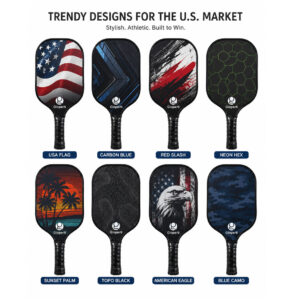
Common decoration methods include UV printing, screen printing, water transfer, decals, spray finishing, textured coatings, and direct surface graphics. The correct method depends on the face construction, desired texture, quantity, and design.
Provide vector artwork, color references, logo dimensions, bleed requirements, and placement instructions. Request a digital proof and a physical sample.
For brand protection:
- sign a manufacturing or confidentiality agreement when appropriate;
- define artwork ownership;
- restrict unauthorized production;
- control logo files;
- use unique packaging and traceable batch markings;
- register trademarks in relevant markets.
The factory should not substitute colors, materials, or printing methods without written approval.
Packaging and Set Configuration
Packaging affects perceived value, shipping cost, damage rates, and marketplace compliance.
Options may include:
- individual polybag;
- paddle cover;
- neoprene cover;
- drawstring bag;
- Oxford fabric bag;
- retail color box;
- two-paddle set bag;
- four-paddle family set;
- master carton;
- custom insert.
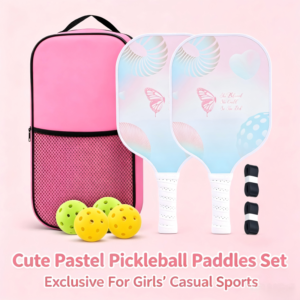
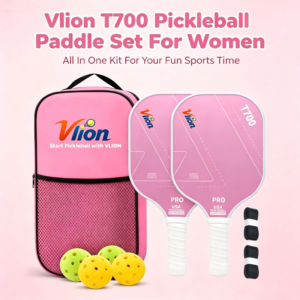
A complete pickleball set may include paddles, indoor balls, outdoor balls, covers, replacement grips, edge tape, or instructions.
Ask for carton dimensions and gross weight before ordering because packaging can materially affect freight cost. For e-commerce, conduct drop and compression testing suitable for parcel delivery.
MOQ, Tooling, and Price Structure
Minimum order quantity depends on customization depth. A logo-only project may allow a lower MOQ than a custom shape, special mold, unique laminate, or exclusive packaging.
Request a quotation that separates:
- unit price;
- sample fee;
- mold or tooling fee;
- printing setup;
- packaging cost;
- accessories;
- testing fees;
- inspection fees;
- freight;
- payment terms.
A low unit price may exclude packaging, texture, edge foam, premium grip, barcode labeling, or export cartons. Compare quotations using the same specification.
Buyers should also ask whether the supplier can support a pilot order before a large production run. A controlled first order is often more valuable than negotiating the absolute lowest MOQ.
Production Lead Time and Capacity
Lead time should be divided into clear stages:
- artwork approval;
- material preparation;
- sample production;
- bulk production;
- inspection;
- packaging;
- shipment booking.
Ask how lead time changes during peak seasons and whether the quoted capacity is reserved. A factory producing for many customers may have strong equipment but limited available capacity.
Build schedule buffers for revisions, testing, inspection, and logistics. Product launches should not rely on the most optimistic production estimate.
Certifications and Market Compliance
Requirements vary by destination and sales channel. Buyers should identify applicable labeling, chemical, packaging, consumer-product, and sports-approval requirements.
Depending on the product and market, documentation may include:
- material declarations;
- test reports;
- social or factory audits;
- packaging compliance;
- restricted-substance testing;
- country-of-origin labeling;
- product traceability;
- sports governing-body approval.
A supplier’s old test report may not apply to your exact construction. Confirm the model, materials, date, laboratory, and scope.
Avoid advertising a paddle as approved unless the exact model has completed the required process and authorization remains valid.
Red Flags When Evaluating Suppliers
Be cautious when a supplier:
- refuses to provide clear material specifications;
- changes the construction description between conversations;
- quotes far below comparable factories without explanation;
- promises every certification immediately;
- cannot explain its quality process;
- avoids live production verification;
- offers famous brand designs without authorization;
- cannot provide consistent samples;
- requests full payment under unusual terms;
- frequently changes the company receiving payment;
- refuses third-party inspection;
- gives unrealistic lead times.
One red flag may have an innocent explanation, but several together justify additional due diligence.
Supplier Comparison Scorecard
Use a weighted scorecard instead of choosing only by price.
Suggested categories:
| Category | Suggested Weight |
|---|---|
| Technical capability | 20% |
| Sample quality | 20% |
| Quality-control system | 15% |
| Communication and response | 10% |
| Price competitiveness | 10% |
| Lead time and capacity | 10% |
| Compliance support | 5% |
| Packaging capability | 5% |
| Financial and company verification | 5% |
Score each supplier using evidence. Sample quality and technical competence should normally carry more weight than a small price difference.
Questions to Ask Before Placing an Order
Ask the shortlisted manufacturer these questions:
- Which paddle constructions are produced in-house?
- Which steps are outsourced?
- What face and core materials are available?
- Can you provide material specifications?
- What are your standard weight and thickness tolerances?
- How do you test bonding and handle strength?
- Can you make thermoformed and cold-pressed models?
- What is the MOQ for logo, custom artwork, custom shape, and custom packaging?
- What is the sample process and cost?
- What is the production lead time?
- Can you support third-party inspection?
- What batch records are maintained?
- What export markets do you currently serve?
- Can you provide a production video or factory audit?
- How are defective units handled?
The quality of the answers is often as important as the answers themselves.
Building a Long-Term Manufacturing Partnership
The best sourcing results usually come from repeatable systems. Provide complete specifications, approve samples carefully, communicate changes in writing, and share realistic forecasts.
A strong manufacturer can help with material selection, engineering, artwork, packaging, cost optimization, and future product development. In return, buyers should avoid last-minute changes, unclear approvals, and constantly shifting requirements.
After each production run, review defect data, customer feedback, returns, delivery performance, and improvement opportunities. Continuous improvement creates better margins than repeatedly changing suppliers to save a few cents.
Why Work With an Experienced Custom Paddle Partner
An experienced custom manufacturer can support multiple market positions, from fiberglass beginner sets to advanced carbon fiber paddles. Important capabilities include rapid visual mockups, sample development, flexible branding, material options, stable quality control, export packaging, and scalable production.
For custom dimensions, face materials, thicknesses, artwork, logo printing, grips, covers, and retail packaging, explore Gloperti’s custom pickleball racket manufacturing service.
A good supplier should treat your project as a defined product-development program, not simply a logo-printing order.
Conclusion
Choosing a pickleball paddle manufacturer in China requires more than comparing quotations. The buyer must verify technical capability, material transparency, sampling discipline, quality systems, weight control, packaging, capacity, and compliance support.
Start with a detailed specification. Evaluate multiple samples. Use a supplier scorecard. Define inspection standards before production. Confirm every commercial term in writing.
When the manufacturer understands the desired playing characteristics and has the process control to reproduce them, the result is a paddle line that can scale with fewer defects, stronger customer reviews, and more reliable reorders.
Frequently Asked Questions
What is the normal MOQ for custom pickleball paddles?
MOQ depends on the level of customization. Logo-only or existing-mold projects may start at a relatively low quantity, while custom molds, special carbon structures, unique grips, or retail packaging usually require higher volumes.
How long does custom paddle production take?
Lead time includes artwork approval, sampling, material preparation, bulk production, inspection, and packaging. A realistic schedule should also include time for sample revisions and shipping.
Is T700 carbon fiber always better than fiberglass?
No. T700 carbon fiber and fiberglass serve different product positions. Carbon models often emphasize control and spin, while fiberglass can provide lively response and strong value. Construction quality matters more than the material name alone.
What should I test in a paddle sample?
Check dimensions, thickness, weight, balance, handle strength, grip size, surface texture, artwork, edge fit, sound, playing response, and packaging. Test multiple units to evaluate consistency.
Should I use a third-party inspection company?
Third-party inspection is useful for first orders, large orders, complex products, or new suppliers. The inspection standard should reference the approved sample and written specifications.
Can a manufacturer help with paddle design?
Many OEM and ODM manufacturers can support shape selection, artwork, material combinations, packaging, and sample development. Confirm which design services are included and who owns the final files and tooling.
What is the difference between cold-pressed and thermoformed paddles?
Cold-pressed paddles generally bond components under controlled pressure without the same integrated hot-molded perimeter used in thermoformed construction. Thermoformed paddles may include a unibody wrap and perimeter foam, but exact construction varies by factory.
How can I reduce the risk of inconsistent bulk production?
Use detailed specifications, approve a pre-production sample, define tolerances, inspect during production, retain reference samples, and require written approval for material substitutions.
What packaging is best for e-commerce?
Protective individual packaging, a fitted paddle cover or set bag, clear labeling, and a strong export carton are common. Packaging should be tested for parcel delivery and optimized for shipping dimensions.
How do I verify that a factory is legitimate?
Review business registration, factory address, payment account, audit documents, production videos, export history, samples, and references. Use live video verification and third-party audits when appropriate.
Looking for a reliable OEM/ODM pickleball paddle manufacturer?
Gloperti specializes in custom pickleball paddle manufacturing — logos, colors, packaging, and specs fully customized for brands, clubs, and retailers.
Ready to Source the Right Paddle?
Whether you need OEM/ODM manufacturing, wholesale pricing, or a custom branded paddle – we’re here to help. Get a free quote within 24 hours.