T700 & thermoformed tungsten weighted tape for pickleball paddles Pickleball Paddle Manufacturer: Complete OEM Sourcing Guide
Focus Keyword: t700 pickleball paddle manufacturer
For sporting-goods brands, distributors, Amazon sellers, clubs and promotional-product buyers, choosing a pickleball paddle supplier is no longer a simple matter of selecting a shape and printing a logo. Modern buyers compare face materials, core thickness, thermoforming methods, swing weight, grip geometry, packaging, compliance documentation and batch-to-batch consistency. A capable T700 pickleball paddle manufacturer must therefore combine material knowledge with disciplined process control and practical OEM service.
This guide explains how to source T700 carbon us pickleball paddle manufacturers-fiber paddles, thin-core speed paddles, thermoformed performance paddles, wholesale paddle programs, wooden entry-level paddles and youth youth pickleball paddle manufacturers models. It also addresses search phrases such as RTS pickleball paddle manufacturer and Selkirk pickleball paddles manufacturer. Those phrases often reflect buyer research into recognized market styles; they should not be interpreted as a claim that Gloperti manufactures for, represents or is affiliated with any third-party brand.
Gloperti, operated by Xiamen ShiPinTengYue Sports Co., Ltd., supports custom paddle development with material selection, visual design, prototyping, logo application, packaging and quality inspection. Standard development options can include carbon fiber or fiberglass faces, 10 mm, 13 mm and 16 mm cores, approximately 400 x 190 mm profiles, weights around 230 g, two-sided UV graphics and custom packaging. Final specifications remain subject to the approved sample and purchase agreement.
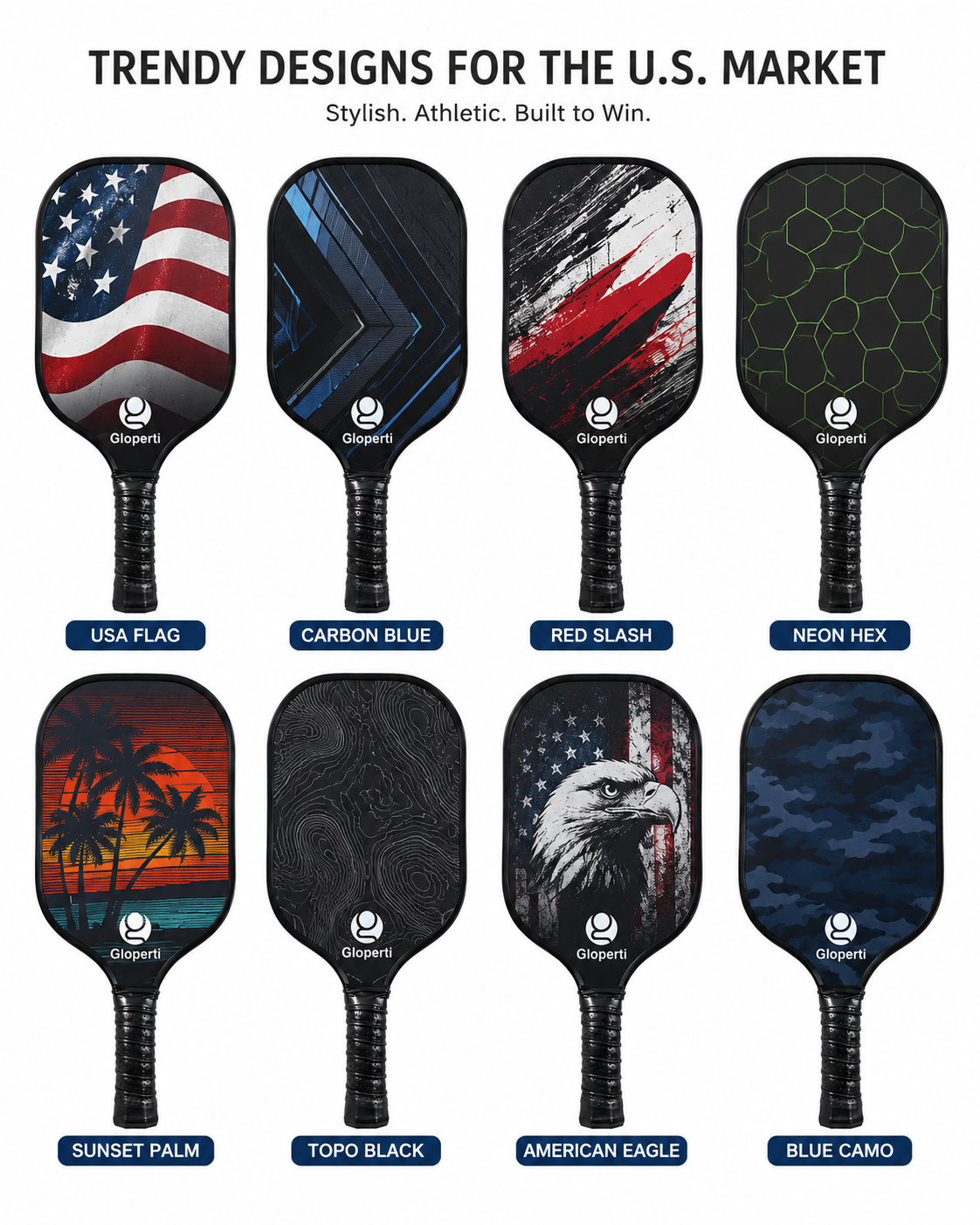
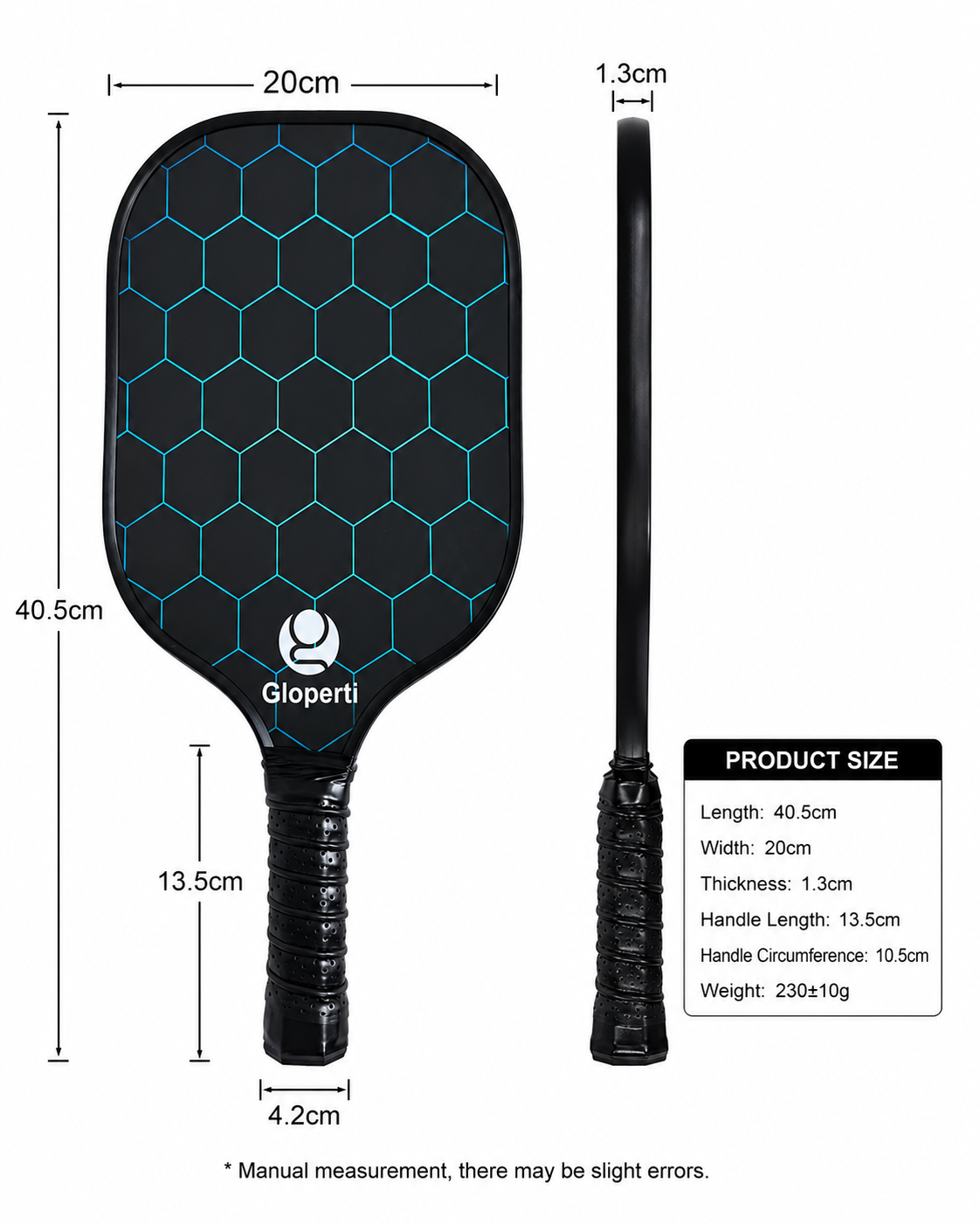
Table of Contents
- Why T700 Carbon Fiber Has Become a Core OEM Material
- Selecting a T700 Thin Core Pickleball Paddle Manufacturer
- What a Thermoformed Pickleball Paddle Manufacturer Should Control
- RTS Pickleball Paddle Manufacturer Searches: What Buyers Usually Mean
- Understanding “Selkirk Pickleball Paddles Manufacturer” as a Search Intent
- Building a Wholesale Pickleball Paddle Manufacturer Program
- When a Wooden Pickleball Paddle Manufacturer Is the Right Choice
- Designing with a Youth Pickleball Paddle for Kids Manufacturer
- OEM and ODM Customization Options
- Quality Control Checklist for Paddle Buyers
- How to Compare Manufacturer Quotations Correctly
- Recommended Development Workflow
- Why Source Custom Pickleball Paddles from Gloperti
- Frequently Asked Questions
Why T700 Carbon Fiber Has Become a Core OEM Material
T700 is widely requested because it offers a useful combination of strength, stiffness and weight efficiency. In paddle construction, the user experiences the complete laminate and surface treatment rather than the carbon designation alone. Resin content, fiber orientation, peel-ply texture, bonding quality and core support all influence feel and durability.
A professional T700 pickleball paddle manufacturer should be able to explain the face layup, confirm whether the requested finish is raw, coated or printed, and control cosmetic consistency across a production batch. Buyers should request a physical sample instead of approving only a digital rendering. The sample should be evaluated for surface texture, balance, edge finishing, handle comfort, sound and visual alignment.
T700 is especially attractive for private-label programs positioned around spin, crisp response and premium appearance. However, a material name should never replace measurable specifications. The purchase specification should identify face construction, core material and thickness, overall dimensions, target weight range, grip circumference, handle length, edge-guard type, graphics method and packaging.
Selecting a T700 Thin Core Pickleball Paddle Manufacturer
Thin-core paddles are commonly associated with faster rebound, quick hand battles and a more direct impact sensation. A T700 thin core pickleball paddle manufacturer may offer 10 mm, 13 mm or 14 mm constructions depending on tooling and target performance. The thinner the core, the more important it becomes to control flatness, bonding and perimeter support.
Brands should define the intended player before choosing thickness. A 10 mm model can suit speed-focused recreational products, while a 13 mm model can provide a middle ground between response and control. A 14 mm model may be used when the buyer wants a relatively quick paddle with slightly more dwell time. The face, foam or perimeter treatment, handle reinforcement and total swing weight must be considered together.
During sampling, test more than one unit. Weigh each paddle, measure thickness at several locations, check the face for waviness, inspect the edge guard and compare balance points. A supplier that can produce one attractive prototype but cannot maintain a controlled tolerance is not ready for a serious wholesale launch.
What a Thermoformed Pickleball Paddle Manufacturer Should Control
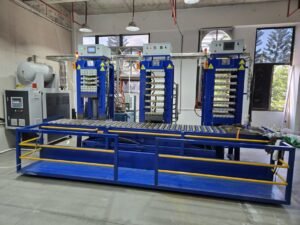
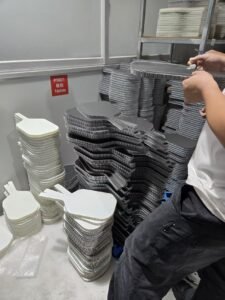
Thermoforming is often used to create a more integrated paddle structure. Depending on the design, heat and pressure may be applied to consolidate the face, core, perimeter and edge components. Some constructions also use perimeter foam or reinforced sidewalls. The commercial benefit is a premium construction story and a firmer, more connected response, but the process requires stable tooling and strict temperature, pressure and curing control.
A thermoformed pickleball paddle manufacturer should document process settings, adhesive or resin handling, mold maintenance and in-process inspection. Common risks include delamination, trapped air, uneven edges, core crushing, excessive resin, inconsistent foam expansion and dimensional drift. Buyers should ask how the factory performs adhesion checks, dimensional checks and destructive sampling.
Thermoforming does not automatically make every paddle better. A successful product still depends on the target user. A control-oriented 16 mm paddle should not be evaluated by the same criteria as a fast 13 mm paddle. Define the intended feel first, then let construction support that objective.
RTS Pickleball Paddle Manufacturer Searches: What Buyers Usually Mean
The phrase RTS pickleball paddle manufacturer can be used in different ways. Some buyers use RTS to mean ready-to-ship, while others may be searching for a model, seller or brand reference. For sourcing purposes, the most useful interpretation is a supplier with stock or semi-custom paddle platforms that can be produced quickly after artwork and packaging approval.
A ready-to-ship or low-development program can reduce launch risk. The buyer selects an existing mold, face material, core thickness, grip color and packaging option, then adds private-label artwork. This approach usually has a shorter sample cycle and lower tooling cost than a fully custom mold.
Even for an RTS program, do not skip approval samples or quality standards. Stock construction may still vary between production lots, and artwork alignment must be checked on the actual paddle geometry.
Understanding “Selkirk Pickleball Paddles Manufacturer” as a Search Intent
Searches for a Selkirk pickleball paddles manufacturer frequently come from buyers studying premium paddle categories, construction trends or supply-chain options. Selkirk is a third-party brand, and this article does not claim any manufacturing, authorization or commercial relationship with that company.
The practical lesson for private-label buyers is to analyze product attributes rather than copy protected branding. Study shape, handle proportion, weight distribution, core thickness, face texture, packaging experience and target player. Then create an original specification and original artwork that fit your own brand positioning.
Responsible OEM development protects trademarks, graphics and product identity. A legitimate manufacturer should decline requests to reproduce another brand's logo or confusingly similar design without authorization.
Building a Wholesale Pickleball Paddle Manufacturer Program
A wholesale pickleball paddle manufacturer should support more than unit pricing. The program must align specifications, minimum order quantity, carton packing, labeling, barcodes, spare components, inspection and shipping documentation. For importers, stable landed cost and repeatability are often more important than the lowest initial quotation.
Start by separating sample cost from production cost. Confirm whether quotations include artwork setup, molds, packaging, barcode labels, testing, export cartons and freight. Ask for pricing at realistic volume tiers such as 50, 100, 300, 500 and 1,000 units. This shows how labor, materials and packaging affect the scale curve.
For mixed-SKU programs, confirm whether the MOQ applies per color, per graphic, per construction or per total order. A factory may allow one paddle construction to carry several graphics, but each artwork requires setup and process control. A written SKU matrix prevents confusion.
- Approved specification sheet and golden sample
- Target weight and dimensional tolerances
- Artwork files with placement dimensions
- Packaging dieline and labeling requirements
- Inspection standard and acceptable quality level
- Production lead time and change-control procedure
- Replacement or claim process for verified defects
When a Wooden Pickleball Paddle Manufacturer Is the Right Choice
Wooden paddles remain relevant for schools, camps, community centers, promotional programs and entry-level sets. A wooden pickleball paddle manufacturer can offer cost-effective products that are easy to understand and robust for shared use. Common constructions use plywood with printed or painted graphics, edge finishing and a wrapped handle.
The key quality points differ from carbon-fiber paddles. Buyers should inspect board thickness, moisture control, flatness, edge sanding, splinter prevention, coating adhesion, handle attachment and print durability. A low price is not useful if rough edges or poorly sealed wood create a safety or appearance problem.
Wooden sets can be bundled with indoor or outdoor balls, a carry bag and simple instructions. For promotional orders, screen printing or UV printing may be selected according to artwork, quantity and budget.
Designing with a Youth Pickleball Paddle for Kids Manufacturer
A youth pickleball paddle for kids manufacturer should adapt the product to smaller hands and lower strength levels rather than simply applying children's graphics to an adult paddle. Important variables include weight, grip circumference, handle length, balance, edge protection and overall length.
For younger players, a lighter paddle can reduce fatigue and make basic technique easier. The grip should allow a secure hold without excessive squeezing. Rounded edges, secure end caps and consistent handle wrapping are important. Artwork can be colorful and playful, but ink and coating systems should be suitable for the intended market and documented when required.
Schools and academies may prefer numbered sets, color coding, replacement grips and durable bags. Retail products may benefit from age guidance, safety statements and clear dimensions on the package. The buyer remains responsible for confirming applicable rules and testing requirements in the destination market.
OEM and ODM Customization Options
An experienced manufacturer can provide a platform-based OEM program or a broader ODM development process. OEM usually starts with an existing shape and construction. ODM may involve a new shape, handle design, layup, surface system or packaging concept. The correct route depends on budget, timeline and differentiation goals.
Gloperti customization can include original graphics, customer logos, two-sided UV printing, grip and edge-guard colors, carbon-fiber or fiberglass faces, multiple core thicknesses and packaging such as PVC bags, Oxford cloth bags or neoprene covers. A typical private-label MOQ may begin around 50 paddles for suitable existing constructions, but the actual MOQ depends on materials, artwork, packaging and production schedule.
Provide vector artwork whenever possible. Define Pantone or other color references, but approve colors on physical material because carbon texture, coatings and lighting change perceived color. The golden sample should be signed or otherwise formally approved before production.
Quality Control Checklist for Paddle Buyers
Quality control should begin before production, not after cartons are sealed. The supplier and buyer should agree on measurable requirements and visual defect standards. During production, incoming materials, lamination, trimming, printing, handle assembly and packing each need checkpoints.
A practical inspection combines measurements with functional evaluation. Weight and dimensions can be recorded numerically. Surface flaws, print registration and edge finishing require visual criteria. Adhesion and durability may require destructive or accelerated tests. Retain samples from each lot for traceability.
For products marketed as approved for organized competition, do not rely on a factory statement alone. Approval programs and equipment lists can change, and the brand owner should verify the current rules directly with the relevant governing body before making claims or printing approval marks.
- Overall length, width and thickness
- Unit weight and weight distribution
- Face flatness and surface consistency
- Logo position, color and print adhesion
- Edge-guard fit and perimeter finish
- Handle alignment, grip overlap and end-cap security
- Core or face bonding and abnormal sound
- Packaging accuracy, barcode readability and carton count
How to Compare Manufacturer Quotations Correctly
Two quotations are comparable only when they describe the same product. A lower price may use a different carbon layer, lower-cost core, simpler surface finish, wider weight tolerance, thinner grip, basic packaging or reduced inspection. Ask each supplier to quote against one controlled specification.
Evaluate communication quality as part of the quotation. Does the supplier identify missing details? Do they explain trade-offs? Are sample and production lead times realistic? Can they provide photos or records from key production stages? Fast answers are useful, but accurate answers are more valuable.
A good sourcing decision balances product cost, defect risk, lead time, intellectual-property discipline, flexibility and after-sales support. The cheapest unit can become the most expensive program when returns, delays or inconsistent reorders are included.
Recommended Development Workflow
Begin with a commercial brief that defines customer, price position, playing style and sales channel. Convert the brief into a technical specification. Select two or three candidate constructions rather than trying to perfect everything in one sample. Test the samples, document feedback and approve a golden sample.
Before mass production, freeze the bill of materials, artwork, packaging and tolerances. Request a pre-production sample when any material or artwork changes after the original approval. During production, use milestone photos or inspections. For the first order, consider a final random inspection before shipment.
After launch, collect structured customer feedback. Separate cosmetic feedback from performance feedback and defect reports. Use that data to improve the next production version without creating uncontrolled changes.
- Define target user and price tier
- Create technical specification and artwork brief
- Select construction and packaging options
- Produce and evaluate samples
- Approve golden sample and quality criteria
- Run production with in-process control
- Inspect, ship and collect market feedback
Why Source Custom Pickleball Paddles from Gloperti
Gloperti supports brands and wholesale buyers that need practical customization without unnecessary complexity. Our team can help translate a product idea into an executable paddle specification, visual mock-up, sample and production plan. We focus on clear communication, original branding and repeatable manufacturing.
Available project directions include T700 carbon-fiber paddles, fiberglass recreational paddles, thin-core models, 16 mm control-oriented models, youth paddles, wooden paddle sets and customized packaging. Buyers can discuss logo placement, graphics, grip colors, covers, set configurations and carton requirements.
Every project should begin with your target market, quantity, preferred construction, artwork and required delivery date. Visit our custom pickleball racket page to share your specifications and request a tailored quotation.
Request a Custom Pickleball Paddle Quote
Frequently Asked Questions
What does a T700 pickleball paddle manufacturer produce?
A T700 pickleball paddle manufacturer produces paddles using T700 carbon-fiber face materials or laminates, combined with a polymer or other approved core, handle, edge system, graphics and packaging. Exact construction should be confirmed in the specification and sample.
Is a T700 thin core paddle suitable for every player?
No. Thin-core paddles often feel quicker and more direct, but some players prefer the softer response and control of a thicker core. The right choice depends on playing style, weight, balance and complete construction.
What is a thermoformed pickleball paddle?
It is a paddle manufactured with heat and pressure to consolidate selected structural components. Designs vary, so buyers should ask the supplier to explain the actual layup, perimeter treatment and quality controls.
Can I order wholesale pickleball paddles with my logo?
Yes. Private-label programs can include custom graphics, logos, colors, grip options, packaging and set configurations. MOQ and pricing depend on the selected construction and customization.
Does Gloperti manufacture Selkirk pickleball paddles?
This article makes no claim that Gloperti manufactures for or is affiliated with Selkirk or any other third-party brand. Gloperti develops original private-label products based on the buyer’s authorized specifications and artwork.
Are wooden pickleball paddles still useful?
Yes. Wooden paddles are useful for schools, camps, promotions, community programs and affordable starter sets, provided the wood, edges, handle and finish are properly controlled.
What should a kids pickleball paddle manufacturer change?
A youth paddle should use an age-appropriate weight, smaller grip, suitable handle length, safe edge finishing and durable graphics. It should not be merely an adult paddle with children’s artwork.
What is the typical MOQ for custom paddles?
For suitable existing constructions, a private-label program may start around 50 paddles, but the exact MOQ depends on materials, artwork, packaging, SKU count and factory schedule.
Conclusion
The best manufacturing partner is not simply the factory with the longest material list. It is the supplier that can convert your commercial goal into a controlled specification and repeat that specification through sampling, production, inspection and reorder. Whether you need a T700 pickleball paddle manufacturer, a T700 thin core pickleball paddle manufacturer, a thermoformed pickleball paddle manufacturer, a wholesale pickleball paddle manufacturer, a wooden pickleball paddle manufacturer or a youth pickleball paddle for kids manufacturer, insist on clear documentation and physical approval samples.
Use third-party brand searches only as market research, create original products and verify any compliance claim before publication. With a disciplined development process, private-label paddle buyers can launch differentiated products while reducing avoidable quality and supply-chain risk.
Next step: Discuss your custom pickleball paddle project with Gloperti.
Related Topics: Learn more about thick core pickleball paddles manufacturers,
women’s pickleball paddle fiberglass manufacturers,
where are joola pickleball paddles manufactured, and
which is the best pickleball paddle manufacturers.
Looking for a reliable OEM/ODM pickleball paddle manufacturer?
Gloperti specializes in custom pickleball paddle manufacturing — logos, colors, packaging, and specs fully customized for brands, clubs, and retailers.
Ready to Source the Right Paddle?
Whether you need OEM/ODM manufacturing, wholesale pricing, or a custom branded paddle – we’re here to help. Get a free quote within 24 hours.