When comparing 3K vs 12K vs 18K carbon fiber pickleball paddles, it is tempting to assume that a higher number means a better paddle. For brands, importers, and wholesale buyers, that assumption can lead to unnecessary costs and misleading product descriptions.
The K number identifies the number of individual carbon filaments in a bundle, known as a tow. It does not independently establish the paddle’s quality, stiffness, spin, or durability.
A useful comparison must look beyond the visible carbon pattern. Fiber grade, fabric construction, resin, laminate thickness, core design, surface finish, and manufacturing consistency all contribute to the finished product.
This guide explains what 3K, 12K, and 18K mean, how to compare them, and what to confirm before ordering custom carbon fiber pickleball paddles.
What Do 3K, 12K, and 18K Carbon Fiber Mean in Pickleball Paddles?
Carbon fiber fabric is made using bundles of fine carbon filaments. The letter “K” means thousand:
- 3K carbon fiber: approximately 3,000 filaments per tow.
- 12K carbon fiber: approximately 12,000 filaments per tow.
- 18K carbon fiber: approximately 18,000 filaments per tow.
These bundles can be woven into fabrics with different patterns and specifications. However, tow size alone does not describe the complete fabric.
For example, two materials advertised as 12K carbon may differ in fiber grade, fabric weight, weave architecture, resin content, and finished thickness. They may therefore produce different results when used in a paddle face.
The practical takeaway: K count is a material specification, not a complete performance rating.
3K vs 12K vs 18K Carbon Fiber: Comparison Table
The following table separates what the K number tells you from what still requires verification.
On smaller screens, swipe the table left or right to see all columns.
| Comparison Point | 3K Carbon Fiber | 12K Carbon Fiber | 18K Carbon Fiber |
|---|---|---|---|
| Filaments per tow | Approximately 3,000 | Approximately 12,000 | Approximately 18,000 |
| Tow size | Smaller filament bundle | Larger than 3K | Larger than 12K |
| Potential visual appearance | Often a finer woven pattern | Often a broader woven pattern | Often a more pronounced woven pattern |
| Guaranteed stiffness level | Not determined by K count | Not determined by K count | Not determined by K count |
| Guaranteed spin advantage | None from K count alone | None from K count alone | None from K count alone |
| Guaranteed paddle weight | Not determined by K count | Not determined by K count | Not determined by K count |
| Best purchasing approach | Review the full specification and test samples | Review the full specification and test samples | Review the full specification and test samples |
The visible pattern also depends on tow spreading, weave design, and finishing. A photograph is useful for discussing appearance, but it cannot verify the underlying fiber grade or laminate quality.
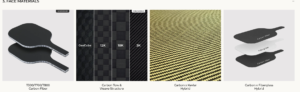
What Do 3K, 12K, and 18K Carbon Fiber Paddle Faces Look Like?
These product images, supplied and labeled by Gloperti, show the visible face appearance of three finished paddle models. Compare the surface pattern and graphics as examples of finished-product presentation.
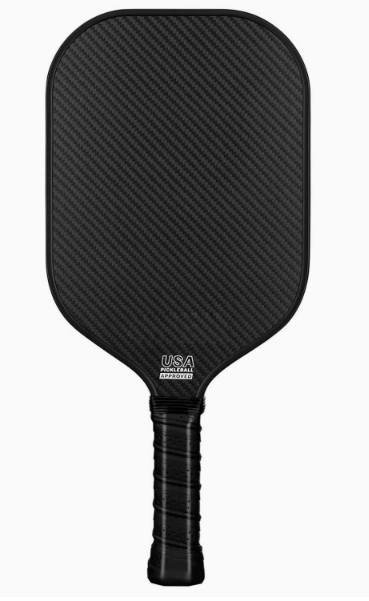
Model identified as 3K by Gloperti.
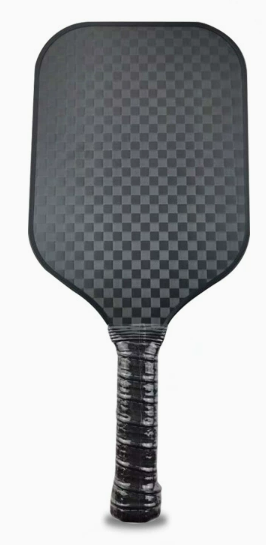
Model identified as 12K by Gloperti.
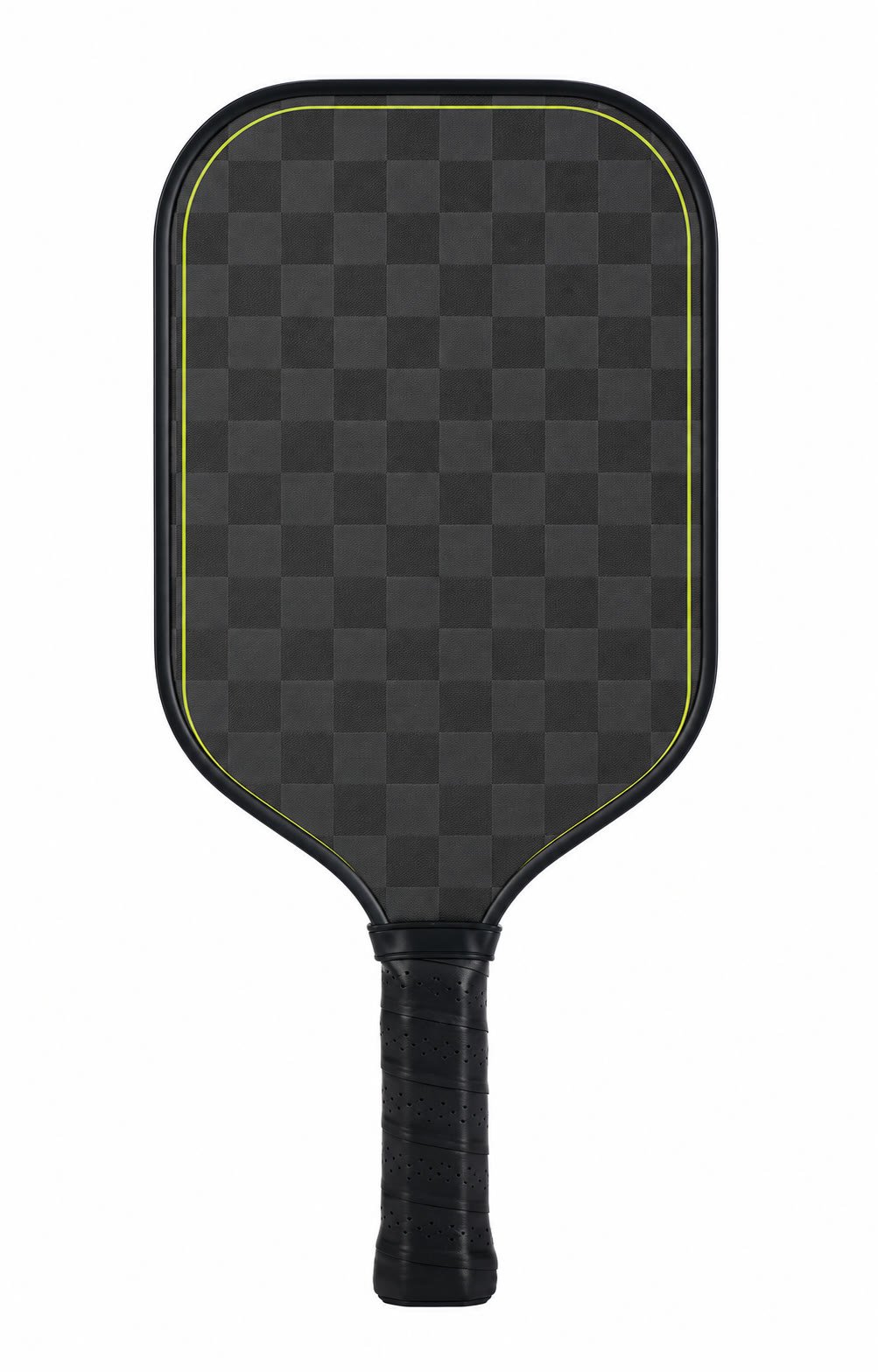
Model identified as 18K by Gloperti.
Image source: Gloperti-supplied product images, identified as 3K, 12K, and 18K. Lighting, camera angle, image resolution, and reproduction scale differ. Images are fitted to equal display areas for readability, not calibrated to a common physical scale. They do not establish relative weave dimensions, fiber grade, performance, or current tournament approval. Material identity should be supported by supplier documentation.
How Does Carbon Fiber Tow Size Affect a Pickleball Paddle Face?
Tow size influences how a fabric can be designed and processed. Its effect on a finished paddle depends on the complete construction.
Does Carbon Tow Size Change the Visible Weave?
Conventional 3K woven fabrics often show a finer pattern than fabrics made with larger bundles. A 12K or 18K fabric may create a bolder visual effect.
This can matter when developing a branded collection. Some customers prefer a subtle carbon appearance, while others want a more visible woven face.
However, graphics, coatings, and surface treatments can cover or alter the appearance. Approve the finished sample rather than choosing from an unfinished fabric photograph.
Fabric Handling and Lamination
Different fabrics can behave differently during cutting, layup, resin impregnation, and molding. The manufacturer must select a process suitable for the actual material.
For buyers, the useful question is: Can the factory consistently reproduce the approved face construction across the production order?
Ask about material identification, layup records, bonding controls, and inspection procedures. These details are more useful than a general promise that one K count is “more advanced.”
Does a Higher K Number Change Paddle Response?
A paddle face is a composite structure made from fibers and resin, supported by a core. Its response cannot be predicted from the tow label alone.
Changing fabric construction may affect the laminate, but any comparison must also account for face thickness, fiber orientation, resin content, and the rest of the paddle.
If a supplier claims that an 18K paddle is more powerful than a 3K paddle, ask whether the core, weight, balance, shape, surface, and manufacturing process are the same.
Without that information, the comparison does not isolate the carbon material.
What Factors Affect Carbon Fiber Pickleball Paddle Performance?
A useful carbon fiber paddle comparison evaluates the whole product.
1. Fiber Grade
Fiber grade and tow size describe different characteristics.
A designation such as T700 identifies a fiber product or grade family, while 3K, 12K, and 18K identify filament counts per tow. They should not be treated as competing categories.
Toray’s T700S technical documentation, for example, lists multiple tow sizes within the same fiber designation. This illustrates why a grade name and a K number answer different questions.
If your project requires a specific branded fiber, request supporting material documentation. A woven appearance alone cannot confirm the supplier or grade.
For a closer explanation of fiber designation versus tow size, read T700 vs 3K carbon fiber explained.
For related manufacturing options, explore our T700 carbon fiber paddle options.
2. Face Layup and Thickness
The face may contain multiple layers with different materials and fiber orientations.
Ask the supplier to clarify:
- The materials used in the outer and inner layers.
- Whether the stated K count applies only to the visible outer layer.
- Fabric weight and finished face thickness.
- The layup used for samples and mass production.
- Whether the construction includes fiberglass or other reinforcement.
Layer count by itself is also incomplete. Two thin layers are not automatically stronger or stiffer than one thicker layer.
3. Resin and Bonding Quality
The resin binds fibers together, while the face-to-core bond allows the components to work as a structure.
Inconsistent impregnation, curing, or bonding can undermine an otherwise suitable material selection. Buyers should review how the manufacturer controls the process and evaluates bonding quality.
A premium carbon label cannot compensate for poor assembly.
4. Core Construction
Core material, thickness, geometry, and support influence the paddle’s response.
When comparing samples, document the core specification. A different core can change the result enough to make a simple “3K versus 18K” comparison misleading.
Avoid assuming that every paddle with the same nominal thickness uses the same internal construction.
5. Surface Finish
The visible weave and the ball-contact surface are not necessarily the same thing.
Surface texture may be influenced by peel-ply processing, resin, coatings, printing, and finishing. A larger carbon pattern does not automatically create more usable grip on the ball.
For a spin-focused product, evaluate the actual finished surface and its consistency after use. Any quantified spin claim should be supported by a defined test method.
6. Weight, Balance, and Shape
Players experience the complete paddle in motion.
Static weight, balance, swing weight, head shape, handle length, and grip size can all affect usability. If these differ between samples, the player may notice those changes more than the carbon weave.
Our carbon fiber pickleball paddle manufacturing services allow buyers to discuss face materials alongside these broader construction requirements.
Is 18K Carbon Fiber Better Than 12K or 3K?
Choose the option that meets your product brief, sample evaluation, quality requirements, and landed-cost target. Ask the supplier to explain any trade-offs in fabric construction or processing, rather than selecting a material by its label alone.
Which Carbon Fiber Should Your Brand Choose: 3K, 12K, or 18K?
Start with the intended product rather than the largest K number.
On smaller screens, swipe the table left or right to see all columns.
| Product Goal | What to Prioritize | How to Evaluate the Carbon Option |
|---|---|---|
| Accessible carbon paddle range | Reliable construction, manageable cost, consistent quality | Compare complete quotations and approved samples |
| Control-focused collection | Predictable response, suitable balance, comfortable handling | Test different face constructions on comparable paddle platforms |
| Power-focused collection | Required response, stability, durability, and weight distribution | Evaluate the full structure rather than selecting by K count |
| Distinctive visual collection | Visible weave, graphics compatibility, finish consistency | Approve a finished appearance sample |
| Spin-focused collection | Finished surface texture and performance retention | Test surface behavior and wear using a consistent method |
| Private-label range with several models | Clear product differences and repeatable specifications | Define each model by measurable features and validated benefits |
For a first collection, a smaller number of well-defined models is often easier to explain and control than several paddles differentiated only by K labels.
Through custom pickleball paddle development, buyers can align materials, shape, thickness, weight, graphics, and packaging around a clear product brief.
How Can Buyers Compare Carbon Fiber Paddle Supplier Quotations?
A quotation for a “12K carbon paddle” is not detailed enough to compare with another supplier’s offer.
Before evaluating prices, request a shared specification covering:
On smaller screens, swipe the table left or right to see all columns.
| Specification | What to Confirm |
|---|---|
| Carbon material | Fiber designation, tow size, and available supporting documentation |
| Face construction | Outer layer, inner layers, fabric weight, and finished thickness where available |
| Core | Material, thickness, and construction |
| Manufacturing process | Pressed, thermoformed, or another agreed process |
| Paddle dimensions | Shape, overall dimensions, and handle length |
| Weight requirements | Target range and agreed tolerances |
| Balance | Agreed target or reference sample |
| Surface | Texture, coating, printing, and finish |
| Accessories | Grip, edge guard, cover, balls, or other included items |
| Packaging | Individual packaging, retail box, labels, and cartons |
| Quality requirements | Inspection points, acceptance criteria, and testing scope |
| Commercial terms | Quantity, MOQ, sample charges, production timing, and shipping terms |
There is no universal rule that 3K is the cheapest option or that 18K is the most expensive. Fiber source, fabric specification, construction, order volume, and processing requirements all affect the quotation.
For a broader budget breakdown, review our guide to pickleball paddle manufacturing costs.
How Should You Test Carbon Fiber Paddle Samples Before a Bulk Order?
Sample testing should connect the material specification to the product experience. Use the pickleball paddle quality control process to plan dimensional, weight, appearance, and assembly checks.
Compare Similar Configurations
Where practical, keep shape, core, thickness, grip, weight range, and surface finish consistent while evaluating different face materials.
If several variables change at once, record them. The test may still help select a finished product, but it cannot establish that tow size caused the difference.
Define the Evaluation Criteria
Assess the qualities that matter to your target customer:
- Touch and response during controlled shots.
- Response during faster swings.
- Off-center stability.
- Handling and comfort.
- Surface consistency.
- Appearance and print quality.
- Signs of damage or bonding problems after agreed testing.
Use several samples and more than one evaluator where practical. A single sample provides limited evidence of production consistency.
Approve a Reference Sample
Once the configuration is selected, retain an approved reference sample and a written specification.
Confirm that production will use the agreed materials and process. Material substitutions should require written approval before manufacturing.
This is particularly important when the woven outer layer looks similar across different material sources.
Common Mistakes When Buying Carbon Fiber Pickleball Paddles
Confusing Carbon Appearance with Material Verification
A visible carbon pattern does not establish the fiber grade, number of layers, or complete face composition. Request documentation and confirm the construction.
Promising More Spin from a Larger Weave
Do not claim that 18K automatically produces more spin than 3K. Test the finished surface before making performance claims.
Comparing Different Paddles as a Material Test
A heavier thermoformed paddle and a lighter pressed paddle may feel very different, even if they use the same carbon tow size. Record all meaningful differences.
Describing a Paddle as Approved Without Verification
Carbon type does not establish tournament approval. If approval matters to your market, verify the exact model’s current status with the relevant organization before using an approval claim.
Frequently Asked Questions
What is the main difference between 3K, 12K, and 18K carbon fiber?
The main difference identified by these labels is the number of filaments per tow: approximately 3,000, 12,000, and 18,000 respectively. The labels do not describe the entire paddle construction.
Is 12K carbon fiber better than 3K for pickleball paddles?
Not necessarily. A useful comparison also considers fiber grade, face layup, resin, core, surface treatment, and manufacturing quality. Choose based on the finished specification and sample results.
Does 18K carbon fiber generate more spin?
Not automatically. Spin depends on the finished ball-contact surface, paddle behavior, player technique, and contact conditions. A larger visible weave alone is insufficient evidence.
Is a 3K carbon fiber paddle lighter than an 18K paddle?
Not necessarily. Finished weight depends on the quantity of material used, laminate thickness, core, dimensions, handle, grip, and other components.
What is the difference between T700 and 12K carbon fiber?
T700 refers to a fiber designation, while 12K refers to filament count per tow. They describe different aspects of the material and may appear together in a specification. Ask the supplier to identify the exact fiber product and supporting documentation.
Which carbon fiber should I choose for a private-label paddle?
Define the intended customer, product experience, appearance, cost, and quality requirements first. Then compare suitable constructions through documented specifications and sample testing.
Can I customize a 3K, 12K, or 18K carbon fiber paddle?
Customization may include shape, thickness, graphics, grip, edge guard, and packaging, depending on the available construction and project requirements. Confirm material availability and the complete specification before ordering.
Choose the Complete Paddle Specification
Turn your material shortlist into a written specification, compare samples against the same brief, and approve the configuration before placing a production order.
Request a Carbon Fiber Paddle Configuration Review
Technical References
These references explain carbon fiber terminology and fiber specifications. They do not establish the performance of any particular finished pickleball paddle.